 乐单
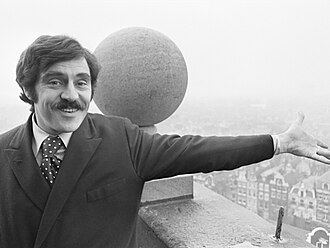
照片:Ron Kroon / Anefo,CC BY-SA 3.0 nl,Wikimedia Commons
介绍
这个词条没有中文维基百科条目,下面是英文维基百科的原文。
Anthony Newley (24 September 1931 – 14 April 1999) was an English actor, director, comedian, singer, and composer. A "latter-day British Al Jolson", he achieved widespread success in song, and on stage and screen. "One of Broadway's greatest leading men", from 1959 to 1962 he scored a dozen entries on the UK Singles Chart, including two number one hits. Newley won the 1963 Grammy Award for Song of the Year for "What Kind of Fool Am I?", sung by Sammy Davis Jr., and wrote "Feeling Good", which became a signature hit for Nina Simone. His songs have been sung by a wide variety of singers including Fiona Apple, Tony Bennett, Barbra Streisand, Michael Bublé, and Mariah Carey.
With songwriting partner Leslie Bricusse, Newley was nominated for an Academy Award for the film score of Willy Wonka & the Chocolate Factory (1971), featuring "Pure Imagination", which has been recorded by dozens of singers. He collaborated with John Barry on the title song for the James Bond film Goldfinger (1964), sung by Shirley Bassey. An "icon of the early 1960s", his TV series The Strange World of Gurney Slade "continues to have a cult following due to its advanced postmodern premise that [he] is trapped inside a television programme."
Described by The Guinness Book of British Hit Singles & Albums as "among the most innovative UK acts of the early rock years before moving into musicals and cabaret", Newley was inducted into the Songwriters Hall of Fame in 1989.
Early life
Newley was born on 24 September 1931 in the London district of Hackney to Frances Grace Newley and George Kirby, who were not married and separated soon after his birth. As "the son of a single mother, who waited on him hand and foot – even after he was married", Newley "mourned the absence of his real father, until, at 82, a jobbing builder made himself known." He was of Jewish descent through his maternal grandmother.
When his parents separated, his aunt and uncle brought him up through unofficial adoption. During the Second World War, he was evacuated to foster homes in the countryside, safe from the Blitz aerial bombing attacks on London. For a time, he stayed in Morecambe, Lancashire with George Pescud, a retired music hall performer whom he later credited with inspiring his freedom of self-expression.
Newley attended Clapton Park Lower School, now named Mandeville Primary School, which today recognises him as an alumnus with an official plaque. Although recognised as very bright by his teachers, by the age of fourteen he had left education and was working as an office boy for an advertising agency in Fleet Street called Hannaford and Goodman.
Prompted by an advertisement in The Daily Telegraph entitled "Boy Actors Urgently Wanted", he applied to the Italia Conti Stage School, only to discover that the fees were too high. Nevertheless, after a brief audition, he was offered a job as an office boy on a salary of 30 shillings a week plus tuition at the school. While serving tea one afternoon he caught the eye of producer Geoffrey de Barkus, who cast Newley as the title character in the children's film serial Dusty Bates (a.k.a. The Adventures of Dusty Bates, 1947).
Career
Early career
Newley followed Dusty Bates with an appearance as Dick Bultitude in Peter Ustinov's Vice Versa (1948). One of the stars of the film was Kay Walsh, whose husband David Lean was about to direct a screen version of Oliver Twist. Walsh rang Lean and told him, "I've found your Artful Dodger".
During the 1950s, Newley made twenty-seven movies for J. Arthur Rank, many of them in the United States, "comfortably transitioning from child to adult actor". He was under contract for many years to Warwick Productions who built him into a star.
He also had to spend two years in the UK military in what was then called "national service".
During the decade, Newley appeared in many British radio programmes, including as Cyril in Floggits, which starred Elsie and Doris Waters, and also "became increasingly involved with the theatre."
Mainstream successes
Newley starred in the 1958 film No Time to Die (also known as Tank Force). The following year, " turning point came with a literally star-making role in the low-budget musical film" Idol on Parade. Newley was cast as a rock singer called up for national service in a story which was somewhat inspired by Elvis Presley, who had recently been drafted for army service in the United States. The performance cemented Newley's position as a leading man. The film also launched his career as a pop singer, with the song "I've Waited So Long" – which featured in the soundtrack – reaching number 3 in the UK charts. This was quickly followed by his number 6 hit "Personality" and then two number 1 hits in early 1960: "Why" (originally a 1959 US hit for Frankie Avalon) and "Do You Mind?" (written by Lionel Bart). His 1961 version of the traditional "Pop Goes the Weasel" hit #12 on the UK charts.
正文摘自英文维基百科「Anthony Newley」,按 CC BY-SA 4.0 使用;删去了参考文献、外部链接、表格和图片;篇幅所限只节选了前面一部分,全文见原条目。
资料卡
- 本名
- Anthony George Newley
- 出生
- 1931 年 9 月 24 日
- 出生地
- 伦敦
- 去世
- 1999 年 4 月 14 日
- 去世地
- 詹森比奇
- 国籍
- 英国
- 职业
- 演员、词曲作家、创作歌手、作曲家、歌手、戏剧导演、舞台演员、电影演员、电视演员、剧本作者、musical theatre composer、电影导演
- 乐器
- 人声
- 流派
- 流行音乐
- 唱片公司
- 迪卡唱片公司
- 使用语言
- 英语
- 官方网站
- anthonynewley.com
资料来自 Wikidata Q573709(CC0)。