 乐单
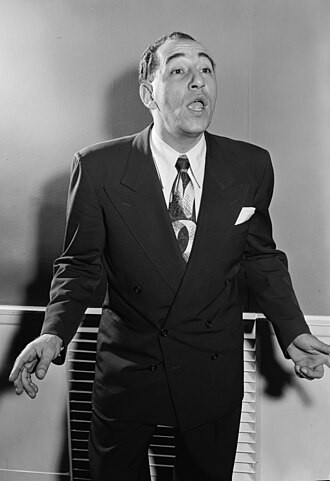
照片:William P. Gottlieb,Public domain,Wikimedia Commons
路易斯·普利马
- 生卒
- 1910 – 1978
- 国家/地区
- 美国
- 外文名
- Louis Prima
- 流派
- 爵士乐
介绍
这个词条没有中文维基百科条目,下面是英文维基百科的原文。
Louis Leo Prima (; December 7, 1910 – August 24, 1978) was an American trumpeter, singer, entertainer, and bandleader. While rooted in New Orleans jazz, swing music, and jump blues, Prima touched on various genres throughout his career: he formed a seven-piece New Orleans–style jazz band in the late 1920s, fronted a swing combo in the 1930s and a big band group in the 1940s, helped to popularize jump blues in the late 1940s and early to mid 1950s, and performed frequently as a Vegas lounge act beginning in the 1950s.
From the 1940s through the 1960s, his music further encompassed early R&B and rock 'n' roll, boogie-woogie, and Italian folk music, such as the tarantella. Prima made prominent use of Italian music and language in his songs, blending elements of his Italian and Sicilian identity with jazz and swing music. At a time when ethnic musicians were discouraged from openly stressing their ethnicity, Prima's conspicuous embrace of his Sicilian ethnicity opened the doors for other Italian-American and ethnic American musicians to display their ethnic roots.
Prima is also known for providing the voice for the orangutan King Louie in the 1967 Disney film The Jungle Book.
Early life
Louis Leo Prima was from a musical Italian American family in New Orleans, Louisiana. His father, Anthony Prima, was the son of Leonardo Di Prima, a Sicilian immigrant from Salaparuta, while his mother, Angelina Caravella, had emigrated from the island of Ustica north of Sicily as a baby. Prima was the second child of four; his older brother, Leon, was born in 1907, while his sisters Elizabeth and Marguerite were younger. Marguerite died when she was three years old. Leon, Louis, and Elizabeth were all baptized at St. Ann's Parish. They lived in a house at 1812 St. Peter Street in New Orleans.
Prima's mother was a music lover, and she made sure that each child played an instrument. Louis was assigned the violin and started out playing at St. Ann's Parish. He became interested in jazz when he heard black musicians, including Louis Armstrong. Italian immigrants, Italian-Americans, and African-Americans in New Orleans at the time frequently socialized together in the same clubs and bars. Local clubs tailored to the ostracized Italian community, such as Matranga's, Joe Segrettas, Tonti's Social Club, and Lala's Big 25, were all Italian-American clubs owned and operated by Italians; African Americans were always welcomed in these clubs and often played music and fraternized with Italians and Italian-Americans. Prima's interest in jazz was sparked while frequenting these clubs and observing black and Italian jazz artists playing together.
According to author Garry Boulard in his book Louis Prima, Prima paid attention to the music coming from clubs and watched his older brother Leon play the cornet. When Leon left the house to spend one summer in Texas, Prima practiced continuously on his worn-down cornet. He formed a band in 1924 with his childhood friends "Candy" Candido (bass), Irving Fazola (clarinet) and Johnny Viviano (drums).
Prima attended Jesuit High School but transferred to Warren Easton High, then a boys' school, in the fall of 1926. At Warren Easton, he played with the "Eastonites", the school band. In 1927, he partnered with fellow musician Frank Federico and the pair played at "The Whip", a run-down French Quarter nightclub. By the spring of 1928, Prima decided he would become a professional musician.
Career
After finishing high school in New Orleans, Prima had a few unsuccessful gigs, including when he joined the Ellis Stratakos Orchestra in 1929. Prima, Federico and saxophonist Dave Winstein drove to Florida for a gig but no one showed up. They made it to a relative's house, where they were given money for gas and a meal. Prima did not give up. He joined Joseph Cherniavsky's Orchestra in 1929 at Jefferson Parish. He got a temporary job playing on the steamship Capital that docked on Canal Street.
Although the Capital did not provide him with a big break for his career, he did meet his first wife Louise Polizzi there. They married on June 25, 1929. From 1931 to 1932, Prima occupied his time by performing in the Avalon Club owned by his brother Leon. His first break was when Lou Forbes hired him for daily afternoon and early evening shows at The Saenger.
New York City
New York was an attraction for hungry musicians during the Great Depression. Guy Lombardo met Prima while he was performing at club Shim Sham during the Mardi Gras season of 1934.
Prima and his New Orleans Gang
In September 1934, Prima began recording for the Brunswick label. He recorded "That's Where the South Begins", "Long About Midnight", "Jamaica Shout", and "Star Dust".
正文摘自英文维基百科「Louis Prima」,按 CC BY-SA 4.0 使用;删去了参考文献、外部链接、表格和图片;篇幅所限只节选了前面一部分,全文见原条目。
资料卡
- 本名
- Louis Leo Prima
- 出生
- 1910 年 12 月 7 日
- 出生地
- 新奥尔良
- 去世
- 1978 年 8 月 24 日
- 去世地
- 新奥尔良
- 国籍
- 美国
- 活跃起始
- 1929 年
- 活跃结束
- 1975 年
- 职业
- 小号手、歌手、创作歌手、演员、爵士音乐家、音乐家、乐队领队
- 乐器
- 小号、人声
- 流派
- 爵士乐
- 唱片公司
- Capitol唱片、Dot唱片公司
- 所属团体
- Louis Prima and His New Orleans Gang、Louis Prima and His Orchestra
- 受到影响
- 路易斯·阿姆斯特朗
- 使用语言
- 英语
- 获奖
- star on Hollywood Walk of Fame
- 官方网站
- louisprima.com
资料来自 Wikidata Q367447(CC0)。
榜单和奖项里的专辑(1)
曲库里的其他专辑(2)
完整作品表见 MusicBrainz。
有关联的艺人
- 路易斯·阿姆斯特朗美国 · 1901–1971 · 爵士乐
成员、所属团体、受到的影响,来自 Wikidata。