乐单
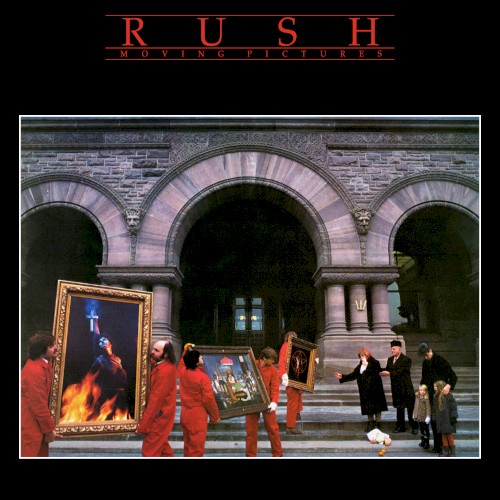
曲目
- 1Tom Sawyer4:33
- 2Red Barchetta6:07
- 3YYZ4:23
- 4Limelight4:18
- 5The Camera Eye10:55
- 6Witch Hunt4:43
- 7Vital Signs4:45
7 首 · 约 40 分钟 · 依据 1981 US 发行的版本,在 MusicBrainz 看这个版本。
介绍
这个词条没有中文维基百科条目,下面是英文维基百科的原文。
Moving Pictures is the eighth studio album by Canadian rock band Rush, released on February 12, 1981, by Anthem Records. After touring to support their previous album, Permanent Waves (1980), the band started to write and record new material in August 1980 with longtime co-producer Terry Brown. They continued to write songs with a more radio-friendly sound, featuring tighter and shorter song structures compared to their earlier albums.
"Limelight", "Tom Sawyer" and "Vital Signs" were released as singles across 1981, and the instrumental "YYZ" was nominated for a Grammy Award for Best Rock Instrumental Performance. Rush supported the album on tour from February to July 1981. In 2020, Rolling Stone ranked the album number 379 on its list of the "500 Greatest Albums of All Time".
Moving Pictures received a positive reception from contemporary and retrospective music critics and became an instant commercial success. The album reached number one in Canada and number three in both the United States and the United Kingdom. Moving Pictures is the fastest-selling album in the band's catalogue. It was certified Platinum by the RIAA on April 27, 1981 for one million copies sold, just two months after the album's release. It has since been certified Platinum five times over, for five million copies sold in the United States.
Background and recording
In June 1980, the band ended their 10-month tour of the United States, Canada and the United Kingdom in support of their previous album, Permanent Waves (1980). The tour was a commercial success for the group, becoming the first of their career to earn them a profit. During their stop in New York City a month prior, the band decided to scrap plans for a second live album in favor of making a new one in the studio. Cliff Burnstein of Mercury Records suggested the idea to the band, and Neil Peart was particularly enthusiastic about the new ideas that were being developed at sound checks and was keen to put them to tape. Geddy Lee and Alex Lifeson caught on to his enthusiasm. The trio pitched the idea to their manager and producer, who had already mapped out a two-year plan for them, but agreed to the change and cancelled the schedule. Lifeson looked back on this change of plan as the most important one in the band's history since the decision to record 2112 (1976), which became their breakthrough hit. Prior to starting on the album, Rush joined fellow Canadian rock band Max Webster to play on "Battle Scar", a track for their album Universal Juveniles (1980). During the sessions their lyricist Pye Dubois suggested a song that he thought was suitable for Rush; this was developed into "Tom Sawyer", the opening track on Moving Pictures.
The band retreated to Stony Lake, Ontario to write and develop new material. The sessions were productive. "The Camera Eye" was the first song to be worked on, followed by "Tom Sawyer", "Red Barchetta", the instrumental "YYZ", and "Limelight". Lee noticed a change in Peart's lyrics during this time, which had started with Permanent Waves, towards more concise and direct words. Following these sessions, Rush returned to Phase One Studios in late August 1980 with their longtime co-producer Terry Brown and prepared demos of these songs. The tracks were refined further during subsequent rehearsals for a series of warm-up shows across the US in September and October 1980, during which "Tom Sawyer" and "Limelight" were performed live for the first time.
Moving Pictures was recorded at Le Studio in Morin-Heights, Quebec in October and November 1980. Rush and Brown worked with 48-track recording for the first time. They'd record the basic tracks—drums and bass—to one 24-track tape reel, and transfer a stereo mix of these to a second 24-track reel for overdubs. This allowed them to preserve the quality of their recordings as much as possible as they were able to place the original backing track reel in storage until the mixing stage, thereby reducing potential damage to the tape from frequent playback. They experimented with a pressure zone microphone, a type of boundary microphone that picks up direct sound and no reverberated signals, that was taped onto Peart's chest as he played the drums. The audio captured from it was used to pick up the ambience in the studio room and was inserted into the final mix. Peart is seen wearing the microphone in the music video for "Vital Signs". The album was mixed down onto a Sony digital mastering machine, being an early example of digital recording. However, the completion of the album was delayed by two weeks due to technical issues in the studio, including with the Sony unit, but, as Brown elaborated, "it’s to be expected when you’re pushing the latest gear to its limits".
正文摘自英文维基百科「Moving Pictures (Rush album)」,按 CC BY-SA 4.0 使用;删去了参考文献、外部链接、表格和图片;篇幅所限只节选了前面一部分,全文见原条目。
资料卡
- 作品性质
- 音乐专辑
- 表演者
- 匆促乐团
- 发行日期
- 1981 年 2 月 12 日
- 时长
- 40 分 07 秒
- 流派
- 交响摇滚、新浪潮
- 语言
- 英语
- 唱片公司
- Anthem唱片
- 制作人
- 匆促乐团
资料来自 Wikidata Q904976(CC0)。
制作名单
- 厂牌
- Mercury Records(目录号 SRM-1-4013)
- 录音室
- pressed at:PRC Recording Company(Compton);混音:Le Studio(Morin‐Heights);录音:Le Studio(Morin‐Heights)
制作
- 工程师
- Paul Northfield
- 助理工程师
- Robbie Whelan
- 制作人
- Terry Brown、匆促乐团
演奏与演唱
- 吉他
- Alex Lifeson
- 鼓
- Neil Peart
- 打击乐
- Neil Peart
- 合成器
- Geddy Lee(第 1、2、4、5、6、7 首)、Hugh Syme(第 6 首)
- 贝斯
- Geddy Lee(第 1、2、4、5、6、7 首)
- Minimoog 合成器
- Geddy Lee(第 1、2、4、5、6、7 首)
- 主唱
- Geddy Lee(第 1、2、4、5、6、7 首)
词曲与编曲
- 编曲
- Terry Brown、匆促乐团
- 作曲
- Geddy Lee、Alex Lifeson(第 1、2、4、5、6、7 首)、Neil Peart(第 3 首)
- 作词
- Neil Peart(第 1、2、4、5、6、7 首)、Pye Dubois(第 1 首)
名单来自 MusicBrainz(CC0)这一发行版本的关系数据,由志愿者录入,不一定齐全。
更多资料与乐评
在哪听
匆促乐团 的其他专辑
艺人页 ›
相似的专辑


同在 1981 年发行