 乐单

照片:Unknown authorUnknown author,Public domain,Wikimedia Commons
Professor Longhair
- 生卒
- 1918 – 1980
- 国家/地区
- 美国
- 流派
- 布鲁斯
介绍
这个词条没有中文维基百科条目,下面是英文维基百科的原文。
Henry Roeland Byrd (December 19, 1918 – January 30, 1980), better known as Professor Longhair or Fess for short, was an American singer and pianist who performed New Orleans blues. He was active in two distinct periods, first in the heyday of early rhythm and blues and later in the resurgence of interest in traditional jazz after the founding of the New Orleans Jazz and Heritage Festival in 1970. His piano style has been described as "instantly recognizable, combining rumba, mambo, and calypso".
Music journalist Tony Russell (in his book The Blues: From Robert Johnson to Robert Cray) wrote that "The vivacious rhumba-rhythmed piano blues and choked singing typical of Fess were too weird to sell millions of records; he had to be content with siring musical offspring who were simple enough to manage that, like Fats Domino or Huey "Piano" Smith. But he is also acknowledged as a father figure by subtler players like Allen Toussaint and Dr. John."
Biography
Byrd was born on December 19, 1918, in Bogalusa, Louisiana, the son of Ella Mae (née Rhodes) and James Byrd. His distinctive style of piano playing was influenced by learning to play on an instrument that was missing some keys.
Around 1921 he and his mother moved to New Orleans and as a child learned to play piano on worn-out uprights he found discarded in alleyways. He began his career in New Orleans in 1948. Mike Tessitore, owner of the Caldonia Club, gave Longhair his stage name. Longhair first recorded in a band called the Shuffling Hungarians in 1949, creating four songs (including the first version of his signature song, "Mardi Gras in New Orleans") for the Star Talent record label. Union problems curtailed their release, but Longhair's next effort for Mercury Records the same year was a winner. Throughout the 1950s, he recorded for Atlantic Records, Federal Records and local labels.
Professor Longhair had only one national commercial hit, "Bald Head", in 1950, under the name Roy Byrd and His Blues Jumpers. He also recorded his favorites, "Tipitina" and "Go to the Mardi Gras". He lacked crossover appeal among white and wide audiences. Yet, he is regarded (and was acknowledged) as being a musician who was highly influential for other prominent musicians, such as Fats Domino, Allen Toussaint and Dr. John.
After suffering a stroke, Professor Longhair recorded "No Buts – No Maybes" in 1957. He re-recorded "Go to the Mardi Gras" in 1959. He first recorded "Big Chief" with its composer, Earl King, in 1964. In the 1960s, Professor Longhair's career faltered. He became a janitor to support himself and fell into a gambling habit.
After a few years during which he disappeared from the music scene, Professor Longhair's musical career finally received "a well deserved renaissance" and wide recognition. He was invited to perform at the New Orleans Jazz and Heritage Festival in 1971 and at the Newport Jazz Festival and the Montreux Jazz Festival in 1973. His album The London Concert showcases work he did on a visit to the United Kingdom. That significant career resurrection saw the recording of the album Live on the Queen Mary, which was recorded on March 24, 1975, during a private party hosted by Paul McCartney and Linda McCartney on board the retired RMS Queen Mary.
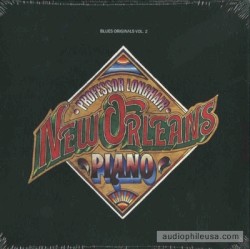
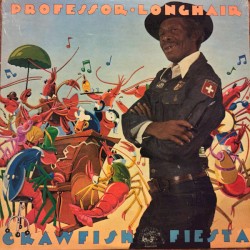
By the 1980s his albums, such as Crawfish Fiesta on Alligator Records and New Orleans Piano on Atlantic Records, which compiled recordings he made for the label in 1949 and 1953, had become readily available across America. In 1974 he appeared on the PBS series Soundstage (with Dr. John, Earl King, and The Meters). In 1980 he co-starred (with Tuts Washington and Allen Toussaint) in the film documentary Piano Players Rarely Ever Play Together which was produced and directed by filmmaker Stevenson Palfi. That documentary (which aired on public television in 1982 and has rarely been seen since), plus a long interview with Fess (which was recorded two days before his sudden death), were included in the 2018 released project "Fess Up".
Professor Longhair died in his sleep of a heart attack while the filming of the documentary was under way (and before the live concert, which was planned to be its climax). Footage from his funeral was included in the documentary. He was interred at Mount Olivet Cemetery in New Orleans.
Professor Longhair's manager through those renaissance years of his career was Allison Miner, of which jazz producer George Wein was quoted saying: "Her devotion to Professor Longhair gave him the best years of his life."
In popular culture
His song "Tipitina" was covered by Hugh Laurie on the 2011 CD album Let Them Talk. Laurie is a long-time fan, having used Longhair's "Go to the Mardi Gras" as the theme for the pilot episode of A Bit of Fry & Laurie. Laurie used to perform these two songs regularly during his world concert tours of 2011–2014 with The Copper Bottom Band, and in March 2013 paid tribute to Professor Longhair in a special concert on board RMS Queen Mary.
正文摘自英文维基百科「Professor Longhair」,按 CC BY-SA 4.0 使用;删去了参考文献、外部链接、表格和图片;篇幅所限只节选了前面一部分,全文见原条目。
资料卡
- 出生
- 1918 年 12 月 19 日
- 出生地
- 博加卢萨
- 去世
- 1980 年 1 月 30 日
- 去世地
- 新奥尔良
- 国籍
- 美国
- 活跃起始
- 1948 年
- 职业
- 钢琴家、街头艺人、音乐家、歌手、blues musician
- 乐器
- 钢琴、人声
- 流派
- 布鲁斯
- 唱片公司
- 大西洋唱片
- 使用语言
- 英语
- 获奖
- 摇滚名人堂(1992)
- 官方网站
- professorlonghair.com
资料来自 Wikidata Q918447(CC0)。
榜单和奖项里的专辑(1)
曲库里的其他专辑(1)
完整作品表见 MusicBrainz。
风格、年代相近的艺人
- 埃尔维斯·普雷斯利美国 · 1935–1977 · 摇滚、流行音乐
- 约翰尼·卡什美国 · 1932–2003 · 乡村音乐、叛道乡村
- 雷·查尔斯美国 · 1930–2004 · 爵士乐、灵魂乐
- 詹姆士·布朗美国 · 1933–2006 · 灵魂乐、放克
- 恰克·贝瑞美国 · 1926–2017 · 摇滚乐、布鲁斯
- B·B·金美国 · 1925–2015 · 布鲁斯、节奏布鲁斯
- 妮娜·西蒙美国 · 1933–2003 · 爵士乐、灵魂乐
- 昆西·琼斯美国 · 1933–2024 · 爵士乐、灵魂乐
- 小理查德美国 · 1932–2020 · 摇滚乐、灵魂乐
- 威利·尼尔森美国 · 1933– · 乡村音乐、流行音乐
- 杰瑞·李·刘易斯美国 · 1935–2022 · 摇滚乐、布鲁斯
- 埃塔·詹姆丝美国 · 1938–2012 · 布鲁斯、灵魂乐