 乐单
伸出援手,我会在那里 (1966)
- 演唱
- 四尖乐队
- 发行
- 1966
- 作曲
- Eddie Holland、拉蒙特·多齐尔、Brian Holland
- 作词
- Eddie Holland、拉蒙特·多齐尔、Brian Holland
介绍
这个词条没有中文维基百科条目,下面是英文维基百科的原文。
"Reach Out I'll Be There" (also rendered as "Reach Out (I'll Be There)") is a song recorded by the American vocal quartet the Four Tops. Written and produced by Motown's main production team, Holland–Dozier–Holland, it is one of the most notable Motown hits of the 1960s.
Released as a single on August 18, 1966, it was the number one song on the Rhythm & Blues chart for two weeks and on the Billboard Hot 100 for two weeks in October 1966. The track also reached number one on the UK Singles Chart for three weeks beginning on October 27, 1966, becoming Motown's second UK chart-topper after the Supremes' "Baby Love" (1964). It was ranked the number five hit of 1966 on the Billboard Year-End Hot 100. In July 1967, it was included on the group's fourth studio album, Reach Out.
Rolling Stone later ranked "Reach Out" number 206 on its list of "The 500 Greatest Songs of All Time". In 2022, it was selected by the Library of Congress for preservation in the National Recording Registry.
Writing and recording
In 1966, the Motown songwriting and production team Holland–Dozier–Holland were writing new songs for the Four Tops to record for an album. Lamont Dozier said that he wanted to write "a journey of emotions with sustained tension, like a bolero. To get this across, I alternated the keys, from a minor, Russian feel in the verse to a major, gospel feel in the chorus." He developed the lyrics with Eddie Holland, aiming for them to sound "as though they were being thrown down vocally." Dozier said that they were strongly influenced by Bob Dylan at the time: "We wanted [Four Tops frontman] Levi [Stubbs] to shout-sing the lyrics... as a shout-out to Dylan."
According to Four Tops backing vocalist Duke Fakir, the writers and producers intentionally put Stubbs at the top of his vocal range, "to make sure he'd have that cry and hunger and wailing in his voice." Arranger Paul Riser overdubbed instruments including a piccolo and flute in the intro, as well as a drum pattern played with timpani mallets on a tambourine head. After the recording was completed, the group begged Motown head Berry Gordy not to release it; according to Fakir, "for us, the song felt a little odd." However, Gordy insisted that it be issued as a single.
Style
Levi Stubbs delivers much of the song in a tone that straddles the line between singing and shouting, as he did on the group's 1965 hit "I Can't Help Myself (Sugar Pie Honey Bunch)". AllMusic critic Ed Hogan praises Stubbs' vocals, as well as the song's "rock-solid groove" and "dramatic, semi-operatic tension and release." Critic Martin Charles Strong calls the song "a soul symphony of epic proportions that remains [the Four Tops'] signature tune."
In 2014, Fakir stated in an interview with The Guardian:
Eddie [Holland] realized that when Levi hit the top of his vocal range, it sounded like someone hurting, so he made him sing right up there. Levi complained, but we knew he loved it. Every time they thought he was at the top, he would reach a little further until you could hear the tears in his voice. The line "Just look over your shoulder" was something he threw in spontaneously. Levi was creative like that; he could always add something from the heart.
Reception
Cash Box called the song "a hard-driving, pulsating pop-r&b romancer about a very-much-in-love guy who claims that he'll always be at his gal's beck-and-call."
In 1988, Jon Wilde of Melody Maker called it the third-best UK number one single to date, stating: "The bit that sounds like a horse galloping at the beginning is fairly unbeatable but, when Levi starts up, I swear it's one of the finest sights in the solar system."
Legacy
In 1998, the original Four Tops version of the song was inducted into the Grammy Hall of Fame. It was selected by the Library of Congress for preservation in the National Recording Registry in 2022.
Joe Biden used the song during his 2020 presidential campaign.
Many artists have covered the song, including the Jaded Hearts Club in 2020.
Diana Ross version
American singer Diana Ross covered "Reach Out, I'll Be There" in 1971. Her version was released by Motown from her third album, Surrender (1971). It was produced by Ashford & Simpson, and reached number 29 on the US Billboard Hot 100 and number 35 in Canada.
Gloria Gaynor version
"Reach Out, I'll Be There" was covered by American singer Gloria Gaynor in 1975. It was the third of three singles released by MGM from her debut album, Never Can Say Goodbye (1975). It peaked at number 60 in the US, number 16 in Canada, number 14 in the UK, and number five in West Germany.
正文摘自英文维基百科「Reach Out I'll Be There」,按 CC BY-SA 4.0 使用;删去了参考文献、外部链接、表格和图片。
资料卡
- 作品性质
- 音乐作品/乐曲
- 表演者
- 四尖乐队
- 发行日期
- 1966 年
- 流派
- 灵魂乐
- 语言
- 英语
- 作曲
- Eddie Holland、拉蒙特·多齐尔、Brian Holland
- 作词
- Eddie Holland、拉蒙特·多齐尔、Brian Holland
资料来自 Wikidata Q2334683(CC0)。
更多资料
在哪听
四尖乐队 的专辑
艺人页 ›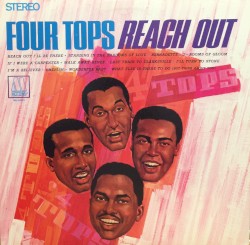
四尖乐队 的其他歌(本站收录)
- 我无法自拔四尖乐队 · 1965
风格、年代相近的歌
- What's Going On马文·盖伊 · 1971
- 让我们在一起阿尔·格林 · 1971
- Signed, Sealed, Delivered I'm Yours史提夫·汪达 · 1970
- Into the Mystic范·莫里森 · 1970
- 我悄声祈祷艾瑞莎·弗兰克林 · 1968
- I Heard It Through the Grapevine马文·盖伊 · 1968
- Son of a Preacher Man达斯蒂·斯普林菲尔德 · 1968
- Respect艾瑞莎·弗兰克林 · 1967
- 天生的女人艾瑞莎·弗兰克林 · 1967
- Chain of Fools艾瑞莎·弗兰克林 · 1967
- 爸爸买了个新包詹姆士·布朗 · 1965
- 泪痕奇迹乐队 · 1965