乐单
曲目
- 1Penitentiary Philosophy6:12
- 2Didn’t Cha Know4:01
- 3My Life4:02
- 4… & On3:36
- 5Cleva3:48
- 6Hey Sugah0:53
- 7Booty4:07
- 8Kiss Me on My Neck (Hesi)5:37
- 9A.D. 20004:53
- 10Orange Moon7:12
- 11In Love With You5:23
- 12Bag Lady5:51
- 13Time’s a Wastin6:44
- 14Green Eyes10:05
14 首 · 约 72 分钟 · 依据 2000-11-21 US 发行的版本,在 MusicBrainz 看这个版本。
介绍
这个词条没有中文维基百科条目,下面是英文维基百科的原文。
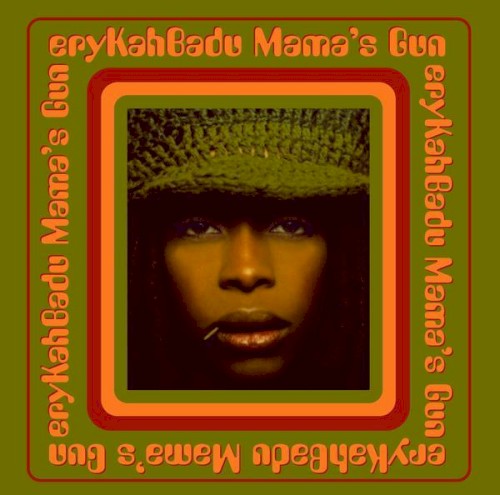
Mama's Gun is the second studio album by American singer-songwriter Erykah Badu. It was released on November 18, 2000, by Motown Records. Largely recorded at the Electric Lady Studios in New York City with the collective Soulquarians, the album is a neo soul record predominantly driven by live instruments. Writing all its songs, Badu explored themes of love, self-worth, and social equity.
After giving birth to her son with rapper André 3000 and experiencing writer's block in the aftermath of her debut studio album Baduizm (1997), Badu began writing and recording Mama's Gun in 1999. Badu primarily collaborated with drummer Ahmir "Questlove" Thompson, bassist Pino Palladino, pianist James Poyser, trumpeter Roy Hargrove, and producer Jay Dee. As the musicians simultaneously contributed to albums recorded by D'Angelo, Common, and Bilal, also at Electric Lady, the artists began collaborating, forming the Soulquarians. Consequently, Mama's Gun emerged more sonically eclectic than Baduizm, experimenting with genres such as jazz, funk, rock, reggae, and traditional soul. Badu's songwriting was more direct and honest than the complex and cryptic lyricism of Baduizm, and derived from her own experiences with fame, motherhood, and separation from André 3000.
On release, Mama's Gun received widespread critical acclaim, mainly for Badu's songwriting and vocal performance, and use of live instruments; multiple publications listed it among best albums of 2000. Commercially, it did not replicate the success of its predecessor, debuting at number 11 on the US Billboard 200 with first-week sales of 191,000 units. However, it registered the largest first-week sales of Badu's career, and was certified platinum by the Recording Industry Association of America (RIAA) four weeks after release, denoting shipments of one million units in the US. The album produced three singles—"Bag Lady", "Didn't Cha Know", and "Cleva". "Bag Lady" became Badu's first top-10 hit on the US Billboard Hot 100 by peaking at number six, and earned two nominations at the 43rd Annual Grammy Awards (2001), while "Didn't Cha Know" earned one at the following ceremony. Badu further promoted the album with the Mama's Gun World Tour (2001).
Released during a period of peak creativity in neo soul, Mama's Gun was proclaimed the female counterpart to D'Angelo's Voodoo, regarding both musical style and lyrical themes, by numerous critics. The critical acclaim persevered with retrospective commentaries, which credited the album with propelling neo soul and Afrofuturism further into the mainstream, noting its influence on artists such as Beyoncé and Childish Gambino. Considered one of Badu's best works, it has also been emphasized as impactful on Badu's career progression, establishing her as an experimental musician and as a touring artist. Furthermore, numerous authors and publications have listed Mama's Gun among the best albums of its era and of all time. To commemorate its 25th anniversary, Badu embarked on the Mama's Gun '25: The Return of Automatic Slim Tour (2025).
Background
Having been signed to Universal Records and Kedar Massenburg's Kedar Entertainment, Erykah Badu released her debut studio album Baduizm on February 11, 1997. Baduizm received unanimous critical acclaim, with numerous critics comparing Badu's vocal performance to Billie Holiday; the album went on to win the Grammy Award for Best R&B Album. As the album debuted at number two on the US Billboard 200, Badu broke the record for the highest-debuting debut album by a woman. The album's success helped establish Badu as one of the emerging leading artists of neo soul, with author Joel McIver crediting Baduizm with introducing the term "neo soul" to mainstream audiences. Shortly after the album's release, Badu became pregnant with the son of her then-partner André Benjamin, widely known as André 3000 of Outkast. While promoting Baduizm, Badu recorded the live album Live, which was released on November 18, 1997—the day Badu gave birth to Seven Sirius Benjamin. Live was another commercial success for Badu, debuting at number four on the Billboard 200. Badu also pursued an acting career, starring in Blues Brothers 2000 (1998) and The Cider House Rules (1999). She further appeared on The Roots' 1999 song "You Got Me"—which won the Grammy Award for Best Rap Performance by a Duo or Group—and recorded "Southern Gul" for hip-hop artist Rahzel's debut studio album Make the Music 2000 (1999). As Massenburg resigned from his position as the senior vice president of Universal Records in favor of being appointed president and chief executive officer (CEO) of Motown in 1998, Badu transferred to Motown as well.
正文摘自英文维基百科「Mama's Gun」,按 CC BY-SA 4.0 使用;删去了参考文献、外部链接、表格和图片;篇幅所限只节选了前面一部分,全文见原条目。
资料卡
- 作品性质
- 音乐专辑
- 表演者
- 埃丽卡‧巴杜
- 发行日期
- 2000 年
- 流派
- 新灵魂
- 语言
- 英语
- 唱片公司
- 摩城唱片
- 制作人
- 奎斯特洛夫
资料来自 Wikidata Q847976(CC0)。
制作名单
- 厂牌
- Motown(目录号 012 153 259-2)
- 录音室
- 母带:Sterling Sound(Chelsea);混音:Electric Lady Studios(Greenwich Village);录音:Electric Lady Studios(Greenwich Village);录音:DARP Studios(Atlanta);录音:The Studio(Philadelphia);混音:The Hit Factory(Manhattan);录音:Dallas Sound Lab(Irving);录音:Palmyra Studios(Ellis County)
制作
- 母带处理
- Tom Coyne、Chris Gehringer
- 制作人
- 埃丽卡‧巴杜(其中 13 首)、James Poyser(其中 7 首)、詹姆士·杨西(第 2、3、8 首)、皮诺·帕拉迪诺(第 1、9 首)、?uestlove(第 1、9 首)
- 执行制作人
- Kedar Massenburg(其中 13 首)
- 录音
- Tom Soares(其中 9 首)、Leslie Brathwaite(第 2、3、5、10 首)、Vernon Mungo(第 2、8、9、10 首)、Chris Bell(第 4、6、7、12 首)、Russell Elevado(第 1、7、8 首)、Mark “Exit” Goodchild(第 3、13 首)、Jon Smeltz(第 3、13 首)
- 混音
- Russell Elevado(第 1、7、8、12、14 首)、Leslie Brathwaite(第 2、3、5、10、13 首)、Tom Soares(第 4、6、9、11 首)
- 助理混音
- Steve Mandel(第 1、7、8、12、14 首)、Shinobu Mitsuoka(第 2、3、5、9、11 首)、Vincent Alexander(第 10、13 首)
- 助理录音
- Jon Adler(第 1、3、5、10、14 首)、Shinobu Mitsuoka(第 2、3、4、5、8 首)、Steve Mandel(第 1、5、7、8 首)、Michael Verdes(第 4、6、7、12 首)、Mike Turner(第 3、8、13 首)、Vincent Alexander(第 5、10、13 首)
演奏与演唱
- 演唱
- 埃丽卡‧巴杜、贝蒂·莱特(第 8、9 首)
- 罗兹电钢琴
- James Poyser(其中 9 首)
- 鼓
- ?uestlove(其中 7 首)、Gino “LockJohnson” Iglehart(第 6、10、12、13 首)
- 和声
- YahZarah(第 1、2、6、10、11、12 首)、埃丽卡‧巴杜(第 1、5、6、8、12 首)、N’Dambi(第 6、10、12 首)、Geno Young(第 6、10、12 首)
- 长笛
- D'Wayne Kerr(第 6、8、10、12、14 首)
- 贝斯
- Braylon Lacy(第 6、10、12、13 首)、皮诺·帕拉迪诺(第 1、5、9 首)、詹姆士·杨西(第 7、8 首)
- 键盘
- Shaun Martin(第 6、10、12、13 首)
- Minimoog 合成器
- James Poyser(第 2、8、9 首)
- 钢琴
- James Poyser(第 3、5、14 首)
- 打击乐
- Leonard Gibbs(第 5、7、8 首)
- 克拉维琴
- James Poyser(第 1、7 首)
- 中提琴
- Davis Barnett(第 3、13 首)、Peter Nocella(第 3、13 首)
- 小提琴
- Olga Konopelsky(第 3、13 首)、Emma Kummrow(第 3、13 首)、Charles Parker(第 3、13 首)、Igor Szwec(第 3、13 首)、Gregory Teperman(第 3、13 首)
- 合成器
- James Poyser(第 5、7 首)
- 小号
- 罗伊·哈格卢夫(第 7、14 首)
- 萨克斯
- Jacques Swarzbart(第 7、14 首)
词曲与编曲
- 作曲
- 埃丽卡‧巴杜、James Poyser(第 1、3、4、5、8、14 首)、Shaun Martin(第 4、10、12、13 首)
- 作词
- 埃丽卡‧巴杜
- 器乐编曲
- Larry Gold(第 3、13 首)
名单来自 MusicBrainz(CC0)这一发行版本的关系数据,由志愿者录入,不一定齐全,人数太多只列了前面一部分。
更多资料与乐评
在哪听
埃丽卡‧巴杜 的其他专辑
艺人页 ›
相似的专辑
同在 2000 年发行