乐单
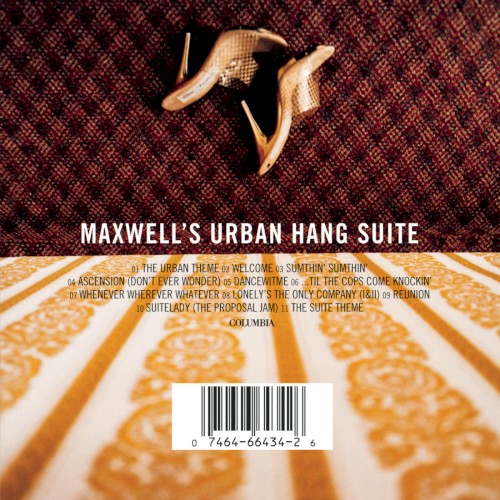
曲目
- 1The Urban Theme2:42
- 2Welcome5:18
- 3Sumthin’ Sumthin’4:17
- 4Ascension (Don’t Ever Wonder)5:46
- 5Dancewitme6:15
- 6...Til the Cops Come Knockin’6:56
- 7Whenever Wherever Whatever3:45
- 8Lonely’s the Only Company (I & II)6:22
- 9Reunion4:53
- 10Suitelady (The Proposal Jam)4:48
- 11The Suite Theme13:47
11 首 · 约 65 分钟 · 依据 1996-04-02 US 发行的版本,在 MusicBrainz 看这个版本。
介绍
这个词条没有中文维基百科条目,下面是英文维基百科的原文。
Maxwell's Urban Hang Suite is the debut album by American R&B singer-songwriter Maxwell. It was recorded in 1994 and 1995 and released on April 2, 1996, by Columbia Records.
Maxwell largely wrote and produced the album himself, recording in sessions at Electric Lady Studios, RPM, Sorcerer, and Chung King Studios in New York City, and CRC recording studios in Chicago. The resulting music features a mellow, groove-based sound with elements of funk, jazz, smooth soul, and quiet storm. A concept album, Maxwell's Urban Hang Suite was composed as a song cycle that focuses on an adult romance, based in part on Maxwell's personal experiences.
Maxwell's Urban Hang Suite was not an immediate commercial success, but it was helped by the release of its second single "Ascension (Don't Ever Wonder)" in July 1996, and the album eventually became a million-seller. It was also a success with critics, who praised it as a departure from the mainstream, hip hop-oriented R&B of the time, while earning Maxwell several accolades and comparisons to soul singers of the past, particularly Marvin Gaye and Prince.
The success of Maxwell's Urban Hang Suite elevated Maxwell's reputation to that of a sex symbol and a notable performer in the music industry. He was credited with shaping the "neo soul" movement of musicians that rose to prominence during the late 1990s. Along with D'Angelo's Brown Sugar (1995) and Erykah Badu's Baduizm (1997), the album provided commercial exposure to neo soul and has since been cited by several critics as Maxwell's greatest work.
Background
After receiving a low-cost Casio keyboard from a friend, Brooklyn, New York-native Maxwell began composing material at age 17. Raised in the borough's East New York-section, Maxwell's previous musical experience included his beginnings as a singer in the congregation of his Baptist church, which had become an integral part of his life after the death of his father in a plane crash. Already a fan of what he described as "jheri curl soul", which was the trademark of early 1980s R&B acts such as Patrice Rushen, S.O.S. Band and Rose Royce, Maxwell began to teach himself to play a variety of instruments. According to him, the R&B of the early 1980s contained "the perfect combination of computerized instrumentation with a live feel", and that the genre's dynamics later became lost due to the influence of hip hop on R&B. Despite facing ridicule from classmates for being shy and awkward, he progressed and continued to develop his musical abilities.
At 19, Maxwell began performing throughout the New York club circuit while supporting himself by waiting tables during the day. He was able to gain access to a 24 track recording studio and started to record songs for a demo tape, which he circulated among his friends. The demo engendered interest, and his official debut concert performance at Manhattan nightclub Nell's drew a crowd. During the next two years, Maxwell wrote and recorded over three hundred songs and played frequently at small venues throughout New York City. Maxwell's performances continued to draw interest and increase the buzz about him, and he was called "the next Prince" by a writer from Vibe magazine who attended one of his shows. After earning a considerable reputation, Maxwell signed a recording contract with Columbia Records in 1994. He adopted his middle name as a moniker out of respect for his family's privacy.
Recording and production
Maxwell recorded his debut album between 1994 and 1995 at Electric Lady Studios, RPM Studios, Sorcerer Studios and Chung King Studios in New York City, and at CRC Studios in Chicago, Illinois. Maxwell's Urban Hang Suite was produced primarily by Peter Mokran, who was credited as P.M., and Maxwell, who was credited as "MUSZE", a play on the word muse. Columbia executives reluctantly gave Maxwell creative freedom in his contract and were hesitant to allow him produce the album alone. They assigned Chicago-based, English producer and multi-instrumentalist Stuart Matthewman to the project, but he only produced the first few tracks. Matthewman had previously worked with English R&B and jazz group Sade. During the recording sessions, Maxwell worked extensively with collaborators, including Matthewman, soul singer-songwriter Leon Ware, and funk guitarist Melvin "Wah-Wah Watson" Ragin. Prior to working with Maxwell, Ware and Ragin were collaborators of soul musician Marvin Gaye; Ware had produced and composed most of Gaye's tenth album I Want You (1976).
正文摘自英文维基百科「Maxwell's Urban Hang Suite」,按 CC BY-SA 4.0 使用;删去了参考文献、外部链接、表格和图片;篇幅所限只节选了前面一部分,全文见原条目。
资料卡
- 作品性质
- 音乐专辑
- 表演者
- 麦斯威尔
- 发行日期
- 1996 年
- 流派
- 当代节奏布鲁斯
- 唱片公司
- 哥伦比亚唱片
- 下一部
- MTV不插电
资料来自 Wikidata Q980430(CC0)。
制作名单
- 厂牌
- Columbia(目录号 CK 66434)
制作
- 混音
- Peter Mokran(第 11 首)
- 制作人
- 麦斯威尔(第 11 首)
演奏与演唱
- 演唱
- 麦斯威尔(第 3、11 首)
词曲与编曲
- 词曲
- 麦斯威尔(第 3、11 首)、Leon Ware(第 3 首)、Melvin “Wah Wah” Watson(第 11 首)
- 编曲
- Federico González Peña(第 11 首)、麦斯威尔(第 11 首)
名单来自 MusicBrainz(CC0)这一发行版本的关系数据,由志愿者录入,不一定齐全。
更多资料与乐评
在哪听
麦斯威尔 的其他专辑
艺人页 ›
相似的专辑
同在 1996 年发行