乐单
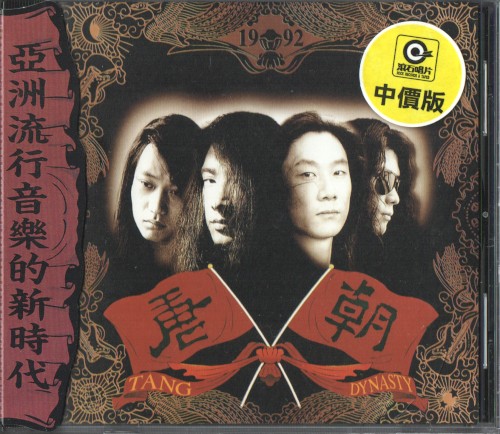
唐朝 (1992)
曲目
- 1梦回唐朝7:05
- 2太阳5:54
- 3九拍6:37
- 4天堂4:22
- 5选择5:48
- 6飞翔鸟7:05
- 7世纪末之梦4:57
- 8月梦4:49
- 9不要逃避4:33
- 10传说4:44
- 11国际歌4:26
11 首 · 约 60 分钟 · 依据 1992 TW 发行的版本,在 MusicBrainz 看这个版本。
介绍
唐朝是中国摇滚乐队唐朝乐队的第一张国语专辑。本专辑《世纪末之梦》一曲,由秦齐主唱。
介绍
该专辑被认为是中国摇滚乐历史第一张金属乐专辑。
正文摘自中文维基百科「唐朝 (专辑)」,按 CC BY-SA 4.0 使用;已转为简体,删去了参考文献、外部链接、表格和图片。
英文维基百科上的更多内容(英文原文,约 3,473 字符)
Tang Dynasty (Chinese: 唐朝; pinyin: Tángcháo), also known as A Dream Return to Tang Dynasty (Chinese: 梦回唐朝; pinyin: Mènghuí Tángcháo) is the debut studio album by Chinese heavy metal band Tang Dynasty, released in China in December 1991 and internationally on December 11, 1992 by Magic Stone Records. The album is lauded as the first Chinese metal album, combining heavy metal and progressive rock with traditional Chinese folk styles, poetry, and Beijing opera vocal techniques.
Background
Tang Dynasty was officially formed in February 1989 by Americans Kaiser Kuo (guitar) and Andrew Szabo (drums), along with Beijing musicians Ding Wu (guitar) and Zhang Ju (bass). However, the Tiananmen Square Protests forced Kuo and Szabo to leave China. The band went on hiatus, and Ding Wu moved to Xinjiang for several months. In October, Ding Wu returned to Beijing, and together with Zhang Ju recruited "lightning-fast" guitarist Liu Yijun and drummer Zhao Nian. On May 1, 1990, the new lineup participated in a fundraising concert for the 1990 Asian Games, playing in front of 100,000 people at the Workers' Stadium. The success of the concert led the band to be signed by Magic Stone Records (Chinese: 魔石唱片; pinyin: Móshí Chàngpīan), the fledgling mainland division of Taiwan-based label Rock Records (Chinese: 滚石唱片; pinyin: Gŭnshí Chàngpīan, lit. "Rolling Stone Records") specializing in Chinese rock acts.
Recording and release
Recording took place in the second floor studio of the China National Radio headquarters in Xicheng, over a 44-day period, from September through October 1991. Founding guitarist Kaiser Kuo briefly returned in May to record some demos with the band, but left again for the United States before sessions formally began in order to complete graduate school. Bassist Zhang Ju had also been singing lead since Kuo's departure, but Kuo insisted that Ding Wu be designated lead vocalist instead, thereby cementing Ding's position as Tang Dynasty's frontman. According to Ding Wu, a significant portion of the songs' melodies were not established until recording was underway, although he later clarified that the band had completed most of the instrumentals before entering the studio.
The album was engineered by Wang "Lao Ge (Chinese: 老哥; lit. 'Old Brother')" Xinbo (Chinese: 王昕波), who had worked on Cui Jian's Rock 'n' Roll on the New Long March and Black Panther's debut album. It was also the first album by a mainland Chinese band to be produced by Jeff Chia (Chinese: 贾敏恕; pinyin: Jiǎ Mǐnshù), who would go on to record other notable Beijing artists for the Magic Stone label. Chia recalled the making of Tang Dynasty as an intensive, around-the-clock process, and that an armed guard was stationed outside the studio as they worked. Despite having never worked with a rock band before, Chia noted the ease with which he and the band members could communicate musical ideas, which streamlined the otherwise stressful undertaking.
Tang Dynasty was released domestically in December 1991. Magic Stone Records spent the next year launching a massive overseas marketing campaign, securing the band a following in Hong Kong, Taiwan, and Singapore. Five high-budget music videos for "A Dream Return to Tang Dynasty", "The Sun", "Nine Rhythm", "Choice", and "Moon Dreams" were shot and released. As Kuo noted, "Nothing like that had ever been done for a Chinese band."
The international version was released on December 11, 1992 in Taiwan, Hong Kong, Japan, South Korea, and Southeast Asia.
这部分摘自英文维基百科「Tang Dynasty (album)」,按 CC BY-SA 4.0 使用;删去了参考文献、外部链接、表格和图片;篇幅所限只节选了前面一部分,全文见原条目。
资料卡
- 作品性质
- 音乐专辑
- 表演者
- 唐朝乐队
- 发行日期
- 1992 年
- 唱片公司
- 魔岩唱片
资料来自 Wikidata Q55634680(CC0)。
制作名单
- 厂牌
- 滾石唱片(目录号 RD-1183)
- 录音室
- 混音:達采錄音室(Taipei);录音:北京百花录音棚(Beijing)
制作
- 混音
- 顏仲坤(第 6 首)
- 制作人
- 賈敏恕(第 6 首)
- 录音
- 王昕波(第 6 首)
演奏与演唱
- 吉他
- 刘义军(第 6 首)
- 电贝斯
- 张炬(第 6 首)
- 鼓
- 赵年(第 6 首)
- 演出
- 唐朝乐队(第 6 首)
- 主唱
- 丁武(第 6 首)
词曲与编曲
- 编曲
- 唐朝乐队(第 6 首)
- 作曲
- 唐朝乐队(第 6 首)、Pierre Degeyter(第 11 首)
- 作词
- 唐朝乐队(第 6 首)、Eugène Pottier(第 11 首)
- 译词
- 萧三(第 11 首)
名单来自 MusicBrainz(CC0)这一发行版本的关系数据,由志愿者录入,不一定齐全。
更多资料与乐评
在哪听
相似的专辑

同在 1992 年发行