乐单
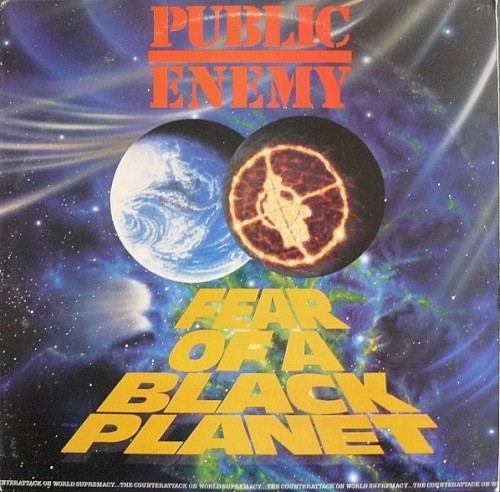
Fear of a Black Planet (1990)
滚石 500(2020) #176滚石 500(2003) #3001001 张专辑
- 艺人
- 全民公敌组合
- 发行
- 1990-03-20
- 类型
- 专辑
- 唱片公司
- Def Jam唱片公司、哥伦比亚唱片
- 版本
- MusicBrainz 上有 17 个发行版本
曲目
- 1Contract on the World Love Jam1:49
- 2Brothers Gonna Work It Out5:03
- 3911 Is a Joke3:17
- 4Incident at 66.6 FM1:38
- 5Welcome to the Terrordome5:26
- 6Meet the G That Killed Me0:45
- 7Pollywanacraka4:14
- 8Anti‐Nigger Machine2:39
- 9Burn Hollywood Burn3:04
- 10Power to the People3:48
- 11Who Stole the Soul?3:52
- 12Fear of a Black Planet3:42
- 13Revolutionary Generation5:43
- 14Can’t Do Nuttin’ for Ya Man2:47
- 15Reggie Jax1:36
- 16Leave This Off Your Fu*kin Charts2:31
- 17B Side Wins Again3:46
- 18War at 33⅓2:08
- 19Final Count of the Collision Between Us and the Damned0:49
- 20Fight the Power4:43
20 首 · 约 63 分钟 · 依据 1990 US 发行的版本,在 MusicBrainz 看这个版本。
介绍
这个词条没有中文维基百科条目,下面是英文维基百科的原文。
Fear of a Black Planet is the third studio album by American hip-hop group Public Enemy. It was released on April 10, 1990, by Def Jam Recordings and Columbia Records, and produced by the group's production team The Bomb Squad, who expanded on the sample-layered sound of Public Enemy's previous album, It Takes a Nation of Millions to Hold Us Back (1988). Having fulfilled their initial creative ambitions with that album, the group aspired to create what lead rapper Chuck D called "a deep, complex album". Their songwriting was partly inspired by the controversy surrounding member Professor Griff's antisemitic public comments and his consequent dismissal from the group, amidst the mainstream success of their radically political single "Fight the Power" (1989).
Reflecting its confrontational tone, Fear of a Black Planet features elaborate sound collages that incorporate varying rhythms, numerous samples, media sound bites, and eccentric loops. Recorded during the golden age of hip-hop, its assemblage of reconfigured and recontextualized aural sources took advantage of creative freedom that existed before the emergence of a sample clearance system in the music industry. Thematically, Fear of a Black Planet explores organization and empowerment within the black community, social issues affecting African Americans, and race relations at the time. Its critiques of institutional racism, white supremacy and the power elite were partly inspired by Dr. Frances Cress Welsing's views on color.
A commercial and critical hit, Fear of a Black Planet sold two million copies in the United States and received rave reviews from critics, many of whom named it one of the year's best albums. Its success contributed significantly to the popularity of Afrocentric and political subject matter in hip-hop and the genre's mainstream emergence at the time. Since then, it has been viewed as one of hip-hop's greatest and most important records, as well as being musically and culturally significant. In 2004, the Library of Congress added it to the National Recording Registry. In 2020, Fear of a Black Planet was ranked number 176 on Rolling Stone's list of the 500 greatest albums of all time.
Background
In 1988, Public Enemy released their second album It Takes a Nation of Millions to Hold Us Back to critical and commercial success. Their music's dense textures, provided by the group's production team The Bomb Squad, exemplified a new production aesthetic in hip-hop. The controversial, politically charged lyrics by the group's lead rapper Chuck D, whose braggadocio raps contained references to political figures such as Assata Shakur and Nelson Mandela, as well as endorsements of Nation of Islam-leader Louis Farrakhan, intensified the group's affiliation with black nationalism and Farrakhan.
It Takes a Nation's success helped raise hip-hop's profile as both art and sociopolitical statement, amid media criticism of the genre. It helped give hip-hop a critical credibility and standing in the popular music community after it had been largely dismissed as a fad since its introduction at the turn of the 1980s. In promoting the record, Public Enemy expanded their live shows and performing dynamic. With the album's content and the group's rage-filled showmanship in concert, they became the vanguard of a movement in hip-hop that reflected a new black consciousness and socio-political dynamic that were taking shape in America at the time.
In May 1989, Chuck D, Bomb Squad producer Hank Shocklee and Def Jam executive Bill Stephney were negotiating with several labels for a production deal from a major record company, their goal since starting Public Enemy in the early 1980s. As they were in negotiations, group member Professor Griff made antisemitic remarks in an interview with The Washington Times, in which he said that Jews were the cause of "the majority of the wickedness" in the world. Public Enemy received media scrutiny and criticism from religious organizations and liberal rock critics, which added to charges against the group's politics being racist, homophobic and misogynistic.
Amid the controversy, Chuck D was given an ultimatum by Shocklee and Stephney to dismiss Griff from the group or the production deal would fall through. He fired Griff in June but he later rejoined and has since denied holding antisemitic views and apologized for the remarks. Several people who had worked with Public Enemy expressed concern about Chuck D's leadership abilities and role as a social spokesman. Def Jam director of publicity Bill Adler later said that the controversy "partly ... fueled the writing of [the album]".
正文摘自英文维基百科「Fear of a Black Planet」,按 CC BY-SA 4.0 使用;删去了参考文献、外部链接、表格和图片;篇幅所限只节选了前面一部分,全文见原条目。
资料卡
- 作品性质
- 音乐专辑
- 表演者
- 全民公敌组合
- 发行日期
- 1990 年 4 月 10 日
- 流派
- 政治嘻哈、硬核说唱、东海岸嘻哈、嘻哈音乐
- 语言
- 英语
- 唱片公司
- Def Jam唱片公司、哥伦比亚唱片
资料来自 Wikidata Q996926(CC0)。
制作名单
- 厂牌
- Columbia(目录号 CK 45413)、Def Jam Recordings(目录号 CK 45413)
制作
- 制作人
- The Bomb Squad(其中 17 首)、查克·迪(第 20 首)、Eric Sadler(第 20 首)、Hank Shocklee(第 20 首)
演奏与演唱
- 人声
- 大老爹凯恩(第 9 首)、艾斯·库伯(第 9 首)
词曲与编曲
- 词曲
- Eric Sadler(其中 18 首)、Keith Shocklee(其中 18 首)、查克·迪(其中 17 首)、Flavor Flav(第 3 首)、大老爹凯恩(第 9 首)、艾斯·库伯(第 9 首)、Terminator X(第 16 首)
- 作曲
- 查克·迪(第 1 首)、Eric Sadler(第 1 首)、Keith Shocklee(第 1 首)
名单来自 MusicBrainz(CC0)这一发行版本的关系数据,由志愿者录入,不一定齐全。
更多资料与乐评
在哪听
全民公敌组合 的其他专辑
艺人页 ›






相似的专辑

同在 1990 年发行