乐单
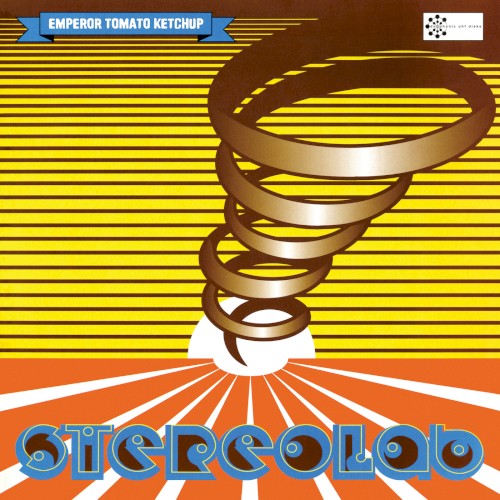
Emperor Tomato Ketchup (1996)
- 艺人
- 立体声实验室
- 发行
- 1996-03-08
- 类型
- 专辑
- 唱片公司
- 艾丽卡唱片、Duophonic Records
- 制作人
- 立体声实验室、John McEntire
- 版本
- MusicBrainz 上有 10 个发行版本
曲目
- 1Metronomic Underground7:55
- 2Cybele's Reverie4:43
- 3Percolator3:47
- 4Les Yper-sound4:05
- 5Spark Plug2:30
- 6OLV 265:42
- 7The Noise of Carpet3:06
- 8Tomorrow Is Already Here4:57
- 9Emperor Tomato Ketchup4:37
- 10Monstre sacre3:44
- 11Motoroller Scalatron3:49
- 12Slow Fast Hazel3:53
- 13Anonymous Collective4:33
13 首 · 约 57 分钟 · 依据 1996 US 发行的版本,在 MusicBrainz 看这个版本。
介绍
这个词条没有中文维基百科条目,下面是英文维基百科的原文。
Emperor Tomato Ketchup is the fourth studio album by English-French rock band Stereolab. It was released on 18 March 1996 and was issued by Duophonic Records and Elektra Records.
The album is named after the 1971 experimental film Emperor Tomato Ketchup by Japanese author and director Shūji Terayama.
Composition and recording
On Emperor Tomato Ketchup, Stereolab experimented with composing songs around looped sounds instead of traditional riffs. Critic Tom Moon found the band's compositional approach reminiscent of hip hop and electronica music, with loops being layered into "richly textured collages".
Guitarist Tim Gane remarked that the shift in style from previous releases emerged from a year-long bout of writer's block, where the band felt they were "drifting about in a musical landscape that wasn't inspiring or particularly exciting. With nothing on the horizon, everything we tried out seemed to be a dead end". The group began working on a cover of the Godz' "ABC" for a tribute album. The challenge of covering a song that was essentially a free improvisation proved to be invigorating: Gane adapted four notes from the track and looped them, providing the basis for an early take on the song "Percolator". This reliance on loops rather than their earlier drone-based approach provided the blueprint for much of the album's direction. The recording sessions for Emperor Tomato Ketchup were split between working with John McEntire in Chicago and Paul Tipler in London.
Release
Emperor Tomato Ketchup was released on 18 March 1996 in the United Kingdom by Duophonic Records, and on 9 April 1996 in the United States by Elektra Records. The artwork for the album was inspired by the LP cover sleeve of a 1964 recording of composer Béla Bartók's Concerto for Orchestra by the Bamberg Symphony conducted by Heinrich Hollreiser.
Preceding the album's release, the track "Cybele's Reverie" was issued as a single (on 7" vinyl) and as an EP (on CD and 10" vinyl) on 19 February 1996. A second single, "Metronomic Underground", was released on 2 December 1996. "The Noise of Carpet" was also promoted as a single to radio outlets in the United States.
AllMusic writer Heather Phares cites Emperor Tomato Ketchup as "Stereolab's greatest success to date". In the US, the album was especially successful on college radio, and by August 1997, the album had sold over 46,000 units in the country, according to Nielsen SoundScan.
A remastered and expanded edition of Emperor Tomato Ketchup was released by Duophonic and Warp on 13 September 2019.
Critical reception and legacy
On its release, Emperor Tomato Ketchup earned positive reviews from music critics.
In 2004's The New Rolling Stone Album Guide, Roni Sarig wrote that Stereolab created their "most well-rounded, confident, and accomplished statement" with Emperor Tomato Ketchup, forgoing their earlier lo-fi aesthetic and crafting "an impeccably produced, creatively mixed collection that's a joy to behold in its full high-fidelity glory." Stephen Thomas Erlewine of AllMusic stated that "Stereolab were poised for a breakthrough" with Emperor Tomato Ketchup given both their growing influence on alternative rock and their increasingly accessible musical direction. He noted that the album saw the band composing hookier songs while incorporating "more avant-garde and experimental influences", resulting in it being their "most complex, multi-layered record." Record Collector's Oregano Rathbone likewise said that Emperor Tomato Ketchup contained "defining examples of Stereolab's rewardingly oxymoronic tendencies".
Emperor Tomato Ketchup has appeared in numerous lists of the greatest albums. Spin named it the 46th best album of the 1990s. It was ranked 51st on Pitchfork's list of the decade's best albums, with staff writer Brent DiCrescenzo praising it as Stereolab's "most definitive and recommended statement" and recalling that it "sounded wholly futuristic and alien" at the time of its release. Tom Moon included Emperor Tomato Ketchup in his book 1,000 Recordings to Hear Before You Die (2008), and it was also included in the book 1001 Albums You Must Hear Before You Die.
Personnel
Credits are adapted from the album's liner notes.
正文摘自英文维基百科「Emperor Tomato Ketchup (album)」,按 CC BY-SA 4.0 使用;删去了参考文献、外部链接、表格和图片。
资料卡
- 作品性质
- 音乐专辑
- 表演者
- 立体声实验室
- 发行日期
- 1996 年
- 时长
- 57 分 15 秒
- 流派
- 后摇滚
- 语言
- 英语
- 唱片公司
- 艾丽卡唱片、Duophonic Records
- 制作人
- 立体声实验室、John McEntire
资料来自 Wikidata Q3053205(CC0)。
制作名单
- 厂牌
- Elektra(目录号 61840-2)、BMG Direct Marketing, Inc.(目录号 D 112651)
制作
- 混音
- 立体声实验室(其中 11 首)、Paul Tipler(其中 8 首)、John McEntire(第 4、8、10、12、13 首)
- 制作人
- 立体声实验室(其中 11 首)、Paul Tipler(其中 8 首)、John McEntire(第 4、8、10、12、13 首)
- 工程师
- Paul Tipler(其中 8 首)、John McEntire(第 4、8、10、12、13 首)
演奏与演唱
- 电钢琴
- Sean O’Hagan(其中 8 首)
- 风琴
- Sean O’Hagan(其中 8 首)
- 颤音琴
- Sean O’Hagan(其中 8 首)、John McEntire(第 8 首)
- 电子乐器
- John McEntire(第 4、10、12、13 首)
- 沙锤
- John McEntire(第 4、10、12、13 首)
- 合成器
- John McEntire(第 4、10、12、13 首)
- 铃鼓
- John McEntire(第 4、10、12、13 首)
- 中音萨克斯
- Ray Dickaty(第 3 首)
- 吉他
- John McEntire(第 8 首)
词曲与编曲
- 作曲
- Tim Gane、Lætitia Sadier、Sean O’Hagan(第 3 首)
- 器乐编曲
- Sean O’Hagan(其中 8 首)
名单来自 MusicBrainz(CC0)这一发行版本的关系数据,由志愿者录入,不一定齐全。
更多资料与乐评
在哪听
立体声实验室 的其他专辑
艺人页 ›

相似的专辑








同在 1996 年发行