乐单
曲目
- A1Don’t Want You No More2:29
- A2It’s Not My Cross to Bear4:48
- A3Black Hearted Woman5:20
- A4Trouble No More3:48
- B1Every Hungry Woman4:16
- B2Dreams7:19
- B3Whipping Post5:20
7 首 · 约 33 分钟 · 依据 1969-11-04 US 发行的版本,在 MusicBrainz 看这个版本。
介绍
这个词条没有中文维基百科条目,下面是英文维基百科的原文。
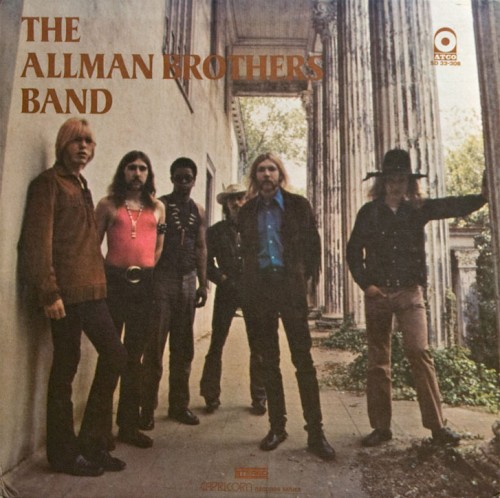
The Allman Brothers Band is the debut studio album by American rock band the Allman Brothers Band. Produced by Adrian Barber, it was released in the United States on November 4, 1969, by Atco Records subsidiary Capricorn. Formed in 1969, the Allman Brothers Band came together following various musical pursuits by each individual member. Guitarist and bandleader Duane Allman moved to Jacksonville, Florida where he led large jam sessions with his new band, one he had envisioned as having two guitarists and two drummers. After rounding out the lineup with the addition of his brother, Gregg Allman, the band moved to Macon, Georgia, where they were to be one of the premiere acts on Capricorn.
The album was recorded and mixed in two weeks at Atlantic Studios in New York City. Much of its material was premiered live over the preceding months and combines blues, jazz and country music to varying degrees. It includes re-workings of "Trouble No More" and "Don't Want You No More," as well as notable originals such as "Dreams", which highlighted the band's jazz influence, and "Whipping Post", which became a crowd favorite. Although the group was arranged to work with producer Tom Dowd (whose credits included Cream and John Coltrane), he was unavailable, and they instead recorded with house engineer Adrian Barber. The album's artwork was photographed in Macon and surrounding areas.
The record initially received a poor commercial response, charting in the lower levels of Billboard's Top 200 Pop Albums chart. Despite this, the album received critical acclaim from publications such as Rolling Stone, who called it "subtle, and honest, and moving". Following the band's increased fame in the early 1970s, this album and its follow-up, Idlewild South (1970), were repackaged into the compilation album Beginnings. Owing to the band's dislike of Barber's original mix, their debut album was remixed by Tom Dowd. In 1973, Beginnings was certified gold for sales of 500,000 copies, according to the Recording Industry Association of America.
In 2016 a Deluxe version of the album was released by Mercury Records that contained the "Original Stereo Mix by Adrian Barber" from 1969 and the "Beginnings" Stereo Mix by Tom Dowd from 1973.
Background
The Allman Brothers Band was formed in March 1969, during large jam sessions with various musicians in Jacksonville, Florida. Duane Allman and Jai Johanny Johanson (Jaimoe) had recently moved from Muscle Shoals, where Duane participated in session work at FAME Studios for artists such as Aretha Franklin, King Curtis, and Wilson Pickett, with whom he recorded a cover of the Beatles' "Hey Jude" that went to number 23 on the national charts. Duane began to put together a new band, and invited bassist Berry Oakley to jam with the new group; the pair had met in a Jacksonville, Florida club some time earlier, and became quick friends. The group had immediate chemistry, and Duane's vision for a "different" band — one with two lead guitarists and two drummers — began evolving. Meanwhile, Phil Walden, the manager of the late Otis Redding and several other R&B acts, was looking to expand into rock acts. Rick Hall became frustrated with the group's recording methods, and offered the tracks recorded and their contract to Walden and Jerry Wexler of Atlantic Records, who purchased them for $10,000. Walden intended the upcoming group to be the centerpiece of his new Atlantic-distributed label, Capricorn.
After the duo moved to Jacksonville, they began to put together large jam sessions. Dickey Betts had played in Oakley's previous band, the Second Coming, and became the group's second lead guitarist, while Butch Trucks, with whom Duane and Gregg had cut a demo less than a year prior, fulfilled the role of the second drummer. The Second Coming's Reese Wynans played keyboards, and Duane, Oakley and Betts all shared vocal duties. The unnamed group began to perform free shows in Willow Branch Park in Jacksonville, with an ever-changing, rotating cast of musicians. Duane felt strongly that his brother should be the vocalist of the new group (which effectively eliminated Wynans' position, as Gregg also played keyboards). Gregg accepted the invitation and entered rehearsal on March 26, 1969, when the group was rehearsing "Trouble No More" by Muddy Waters. Although initially intimidated by the musicians, Gregg was pressured by Duane "into singing [his] guts out". Four days later, the group made their début at the Jacksonville Armory. Although many names were suggested including Beelzebub, the six-piece eventually decided on the Allman Brothers Band.
正文摘自英文维基百科「The Allman Brothers Band (album)」,按 CC BY-SA 4.0 使用;删去了参考文献、外部链接、表格和图片;篇幅所限只节选了前面一部分,全文见原条目。
资料卡
- 作品性质
- 音乐专辑
- 表演者
- 欧曼兄弟乐团
- 发行日期
- 1969 年
- 流派
- 南方摇滚
- 语言
- 英语
- 唱片公司
- 阿特科
资料来自 Wikidata Q538876(CC0)。
制作名单
- 厂牌
- ATCO Records(目录号 SD 33-308)
- 录音室
- 录音:Atlantic Studios(Midtown Manhattan)
制作
- 制作人
- Adrian Barber
- 录音
- Adrian Barber
演奏与演唱
- 贝斯
- Berry Oakley
- 原声吉他
- 杜安·奥尔曼(第 A1、A2、A3、A4、B1 首)
- 滑棒吉他
- 杜安·奥尔曼(第 A1、A2、A3、A4、B1 首)
- 风琴
- 克雷格·欧曼(第 A1、A2、A3、A4、B1 首)
- 钢琴
- 克雷格·欧曼(第 A1、A2、A3、A4、B1 首)
- 打击乐
- Jai Johanny Johanson(第 A1、A2、A3、A4、B1 首)、Butch Trucks(第 A1、A2、A3、A4、B1 首)
- 鼓
- Jai Johanny Johanson(第 A1、A2、A3、A4、B1 首)、Butch Trucks(第 A1、A2、A3、A4、B1 首)
- 演唱
- 克雷格·欧曼(第 A2、A3、B1、B3 首)
- 主唱
- 克雷格·欧曼(第 A4、B2 首)
词曲与编曲
- 编曲
- 欧曼兄弟乐团
- 作曲
- 克雷格·欧曼(第 A2、B2、B3 首)、Sleepy John Estes(第 A4 首)
- 作词
- 克雷格·欧曼(第 A2、B2、B3 首)、Sleepy John Estes(第 A4 首)、马迪·沃特斯(第 A4 首)
- 词曲
- 克雷格·欧曼(第 A3、B1 首)、Spencer Davis(第 A1 首)、Phil Sawyer(第 A1 首)
名单来自 MusicBrainz(CC0)这一发行版本的关系数据,由志愿者录入,不一定齐全。
更多资料与乐评
在哪听
欧曼兄弟乐团 的其他专辑
艺人页 ›
同在 1969 年发行