乐单
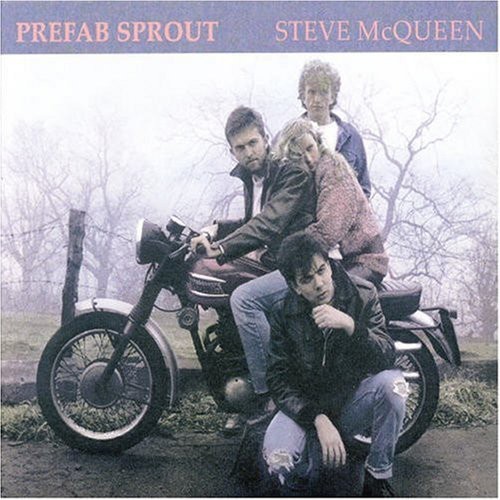
曲目
- A1Faron3:47
- A2Bonny3:45
- A3Appetite3:57
- A4When Love Breaks Down3:46
- A5Goodbye Lucille #14:29
- A6Hallelujah4:20
- B1Moving the River3:58
- B2Horsin’ Around4:38
- B3Desire As5:20
- B4Blueberry Pies2:25
- B5When the Angels4:27
11 首 · 约 45 分钟 · 依据 1985 US 发行的版本,在 MusicBrainz 看这个版本。
介绍
这个词条没有中文维基百科条目,下面是英文维基百科的原文。
Steve McQueen is the second studio album by English alternative pop band Prefab Sprout, released on 22 June 1985 in the UK by Kitchenware Records. On 3 September 1985, the album was released by Epic Records in the United States as Two Wheels Good in anticipation of legal conflict with the estate of American actor Steve McQueen. The album cover references McQueen's lifelong passion for Triumph motorcycles and his 1963 film The Great Escape.
The album received highly positive reviews from critics and was a modest commercial success, reaching number 21 in the United Kingdom. Four singles from the album entered top 100 of the UK Singles Chart, with "When Love Breaks Down" reaching the top 30. Retrospectively, Steve McQueen has received lasting critical acclaim, widely credited as an indie pop benchmark and ranked by many British publications among the greatest albums of all time.
In 2007, it was reissued as a "legacy edition" double CD, featuring a remastered version of the original album and a bonus disc featuring acoustic versions of the songs recorded in 2006 by the band's frontman, Paddy McAloon.
Recording
On an episode of the BBC Radio 1 programme Roundtable, musician and producer Thomas Dolby, a panelist on the programme, spoke favourably of Prefab Sprout's "Don't Sing", a track from their 1984 album Swoon. The band subsequently contacted Dolby, who met with frontman and songwriter Paddy McAloon in the latter's County Durham home. McAloon presented Dolby with a number of songs he had written, "probably 40 or 50" by Dolby's estimate, some written as far back as 10 to 12 years prior. Dolby then picked his favourites and asked McAloon to make demo recordings of them; these recordings served as the basis for Dolby's initial process of planning the album's recording.
In the autumn of 1984, Dolby and Prefab Sprout began working on the album's songs in rehearsals at Nomis Studios in West London, after which they moved to Marcus Studios for proper recording. The sessions were amicable, with the band being respectful of Dolby's edge over them in recording and musical experience, and Dolby keeping into account the band's wishes, knowing that McAloon "wouldn't want to be diluted" by Dolby's additions to the album. Subsequent mixing was carried out at Farmyard Studios in Buckinghamshire.
Music and lyrics
Musically, Steve McQueen is informed by Dolby's lush, jazz-tinged production. Pitchfork said the album "was McAloon's stab at pop, a suite of literate songs that draw as much from 1950s rock and country as from Elvis Costello." Wendy Smith's backing vocals have been described as "serv[ing] as guide rails" on the album. McAloon's lyrics on Steve McQueen touch on a number of themes, including love, infidelity, regret, and heartbreak. Alex Robertson of Sputnikmusic described the album's songs as lyrically "literate and humorous without being condescending in the slightest".
Singles
"When Love Breaks Down" was first released as a single in October 1984, before the album was released, but failed to chart in the top 40, peaking at No. 89 on the UK Singles Chart. It was reissued as a new single in March 1985, but again failed to chart, peaking at No. 88. It was only after the album's release, and on the single's third issue in October 1985, that it finally broke through the top 40 and peaked at No. 25 for two weeks in November and December 1985.
Between the second and third releases of "When Love Breaks Down", two further singles were released: "Faron Young" (referencing the country music singer of the same name) in July 1985, peaking at No. 74, and "Appetite" in August 1985, peaking at No. 92.
"Goodbye Lucille #1" was renamed "Johnny Johnny" for the final single release from the album in January 1986, peaking at No. 64.
Critical reception
Steve McQueen was critically acclaimed at the time of its release. Record Mirror's Graham K. Smith awarded it a score of five out of five, championing it as "the finest album you will hear this year" and Paddy McAloon as "the country's best (by a mile) songwriter". Rating the album nine out of ten in Smash Hits, Chris Heath praised McAloon as one of the best writers of "depressingly precise songs about the joys, fears and disappointments of love" and lamented that listeners might be put off by the "obscurity and complexity" of Prefab Sprout's music.
正文摘自英文维基百科「Steve McQueen (album)」,按 CC BY-SA 4.0 使用;删去了参考文献、外部链接、表格和图片;篇幅所限只节选了前面一部分,全文见原条目。
资料卡
- 作品性质
- 音乐专辑
- 表演者
- 合成芽
- 发行日期
- 1985 年 6 月
- 流派
- 流行摇滚
- 语言
- 英语
- 唱片公司
- Kitchenware Records
- 制作人
- 托马斯·多尔比
资料来自 Wikidata Q847082(CC0)。
制作名单
- 厂牌
- Epic(目录号 BFE 40100)
制作
- 混音
- 托马斯·多尔比(其中 10 首)、Mike Shipley(其中 10 首)
- 制作人
- 托马斯·多尔比(其中 10 首)、Phil Thornalley(第 A4 首)
演奏与演唱
- 吉他
- Kevin Armstrong(第 A6、B3 首)、帕迪·麦卡隆(第 A4 首)
- 鼓
- Neil Conti(第 A4 首)
- 键盘
- 托马斯·多尔比(第 A4 首)
- 合成器
- 托马斯·多尔比(第 A4 首)
- 贝斯
- Martin McAloon(第 A4 首)
- 演唱
- 帕迪·麦卡隆(第 A4 首)、Wendy Smith(第 A4 首)
- 萨克斯
- Mark Lockhart(第 B3 首)
词曲与编曲
- 作曲
- 帕迪·麦卡隆
- 作词
- 帕迪·麦卡隆
名单来自 MusicBrainz(CC0)这一发行版本的关系数据,由志愿者录入,不一定齐全。
更多资料与乐评
在哪听
合成芽 的其他专辑
艺人页 ›
同在 1985 年发行