乐单
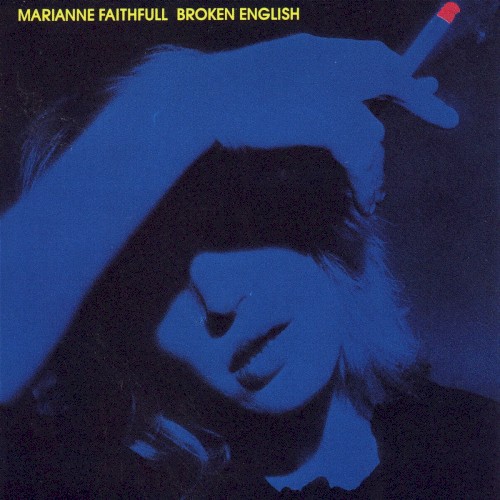
Broken English (1979)
曲目
- A1Broken English4:38
- A2Witches’ Song4:46
- A3Brain Drain4:16
- A4Guilt5:12
- B1The Ballad of Lucy Jordan4:13
- B2What’s the Hurry?3:06
- B3Working Class Hero4:43
- B4Why D’Ya Do It?6:47
8 首 · 约 38 分钟 · 依据 1979 US 发行的版本,在 MusicBrainz 看这个版本。
介绍
这个词条没有中文维基百科条目,下面是英文维基百科的原文。
Broken English is the seventh studio album by English singer Marianne Faithfull. It was released on 2 November 1979 by Island Records. The album marked a major comeback for Faithfull after years of drug abuse, homelessness and anorexia. It is often regarded as her definitive recording, and Faithfull herself described it as her "masterpiece".
Broken English was Faithfull's first major release since her album Love in a Mist (1967). After ending her relationship with Mick Jagger in 1970 and losing custody of her son, Faithfull suffered from heroin addiction and lived on the streets of London. Severe laryngitis and drug abuse during this period permanently altered Faithfull's voice, leaving it cracked and lower in pitch. She attempted a comeback in 1976 with Dreamin' My Dreams, which achieved only minor success. Shortly afterwards, Faithfull began working with musician Barry Reynolds, who produced the songs "Broken English" and "Why D'Ya Do It". The demos attracted the attention of Chris Blackwell who signed Faithfull to his record label Island Records.
The album was recorded at Matrix Studios in London. Faithfull collaborated with producer Mark Miller Mundy on the remaining songs for the album. After the whole album was recorded, he suggested making the music "more modern and electronic" and brought in Steve Winwood on keyboards. Musically, Broken English is a new wave album with elements of other genres such as punk, blues and reggae.
Broken English received critical acclaim. It peaked at number 82 on the Billboard 200, becoming her first album to chart in the United States since Go Away from My World (1965) and giving Faithfull a first nomination for the Grammy Award for Best Female Rock Vocal Performance. It reached number 57 in the United Kingdom and entered the top five in Germany, France and New Zealand. Broken English was certified platinum in Germany and France, and sold over one million copies worldwide. Two singles were released from the album, with "The Ballad of Lucy Jordan" peaking at number 48 on the UK Singles Chart. The album was included on NME magazine's list of "500 Greatest Albums of All Time" and in the book 1001 Albums You Must Hear Before You Die.
Background
Faithfull's immediately preceding albums, Dreamin' My Dreams and Faithless, had been in a relatively gentle folk or country and western style. Broken English was a radical departure, featuring a contemporary fusion of punk, new wave and dance, with liberal use of synthesizers. After years of cigarette smoking and drug use, Faithfull's voice was in a lower register, far raspier, and had a more world-weary quality than in the past that matched the often raw emotions expressed in the newer songs.
The backing band of Barry Reynolds and Joe Mavety (guitars), Steve York (bass) and Terry Stannard (drums) had been formed in 1977 to tour Ireland with Faithfull promoting Dreamin' My Dreams.
Marianne Faithfull recounted how Mark Mundy was brought on as the album's producer: "I don't think I could have handled Broken English without a producer. You can't imagine what it was like. There I am with no respect at all within the music business. ... So I found somebody who wanted the break, and that was Mark Mundy. He wanted to be a record producer, and he had some great ideas."
Composition
The album's title track took inspiration from terrorist figures of the time, particularly Ulrike Meinhof of the Baader-Meinhof group. "Guilt" was informed by the Catholic upbringing of the singer and her composer Barry Reynolds. "The Ballad of Lucy Jordan", originally performed by Dr. Hook & the Medicine Show, is a melancholy tale of a middle-class housewife's disillusionment; Faithfull's version became something of an anthem and was used on the soundtracks of the films Montenegro (1981) and Thelma & Louise (1991). "What's the Hurry?" was described by Faithfull as reflecting the everyday desperation of the habitual drug user. Her cover of John Lennon's "Working Class Hero" was recorded as a tribute to her own heroes such as Mick Jagger and Keith Richards, David Bowie and Iggy Pop, and Lennon himself.
正文摘自英文维基百科「Broken English (album)」,按 CC BY-SA 4.0 使用;删去了参考文献、外部链接、表格和图片;篇幅所限只节选了前面一部分,全文见原条目。
资料卡
- 作品性质
- 音乐专辑
- 表演者
- 玛丽安娜·费思富尔
- 发行日期
- 1979 年 11 月 2 日
- 流派
- 摇滚乐
- 语言
- 英语
- 唱片公司
- 小岛唱片
资料来自 Wikidata Q849982(CC0)。
制作名单
- 厂牌
- Island(目录号 ILPS 9570)
制作
- 制作人
- Mark Miller Mundy(第 B1 首)
词曲与编曲
- 词曲
- 玛丽安娜·费思富尔(第 A1、A2 首)、Joe Mavety(第 A1、A2 首)、Barry Reynolds(第 A1、A2 首)、Terry Stannard(第 A1、A2 首)、Steve York(第 A1、A2 首)
- 作曲
- Barry Reynolds(第 A4 首)、谢尔·希尔弗斯坦(第 B1 首)、约翰·列侬(第 B3 首)
- 作词
- Barry Reynolds(第 A4 首)、谢尔·希尔弗斯坦(第 B1 首)、约翰·列侬(第 B3 首)
名单来自 MusicBrainz(CC0)这一发行版本的关系数据,由志愿者录入,不一定齐全。
更多资料与乐评
在哪听
玛丽安娜·费思富尔 的其他专辑
艺人页 ›

同在 1979 年发行