乐单
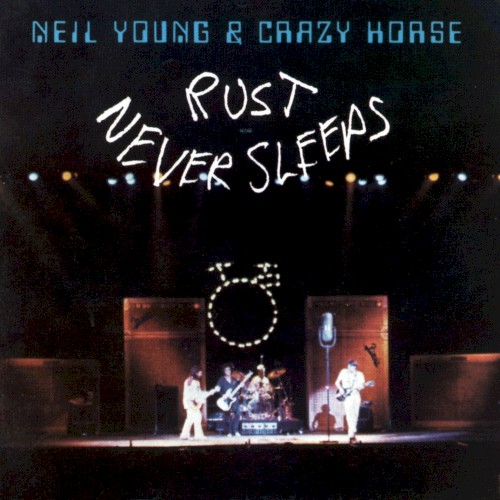
Rust Never Sleeps (1979)
滚石 500(2020) #296滚石 500(2003) #3501001 张专辑
- 艺人
- Neil Young and Crazy Horse
- 发行
- 1979-06-22
- 类型
- 专辑
- 唱片公司
- 重复唱片
- 制作人
- 尼尔·杨
- 版本
- MusicBrainz 上有 13 个发行版本
曲目
- A1My My, Hey Hey (Out of the Blue)3:48
- A2Thrasher5:41
- A3Ride My Llama2:31
- A4Pocahontas3:24
- A5Sail Away3:50
- B1Powderfinger5:31
- B2Welfare Mothers3:49
- B3Sedan Delivery4:40
- B4Hey Hey, My My (Into the Black)5:13
9 首 · 约 38 分钟 · 依据 1979-06-22 US 发行的版本,在 MusicBrainz 看这个版本。
介绍
这个词条没有中文维基百科条目,下面是英文维基百科的原文。
Rust Never Sleeps is the tenth album by Canadian American singer-songwriter Neil Young and his third with American band Crazy Horse. It was released on June 22, 1979, by Reprise Records and features both studio and live tracks. Most of the album was recorded live, then overdubbed in the studio, while other songs originated in the studio. Young used the phrase "rust never sleeps" as a concept for his tour with Crazy Horse to avoid artistic complacency and try more progressive, theatrical approaches to performing live.
The album peaked at No. 8 on the Billboard 200 album chart and spawned the hit single "Hey Hey, My My (Into the Black)" that peaked at No. 79 on the US Billboard Hot 100 chart. It also included one of Young's most popular and critically acclaimed songs, the enigmatic "Powderfinger". The album, along with Young's 1990 release Ragged Glory, has widely been considered a precursor of grunge music with the bands Nirvana and Pearl Jam having cited Young's heavily distorted and abrasive guitar style on the B side of the album as an inspiration.
Background
The album was recorded in May 1978 during solo acoustic performances at The Boarding House in San Francisco and in October 1978 during the "Rust Never Sleeps" tour, in which Young played a wealth of new material. The concert tour was divided into a solo acoustic set and an electric set with Crazy Horse. Two new songs, the acoustic "My My, Hey Hey (Out of the Blue)" and electric "Hey Hey, My My (Into the Black)" were the centerpiece of the new material. The overdubbed live tracks are complemented with two outtakes from Young's previous album, Comes a Time.
Writing
The album sees Young reunited with Crazy Horse, his first credited to the band since 1975's Zuma. Four of the album's eight songs date from the sessions from that previous album: "Pocahontas", "Ride My Llama", "Powderfinger" and "Sedan Delivery". Studio attempts at each of these songs from the summer of 1975 have since been released through Young's Archives series. Young explains in his memoir, Waging Heavy Peace: "The album Zuma is the first album we made with Crazy Horse after Poncho joined the band. We kept playing day after day and partying at night. We did the original "Powderfinger" and held it back. We did "Sedan Delivery" and held it back. "Ride My Llama" was completely finished and mixed and held back. Today I like listening to all of those tracks together in a compilation I call Dume that is in The Archives Volume 2."
The album's title, Rust Never Sleeps, takes its name from the song that bookends the album, titled "My My, Hey Hey (Out of the Blue)" and "Hey Hey, My My (Into the Black)". The line "It's better to burn out than it is to rust" was borrowed from a line in a song by Jeff Blackburn, Young's bandmate in The Ducks, with whom he toured in 1977. Devo vocalist Mark Mothersbaugh added the lyrics "Rust never sleeps", a slogan he remembered from his graphic arts career promoting the automobile rust proofing product Rust-Oleum. Young recalls in a 1981 Rockline interview: I think Mark had the idea in the first place. We were doing this version of "Out of the Blue" together and we were in the studio playing and Booji Boy was there and he was singing "Hey Hey, My My" and he just had a lyric sheet and it said "It's better to burn out than to rust" and he just said 'Well it's better to burn out 'cause rust never sleeps" and I thought, well all right, that makes a lot of sense to me.
Young adopted Mothersbaugh's lyrics and created a new version of the song with Crazy Horse. He also adopted Mothersbaugh's lyrics for the title of his album as a metaphor about the hazards of complacency on his music career and the need to keep moving forward. Young explained in a June 1988 interview for Spin Magazine how the lyrics resonated with him, and how he felt both the record industry should be shaken up at the time, and how he applies the sentiment of the song to his style of recording:
正文摘自英文维基百科「Rust Never Sleeps」,按 CC BY-SA 4.0 使用;删去了参考文献、外部链接、表格和图片;篇幅所限只节选了前面一部分,全文见原条目。
资料卡
- 作品性质
- 音乐专辑
- 表演者
- Neil Young and Crazy Horse
- 发行日期
- 1979 年 6 月 22 日
- 流派
- 摇滚乐
- 语言
- 英语
- 唱片公司
- 重复唱片
- 制作人
- 尼尔·杨
- 上一部
- Comes a Time
- 下一部
- Live Rust
资料来自 Wikidata Q927457(CC0)。
制作名单
- 厂牌
- Reprise Records(目录号 HS 2295)
- 录音室
- 录音:Triiad Recording Studios(Fort Lauderdale);录音:Woodland Studios(Nashville);录音:St. Paul Civic Center(Saint Paul);录音:Cow Palace(Daly City)
制作
- 制作人
- David Briggs、Tim Mulligan、尼尔·杨
- 录音
- David Hewitt(第 B4 首)
演奏与演唱
- 演出
- 尼尔·杨(其中 8 首)、疯马乐队(第 B1、B2、B3、B4 首)
- 主唱
- 尼尔·杨(第 A5、B2 首)
- 鼓
- Ralph Molina(第 B2、B4 首)、Karl T. Himmel(第 A5 首)
- 电吉他
- Frank Sampedro(第 B2、B4 首)、尼尔·杨(第 B2、B4 首)
- 电贝斯
- Joe Osborn(第 A5 首)、Billy Talbot(第 B2 首)
- 原声吉他
- 尼尔·杨(第 A5 首)
- 口琴
- 尼尔·杨(第 A5 首)
- 演唱
- Nicolette Larson(第 A5 首)、Ralph Molina(第 B4 首)、Billy Talbot(第 B4 首)、尼尔·杨(第 B4 首)
- 打击乐
- 尼尔·杨(第 B2 首)
- 和声
- Ralph Molina(第 B2 首)、Frank Sampedro(第 B2 首)、Billy Talbot(第 B2 首)
- 贝斯
- Billy Talbot(第 B4 首)
词曲与编曲
- 作曲
- 尼尔·杨(其中 8 首)
- 作词
- 尼尔·杨(其中 8 首)、Jeff Blackburn(第 B4 首)
- 词曲
- Jeff Blackburn(第 A1 首)、尼尔·杨(第 A1 首)
名单来自 MusicBrainz(CC0)这一发行版本的关系数据,由志愿者录入,不一定齐全。
更多资料与乐评
在哪听
Neil Young and Crazy Horse 的其他专辑
艺人页 ›
相似的专辑

同在 1979 年发行