 乐单
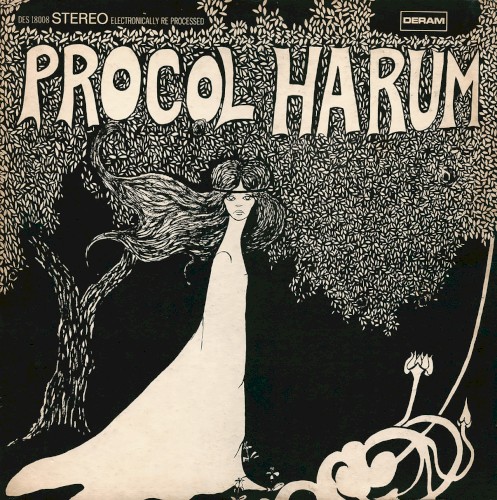
A Whiter Shade of Pale (1967)
介绍
这个词条没有中文维基百科条目,下面是英文维基百科的原文。
"A Whiter Shade of Pale" is a song by the English rock band Procol Harum that was issued as their debut single on 12 May 1967. The single reached number 1 in the UK Singles Chart on 8 June and stayed there for six weeks. Without much promotion, it reached number 5 on the US Billboard Hot 100. One of the anthems of the 1967 Summer of Love, it is one of the most commercially successful singles in history, having sold more than 10 million copies worldwide. In the years since, "A Whiter Shade of Pale" has become an enduring classic, with more than 1,000 known cover versions by other artists.
With its Bach-derived instrumental melody, soulful vocals, melancholic tone, and unusual lyrics, the music of "A Whiter Shade of Pale" was composed by Gary Brooker and Matthew Fisher, while the lyrics were written by Keith Reid. Originally, the writing credits only listed Brooker and Reid. In 2009, Fisher won his battle to be recognised as co-writer of the music in a unanimous ruling from the Law Lords.
In 1977, the song was named joint winner (along with Queen's "Bohemian Rhapsody") of "The Best British Pop Single 1952–1977" at the Brit Awards. In 1998, the song was inducted into the Grammy Hall of Fame. In 2004, the performing rights group Phonographic Performance Limited recognised it as the most-played record by British broadcasting of the past 70 years and Rolling Stone placed it 57th on its list of "The 500 Greatest Songs of All Time". In 2009, it was reported as the most played song in the last 75 years in public places in the UK.
The song has been included in many music compilations over the decades and has also been used in the soundtracks of numerous films and television shows, including The Big Chill, Purple Haze, Breaking the Waves, The Boat That Rocked, Tour of Duty, House M.D., Memory, Martin Scorsese's segment of New York Stories, Stonewall, Oblivion, Ken Burns and Lynn Novick's documentary series The Vietnam War, and the limited series The Offer and Billions. Cover versions of the song have also been featured in many films, for example, by King Curtis in Withnail and I and by Annie Lennox in The Net.
Lyrics
Keith Reid got the title and starting point for the song at a party. He overheard Guy Stevens of Island Records at the party saying to his wife Diane Cox, "You've turned a whiter shade of pale", and the phrase stuck in his mind.The original lyrics had four verses, of which only two are heard on the original recording. The third verse has been heard in live performances by Procol Harum, and more seldom the fourth. Claes Johansen, in his book Procol Harum: Beyond the Pale, suggests that the song "deals in metaphorical form with a male/female relationship which after some negotiation ends in a sexual act". This is supported in Lives of the Great Songs by Tim de Lisle, who remarks that the lyrics concern a drunken seduction, which is described through references to sex as a form of travel, usually nautical, using mythical and literary journeys. Other observers have also commented that the lyrics concern a sexual relationship.
Contrary to the above interpretations, Reid was quoted in the February 2008 issue of Uncut magazine as saying:
I was trying to conjure a mood as much as tell a straightforward, girl-leaves-boy story. With the ceiling flying away and room humming harder, I wanted to paint an image of a scene. I wasn't trying to be mysterious with those images, I was trying to be evocative. I suppose it seems like a decadent scene I'm describing. But I was too young to have experienced any decadence, then. I might have been smoking when I conceived it, but not when I wrote. It was influenced by books, not drugs.
Structurally and thematically, the song is unusual. While the recorded Procol Harum version is 4:03 long, it is composed of only two verses, each with chorus. The piece is also more instrument-driven than most songs of the period, and with a much looser rhyme scheme. Its unusually allusive and referential lyrics are much more complex than most lyrics of the time (for example, the chorus alludes to Geoffrey Chaucer's "The Miller's Tale"). The lyricist, Keith Reid, said: "I'd never read The Miller's Tale in my life. Maybe that's something that I knew subconsciously, but it certainly wasn't a conscious idea for me to quote from Chaucer, no way."
The phrase a whiter shade of pale has since gained widespread use in the English language, as noted by several dictionaries. As such, the phrase is today often used in contexts independent of any consideration of the song. It has also been heavily paraphrased, in forms like "an Xer shade of Y", to the extent that it has been recognised as a snowclone – a type of cliché and phrasal template.
正文摘自英文维基百科「A Whiter Shade of Pale」,按 CC BY-SA 4.0 使用;删去了参考文献、外部链接、表格和图片;篇幅所限只节选了前面一部分,全文见原条目。
资料卡
- 作品性质
- 音乐作品/乐曲
- 表演者
- 普洛柯哈伦
- 发行日期
- 1967 年
- 收录于 / 属于
- Procol Harum
- 流派
- 流行音乐
- 语言
- 英语
- 作曲
- 加里·布鲁克、马修·费舍尔
- 作词
- 基思·里德
- 改编自
- G弦上的咏叹调
资料来自 Wikidata Q300620(CC0)。
制作名单
- ISRC
- ARF410701379、ATM470300459、GBBWX0701000
制作
- 制作人
- Denny Cordell
演奏与演唱
- 鼓
- Bill Eyden
- 哈蒙德风琴
- Matthew Fisher
- 贝斯
- David Knights
- 吉他
- Ray Royer
- 演唱
- Gary Brooker
词曲与编曲
- 作曲
- Gary Brooker、Matthew Fisher
- 作词
- Keith Reid
名单来自 MusicBrainz(CC0)这条录音的关系数据,由志愿者录入,不一定齐全。
更多资料
在哪听
普洛柯哈伦 的专辑
艺人页 ›
风格、年代相近的歌
- Tiny Dancer艾尔顿·强 · 1972
- Changes大卫·鲍伊 · 1972
- 想象约翰·列侬 · 1971
- It's Too Late卡洛尔·金 · 1971
- 失去你哈利·尼尔森 · 1971
- 你的歌艾尔顿·强 · 1970
- The Tears of a Clown奇迹乐队 · 1970
- Sunday Mornin' Comin' Down克里斯·克里斯托弗森 · 1970
- Hey Jude披头士乐队 · 1968
- Time of the Season僵尸合唱团 · 1968
- Strawberry Fields Forever披头士乐队 · 1967
- 便士巷披头士乐队 · 1967