乐单
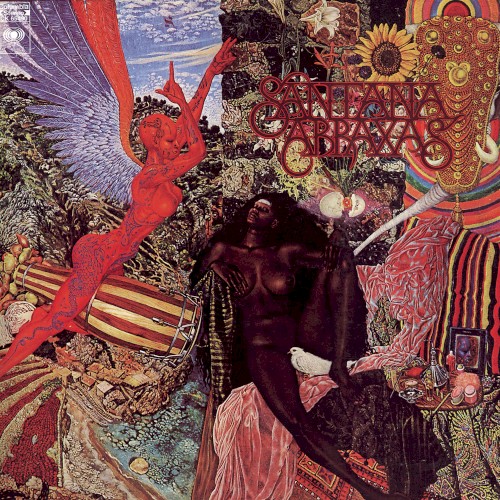
Abraxas (1970)
滚石 500(2020) #334滚石 500(2003) #2051001 张专辑
- 艺人
- 桑塔纳
- 发行
- 1970-09-23
- 类型
- 专辑
- 唱片公司
- 哥伦比亚唱片、CBS
- 制作人
- 卡洛斯·山塔那
- 版本
- MusicBrainz 上有 34 个发行版本
曲目
- A1Singing Winds, Crying Beasts4:54
- A2Black Magic Woman / Gypsy Queen5:17
- A3Oye como va4:17
- A4Incident at Neshabur5:00
- B1Se a cabo2:52
- B2Mother’s Daughter4:28
- B3Samba pa ti4:48
- B4Hope You’re Feeling Better4:18
- B5El Nicoya1:31
9 首 · 约 37 分钟 · 依据 1970 US 发行的版本,在 MusicBrainz 看这个版本。
介绍
这个词条没有中文维基百科条目,下面是英文维基百科的原文。
Abraxas is the second studio album by the American rock band Santana. It was released on September 23, 1970, by Columbia Records and became the band's first album to top the Billboard 200 in the United States. In 2020, Rolling Stone magazine ranked the album number 334 on its list of the "500 Greatest Albums of All Time".
Title
The title of the album originates from a line in Hermann Hesse's 1919 book Demian, quoted on the album's back cover: "We stood before it and began to freeze inside from the exertion. We questioned the painting, berated it, made love to it, prayed to it: We called it mother, called it whore and slut, called it our beloved, called it Abraxas..."
Songs
Carlos Santana had been interested in Fleetwood Mac's leader and songwriter Peter Green, having seen him perform at the Fillmore West in San Francisco, and decided to cover the band's song "Black Magic Woman" (both had also been influenced as guitarists by B.B. King). The band added a cover of Gábor Szabó's instrumental "Gypsy Queen" to the end. "Oye Como Va" was a hit by Tito Puente in the early 1960s and the group played it live regularly, as they realized it was good for audiences to dance to.
"Incident at Neshabur" was co-written by Santana and his friend Alberto Gianquinto, who played piano on the track. Gregg Rolie played the other keyboards, contrasting with Gianquinto's jazz-influenced style. It ran through various time and key signatures.
The instrumental, "Samba Pa Ti" ("Samba for You"), was written by Santana when he saw a jazz saxophonist performing in the street outside his apartment. It was later covered by José Feliciano, who added lyrics, and also by Angélique Kidjo, who put lyrics in Yoruba, on her album Oyo. It is also one of the tracks featured in Nick Hornby's book 31 Songs.
Cover art
The album cover features the 1961 painting Annunciation by German-French painter Mati Klarwein. According to the artist, it was one of the first paintings he did after relocating to New York City. Carlos Santana reportedly noticed it in a magazine and asked that it be on the cover of the band's upcoming album. On the back of the record sleeve the cover art is just credited to 'MATI'. It is now considered a classic of rock album covers. Klarwein went on to design album artwork for many notable artists, including Miles Davis, Herbie Hancock, Gregg Allman, and Earth, Wind & Fire.
Critical reception
In 2003, the album was ranked No. 205 on Rolling Stone magazine's list of the 500 greatest albums of all time, at No. 207 on the 2012 revision of the list, and then again at No. 334 in its 2020 release. In 2000, it appeared at No. 202 in Colin Larkin's All Time Top 1000 Albums. The album was also included in the book 1001 Albums You Must Hear Before You Die. In 2015, the album was listed among Billboard's 50 Essential Latin Albums of the 50 Past Years.
Rock critic Robert Christgau, in one of his capsule reviews in The Village Voice, at the time of the album's release, gave it a rating of only C+, which denotes "a not disreputable performance, most likely a failed experiment or a pleasant piece of hackwork".
Legacy
Abraxas was deemed "culturally, historically, or aesthetically significant" by the Library of Congress and was selected for preservation in their National Recording Registry in 2015.
Personnel
Santana
- Carlos Santana – lead guitar, backing vocals, producer
- Gregg Rolie – keyboards, lead vocals
- David Brown – bass
- Michael Shrieve – drums
- José "Chepito" Areas – percussion, congas, timbales
Michael Carabello – percussion, congas, possibly keyboards on "Singing Winds, Crying Beasts" (the latter disputed by Santana)
Additional personnel
Rico Reyes – backing vocals on "Oye Como Va" and “El Nicoya”, percussion on "El Nicoya"
Alberto Gianquinto – piano on "Incident at Neshabur"
- Fred Catero – producer
- John Fiore, David Brown – engineer
- Bob Venosa – graphics
- MATI – illustrations
- Marian Schmidt, Joan Chase – photography
正文摘自英文维基百科「Abraxas (album)」,按 CC BY-SA 4.0 使用;删去了参考文献、外部链接、表格和图片。
资料卡
- 作品性质
- 音乐专辑
- 表演者
- 桑塔纳
- 发行日期
- 1970 年 9 月 23 日
- 流派
- 拉丁摇滚、奇卡诺摇滚、融合爵士乐、迷幻摇滚、蓝调摇滚
- 语言
- 多语种
- 唱片公司
- 哥伦比亚唱片、CBS
- 制作人
- 卡洛斯·山塔那
资料来自 Wikidata Q284798(CC0)。
制作名单
- 厂牌
- Columbia(目录号 KC 30130)
- 录音室
- pressed at:Columbia Records Pressing Plant(Pitman);录音:Wally Heider Studios(San Francisco);录音:Pacific Recording Studio(San Mateo)
制作
- 工程师
- David Brown、John Fiore
- 制作人
- 卡洛斯·山塔那(第 A3、B1、B3、B4 首)、Fred Catero(第 A2、A3、B3 首)、桑塔纳(第 A2、B3 首)、Bob Irwin(第 B3 首)
演奏与演唱
- 康加鼓
- José “Chepito” Áreas、Michael Carabello
- 打击乐
- José “Chepito” Áreas、Michael Carabello、Rico Reyes
- 天巴鼓
- José “Chepito” Áreas
- 贝斯
- David Brown
- 键盘
- Gregg Rolie
- 吉他
- 卡洛斯·山塔那
- 塔布拉鼓
- Steven Saphore
- 鼓
- Michael Shrieve
- 和声
- Rico Reyes(第 A2、A3、B1、B2、B4、B5 首)、卡洛斯·山塔那(第 A2、A3、B1、B2、B4、B5 首)
- 主唱
- Gregg Rolie(第 A2、A3、B1、B2、B4、B5 首)
- 演唱
- Gregg Rolie(第 A2 首)
- 钢琴
- Alberto Gianquinto(第 A4 首)
词曲与编曲
- 编曲
- 桑塔纳(第 A1、A2、A3、A4、B2、B4 首)、José “Chepito” Áreas(第 B1、B5 首)、Gregg Rolie(第 B3 首)、卡洛斯·山塔那(第 B3 首)、Michael Carabello(第 B5 首)、Rico Reyes(第 B5 首)
- 作曲
- 卡洛斯·山塔那(第 A4、B3 首)、José “Chepito” Áreas(第 B1、B5 首)、Gregg Rolie(第 B2、B4 首)、Michael Carabello(第 A1 首)、彼得·格林(第 A2 首)、加博尔·萨博(第 A2 首)、蒂托·普恩特(第 A3 首)、Alberto Gianquinto(第 A4 首)
- 作词
- 彼得·格林(第 A2 首)、蒂托·普恩特(第 A3 首)、José “Chepito” Áreas(第 B1 首)、Gregg Rolie(第 B4 首)
名单来自 MusicBrainz(CC0)这一发行版本的关系数据,由志愿者录入,不一定齐全。
更多资料与乐评
在哪听
桑塔纳 的其他专辑
艺人页 ›
相似的专辑
同在 1970 年发行