乐单
Are We Not Men? We Are Devo! (1978)
滚石 500(2020) #252滚石 500(2003) #4471001 张专辑
- 艺人
- 退化
- 发行
- 1978-07
- 类型
- 专辑
- 唱片公司
- 华纳兄弟唱片公司、维珍
- 制作人
- 布莱恩·伊诺
- 版本
- MusicBrainz 上有 11 个发行版本
曲目
- A1Uncontrollable Urge3:08
- A2(I Can’t Get No) Satisfaction2:38
- A3Praying Hands2:47
- A4Space Junk2:13
- A5Mongoloid3:42
- A6Jocko Homo3:38
- B1Too Much Paranoias1:56
- B2Gut Feeling / (Slap Your Mammy)4:54
- B3Come Back Jonee3:46
- B4Sloppy (I Saw My Baby Gettin’)2:37
- B5Shrivel‐Up3:05
11 首 · 约 34 分钟 · 依据 1978-07 US 发行的版本,在 MusicBrainz 看这个版本。
介绍
Q: Are We Not Men? A: We Are Devo!是新浪潮乐队Devo的首张专辑。制作人布莱恩·伊诺,主要在德国科隆录制,1978年由维京唱片和华纳兄弟唱片分别在英国和美国发行。
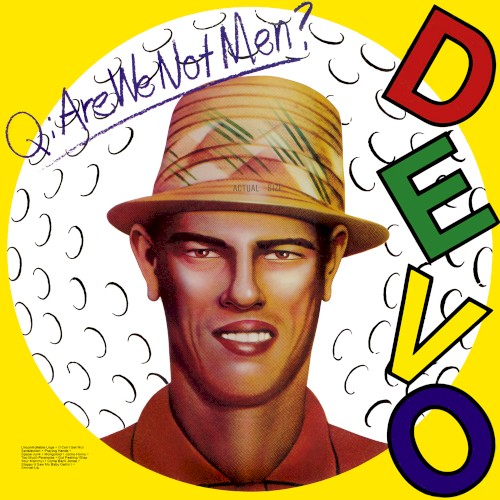
专辑封面本拟采用高尔夫球手吉吉·罗德里格斯被印在其代言的高尔夫球外包装上的头像,但被华纳兄弟的律师阻止;后来乐队找到了一张四名美国总统头像的合成照片(乐队成员马克·马瑟斯鲍夫形容其“极为丑陋”),并将其利用喷枪在罗德里格斯的照片上喷涂出来,形成现今的封面。
专辑获得相当褒贬不一的评价。在1978年的英国专辑排行榜上专辑最高达到第12位,在同年的美国公告牌上则达到最高第78。《滚石》杂志在“史上最佳100张朋克专辑”榜单中称其“紧凑、嘈杂又透着奇特的欢快感”。
正文摘自中文维基百科「Q:Are We Not Men? A: We Are Devo!」,按 CC BY-SA 4.0 使用;已转为简体,删去了参考文献、外部链接、表格和图片。
英文维基百科上的更多内容(英文原文,约 3,328 字符)
Q: Are We Not Men? A: We Are Devo! is the debut studio album by American new wave band Devo. It was released in August 1978 on Warner Bros. in North America and Virgin Records in Europe. Produced by Brian Eno, the album was recorded from October 1977 to February 1978, primarily in Cologne, West Germany.
The album peaked at No. 78 on the U.S. Billboard chart and No. 12 on the UK Albums Chart. Retrospectively, the album has been included on several "best of" lists from publications, including Rolling Stone, Pitchfork, and Spin.
Production and recording
Composition
Mark Mothersbaugh, Gerald Casale, and Bob Mothersbaugh wrote the album from 1974 to 1977. "Jocko Homo", written by Mark Mothersbaugh, was demoed in 1974 and first played live on October 31, 1975. During this period, Devo were a quartet consisting of Mark Mothersbaugh, Gerald Casale, Bob Mothersbaugh, and drummer Jim Mothersbaugh. In 1976, Alan Myers replaced Jim Mothersbaugh, and Bob Casale ("Bob 2") re-joined as rhythm guitarist and additional keyboardist following a two-year absence. By February 1977, Devo were also performing "Shrivel-Up" live, as well as early versions of "Uncontrollable Urge," "Praying Hands," "Mongoloid," "Too Much Paranoias," and "Jocko Homo." In March 1977, Devo released their first single, a self-produced recording of "Mongoloid" / "Jocko Homo".
By May 19, 1977, the group had debuted all of the album's tracks live, and developed the material throughout the year.
Production
In 1977, David Bowie and Iggy Pop received a tape of Devo demo songs from the wife of Michael Aylward, guitarist in the band Tin Huey. Both Pop and Bowie, as well as Brian Eno and Robert Fripp, expressed interest in producing Devo's first release. In October 1977, Patrick Gleeson invited the band to record "Come Back Jonee" and "Shrivel-Up" at his Different Fur studio in San Francisco. The following month, Devo returned to New York and were introduced ahead of a show at Max's Kansas City by Bowie, who told the audience that he planned to produce Devo's first album in Tokyo over the winter.
Eventually, Eno was chosen to produce the album at Conny Plank's studio near Cologne after a series of engagements prevented Bowie from undertaking the recording. The band were flown to Germany in February 1978. Bowie was busy filming Just a Gigolo at the time, but assisted Eno on weekends. Since Devo had not yet been signed to a record label, Eno paid for the flights and studio cost of the band, confident that they would be signed; in return, he asked for a share of any subsequent deals. The Different Fur recordings of "Come Back Jonee" and "Shrivel-Up" had been overdubbed upon during these sessions.
Gerald Casale was not present for the first day of recording because he had missed the flight. With their bassist missing, the rest of the group spent the day playing with Eno, Bowie, Holger Czukay of Can, and Dieter Moebius of Cluster and Harmonia.
The recording sessions were a source of frustration for Eno and Devo. Eno found the band unwilling to experiment or deviate from the sound of their demo recordings. Devo later admitted that "we were overtly resistant to Eno's ideas. He made up synth parts and really cool sounds for almost every part of the album, but we used them on three or four songs." After conflicts arose between the group and Eno, Bowie was brought in to remix the album.
这部分摘自英文维基百科「Q. Are We Not Men? A: We Are Devo!」,按 CC BY-SA 4.0 使用;删去了参考文献、外部链接、表格和图片;篇幅所限只节选了前面一部分,全文见原条目。
资料卡
- 作品性质
- 音乐专辑
- 表演者
- 退化
- 发行日期
- 1978 年 8 月 28 日
- 流派
- 朋克摇滚
- 语言
- 英语
- 唱片公司
- 华纳兄弟唱片公司、维珍
- 制作人
- 布莱恩·伊诺
资料来自 Wikidata Q670074(CC0)。
制作名单
- 厂牌
- Warner Bros. Records(目录号 BSK 3239)
- 录音室
- 混音:Conny’s Studio(Neunkirchen);录音:Conny’s Studio(Neunkirchen);录音:Different Fur Studios(San Francisco)
制作
- 工程师
- Conny Plank、Patrick Gleeson(第 B3、B5 首)
- 制作人
- 布莱恩·伊诺
词曲与编曲
- 词曲
- Gerald Casale(第 A3、A4、B2、B3、B4、B5 首)、马克·马瑟斯鲍夫(第 A3、A4、B2、B3、B4、B5 首)、Bob Mothersbaugh(第 B2、B4、B5 首)、米克·贾格尔(第 A2 首)、基思·理查兹(第 A2 首)、Gary Jackett(第 B4 首)
- 作曲
- 马克·马瑟斯鲍夫(第 A1、A6、B1 首)、Gerald Casale(第 A5 首)
- 作词
- 马克·马瑟斯鲍夫(第 A1、A6、B1 首)、Gerald Casale(第 A5 首)
包装与设计
- 摄影
- Bobbi Watson
名单来自 MusicBrainz(CC0)这一发行版本的关系数据,由志愿者录入,不一定齐全。
更多资料与乐评
在哪听
退化 的其他专辑
艺人页 ›


相似的专辑
同在 1978 年发行