乐单
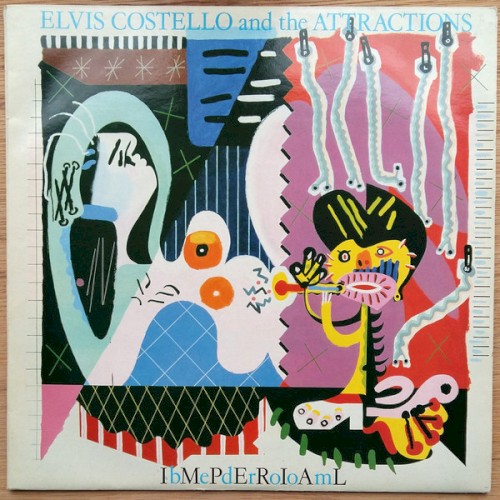
Imperial Bedroom (1982)
- 艺人
- Elvis Costello & the Attractions
- 发行
- 1982-07-02
- 类型
- 专辑
- 唱片公司
- F-Beat Records
- 制作人
- 乔弗里·艾默里克
- 版本
- MusicBrainz 上有 15 个发行版本
曲目
- 1Beyond Belief2:35
- 2Tears Before Bedtime3:03
- 3Shabby Doll4:49
- 4The Long Honeymoon4:17
- 5Man Out of Time5:28
- 6Almost Blue2:51
- 7…And in Every Home3:25
- 8The Loved Ones2:49
- 9Human Hands2:44
- 10Kid About It2:46
- 11Little Savage2:38
- 12Boy With a Problem2:14
- 13Pidgin English3:59
- 14You Little Fool3:12
- 15Town Cryer4:15
15 首 · 约 51 分钟 · 依据 1982 US 发行的版本,在 MusicBrainz 看这个版本。
介绍
这个词条没有中文维基百科条目,下面是英文维基百科的原文。
Imperial Bedroom is the seventh studio album by the English singer-songwriter Elvis Costello, and his sixth with the Attractions—keyboardist Steve Nieve, bassist Bruce Thomas and drummer Pete Thomas (no relation). It was released on 2 July 1982 through F-Beat Records in the United Kingdom and Columbia Records in the United States. Recording took place at AIR Studios in London from late 1981 to early 1982 with production handled by Geoff Emerick. Placing an emphasis on studio experimentation, the album saw the group use unusual instruments, including harpsichord, accordion and strings arranged by Nieve. Songs were rewritten constantly while Costello tinkered with the recordings, adding numerous overdubs.
Employing a variety of pop styles that embody new wave, baroque pop and art rock, Imperial Bedroom contains an ornately lush production that several commentators compared to the Beatles and Phil Spector's wall of sound. The lyrics primarily concern love and relationships, with insight into the emotional problems of individuals. Squeeze's Chris Difford co-wrote the lyrics for "Boy With a Problem". The cover artwork, a painting by Barney Bubbles, is a pastiche of Pablo Picasso's Three Musicians.
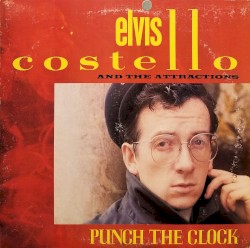
Promoted under the tagline "Masterpiece?", Imperial Bedroom reached number 6 in the UK and number 30 in the US. Its singles, "You Little Fool" and "Man Out of Time", failed to break the top 50 in the UK. Its commercial performance led Costello to take a new direction with 1983's Punch the Clock. It was greeted with massive acclaim from music critics and continues to be regarded as one of Costello's best works. Reviewers praised the songwriting, production, instrumentation and performances, although its complexity was divisive. Imperial Bedroom has appeared on several best-of lists and has been reissued multiple times with bonus tracks.
Background
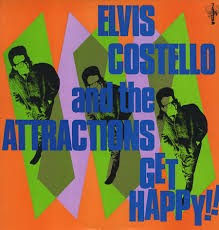
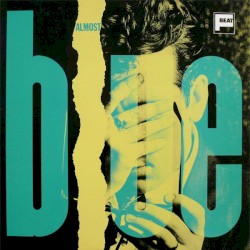
By 1981, Elvis Costello had released six studio albums in four years. Following the release of his country covers album Almost Blue (1981), the artist was facing diminishing popularity, particularly in America, where Trust (1981) and the Taking Liberties (1980) collection of non-album tracks had only reached the top 30; Armed Forces (1979) and Get Happy!! (1980) had both reached the top 15. He had experimented musically with Get Happy!!, Trust and Almost Blue, and began to write more introspective lyrics than the angry material of his first three albums. However, the weaker commercial performances of these projects caused him to re-evaluate himself as an artist, leading him to take a new direction for his next album.
Costello's initial vision for his seventh studio project was to record most of it live with minimal overdubs. He and his backing band the Attractions—keyboardist Steve Nieve, bassist Bruce Thomas and drummer Pete Thomas (no relation)—spent two weeks rehearsing the material at a remote college in Devon using this method, yielding an eight-track album. Costello eventually settled on using heavy studio experimentation when he found the material sounded too similar to Trust.
Recording and production
The band regrouped at London's AIR Studios in November 1981, where Costello had booked 12 weeks to record the album. He chose former Beatles engineer Geoff Emerick to produce the album, who the artist primarily used to "make his scattershot ideas a reality"; Emerick would be listed on the album sleeve as producing "from an original idea by Elvis Costello, assisted by Jon Jacobs". It was Costello's first album of original material not produced by Nick Lowe, as Costello believed his complex ideas for the record would be too much for the producer; engineer Roger Béchirian did not return either. Lowe later returned to produce 1986's Blood & Chocolate.
Emerick's primary role was to let the musicians take charge of themselves, as a way to "draw things out of the artist". Costello commented in 1995: "He was used to being thrown an incomprehensible garble of sounds and musical directions and making some sense of it. After working with the Beatles at the height of their psychedelic era, he was used to innovation." According to the author Tony Clayton-Lea, Emerick transformed the record from a "decent" eight-track demo album into an "aural tour de force". The album was recorded at the same time as Paul McCartney's Tug of War, on which Emerick simultaneously served as engineer while George Martin produced; Emerick departed for small periods to work on Tug of War—with Jacobs taking over—before resuming work with Costello. The artist later explained that he and McCartney were initially set to have non-conflicting recording schedules but the latter's was moved up, forcing Emerick to work between the two.
正文摘自英文维基百科「Imperial Bedroom」,按 CC BY-SA 4.0 使用;删去了参考文献、外部链接、表格和图片;篇幅所限只节选了前面一部分,全文见原条目。
资料卡
- 作品性质
- 音乐专辑
- 表演者
- Elvis Costello & the Attractions
- 发行日期
- 1982 年 7 月 2 日
- 流派
- 摇滚乐
- 语言
- 英语
- 唱片公司
- F-Beat Records
- 制作人
- 乔弗里·艾默里克
资料来自 Wikidata Q846779(CC0)。
制作名单
- 厂牌
- Columbia(目录号 CK 38157)
- 录音室
- 录音:AIR Studios(Hampstead)
制作
- 制作人
- Geoff Emerick
演奏与演唱
- 演出
- The Attractions(第 5 首)、埃尔维斯·科斯特洛(第 5 首)
词曲与编曲
- 作曲
- 埃尔维斯·科斯特洛、松卓·雷尔克(第 9 首)
- 作词
- 埃尔维斯·科斯特洛、Chris Difford(第 12 首)
名单来自 MusicBrainz(CC0)这一发行版本的关系数据,由志愿者录入,不一定齐全。
更多资料与乐评
在哪听
Elvis Costello & the Attractions 的其他专辑
艺人页 ›

相似的专辑
同在 1982 年发行