乐单
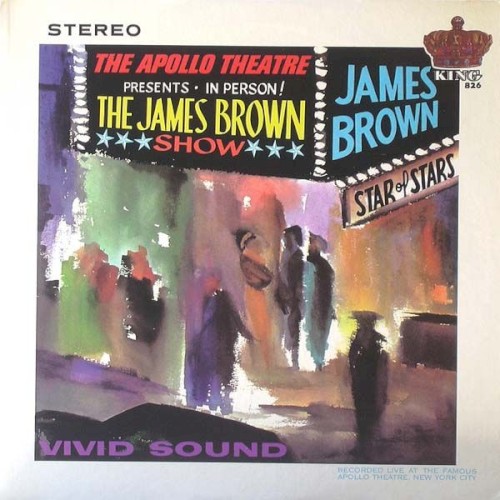
Live at the Apollo (1963)
曲目
- A1I’ll Go Crazy3:53
- A2Try Me2:14
- A3Think1:57
- A4I Don’t Mind2:40
- A5Lost Someone10:54
- 6Please Please Please0:27
- 7You’ve Got the Power0:11
- 8I Found Someone0:38
- 9Why You Do Me0:25
- 10I Want You So Bad0:23
- 11I Love You Yes I Do1:42
- 12Why Does Everything Happen to Me1:17
- 13Bewildered0:50
- 14Please Please Please #20:30
- B2Night Train, Closing3:26
15 首 · 约 31 分钟 · 依据 1963 US 发行的版本,在 MusicBrainz 看这个版本。
介绍
这个词条没有中文维基百科条目,下面是英文维基百科的原文。
Live at the Apollo is the first live album by James Brown and the Famous Flames, recorded at the Apollo Theater in Harlem in October 1962 and released in May 1963 by King Records. Capturing Brown's popular stage show for the first time on record, the album was a major commercial success, was critically acclaimed, and cemented his status as a leading R&B star. It is also widely famous for its incredibly loud, piercing crowd noise and intense audience reactions, especially during the slower ballad medleys.
The album is included in Robert Christgau's "Basic Record Library" of 1950s and 1960s recordings, published in Christgau's Record Guide: Rock Albums of the Seventies (1981). In 2000 it was voted number 248 in Colin Larkin's All Time Top 1000 Albums. In 2003, the album was ranked number 24 on Rolling Stone magazine's list of The 500 Greatest Albums of All Time, then was re-ranked at number 25 in 2012, and then re-ranked at number 65 in a 2020 reboot of the list. In 2004, it was one of 50 recordings chosen that year by the Library of Congress to be added to the National Recording Registry. In 1998, the album was inducted into the Grammy Hall of Fame.
Background
The album was recorded on the night of October 24, 1962, at Brown's own expense. Although not credited on the album cover or label, Brown's vocal group, The Famous Flames (Bobby Byrd, Bobby Bennett, and Lloyd Stallworth), played an important co-starring role in Live at the Apollo, and are included with Brown by MC Fats Gonder in the album's intro. It wasn't until the CD release of this album, decades later, that The Flames were finally credited for their work on this album. While Brown's record label, King Records, originally opposed releasing the album, believing that a live album featuring no new songs would not be profitable, the label finally relented under pressure from both Brown's manager Bud Hobgood and Brown himself.
Release and reception
Live at the Apollo was an amazingly rapid seller. It spent 66 weeks on the Billboard Top Pop Albums chart, peaking at #2. Many record stores, especially in the southeast US, found themselves unable to keep up with the demand for the product, eventually ordering several cases at a time. R&B DJs often would play side 1 in its entirety, pausing only to insert commercials and to flip the record to side 2, which was often played in full as well.
Legacy
In a retrospective article for Rolling Stone, music critic Robert Christgau said that Brown was a "striking but more conventional performer" in the show than on his contemporary studio recordings and wrote of the album:
Recorded in 1962 and barely half an hour long, it lacks the heft we associate with live albums, relegating major songs to the same eight-title medley as forgettable ones. But not only did it establish Brown as an r&b superstar and a sales force to be reckoned with, it's a time capsule, living testament of a chitlin circuit now defunct. The band is clean as a silk suit, and how the women love this rough singer's tender lover-in-song act. There is no music anywhere quite like the perfectly timed and articulated female fan-screeches that punctuate the 10-minute 'Lost Someone.'
Brown went on to record several more albums at the Apollo throughout his career, including 1968's Live at the Apollo, Volume II (King), 1971's Revolution of the Mind: Live at the Apollo, Volume III (Polydor), and Live at the Apollo 1995 (Scotti Bros.).
In 2015, Rolling Stone listed it as the greatest live album of all time.
MC5 guitarist Wayne Kramer cited Live at the Apollo as the inspiration to Kick Out the Jams. "Our whole thing was based on James Brown. We listened to Live at the Apollo endlessly on acid. We would listen to that in the van in the early days of 8-tracks on the way to the gigs to get us up for the gig. If you played in a band in Detroit in the days before The MC5, everybody did 'Please, Please, Please' and 'I Go Crazy.' These were standards. We modeled The MC5's performance on those records. Everything we did was on a gut level about sweat and energy. It was anti-refinement. That's what we were consciously going for."
CD reissues
Despite its renowned and historical significance, Live at the Apollo was not reissued on CD until 1990 because the original master recordings had been misplaced and the available copies were not of a high enough quality for a satisfactory CD release.
正文摘自英文维基百科「Live at the Apollo (1963 album)」,按 CC BY-SA 4.0 使用;删去了参考文献、外部链接、表格和图片;篇幅所限只节选了前面一部分,全文见原条目。
资料卡
- 作品性质
- 音乐专辑
- 表演者
- 詹姆士·布朗、知名之火
- 发行日期
- 1963 年 5 月
- 录制时间
- 1962 年 10 月 24 日
- 录音地点
- 阿波罗歌剧院
- 流派
- 灵魂乐
- 语言
- 英语
- 唱片公司
- 美国国王唱片
- 制作人
- 詹姆士·布朗
资料来自 Wikidata Q898420(CC0)。
制作名单
- 厂牌
- Polydor(目录号 PD 0826)
词曲与编曲
- 作词
- 詹姆士·布朗(其中 10 首)、Bobby Byrd(第 A5、8、9 首)、Johnny Terry(第 6、7、14 首)、Lloyd Stallworth(第 A5、8 首)、Lowman Pauling(第 A3 首)、Sylvester Keels(第 9 首)、Henry Glover(第 11 首)、Sally Nix(第 11 首)、Roy Hawkins(第 12 首)、Teddy Powell(第 13 首)、Leonard Whitcup(第 13 首)
- 作曲
- 詹姆士·布朗(其中 9 首)、Bobby Byrd(第 A5、8、9 首)、Johnny Terry(第 6、7、14 首)、Lloyd Stallworth(第 A5、8 首)、Lowman Pauling(第 A3 首)、Sylvester Keels(第 9 首)、Henry Glover(第 11 首)、Sally Nix(第 11 首)、Roy Hawkins(第 12 首)、Teddy Powell(第 13 首)、Leonard Whitcup(第 13 首)、Jimmy Forrest(第 B2 首)
名单来自 MusicBrainz(CC0)这一发行版本的关系数据,由志愿者录入,不一定齐全。
更多资料与乐评
在哪听
詹姆士·布朗 的其他专辑
艺人页 ›
相似的专辑
同在 1963 年发行