乐单
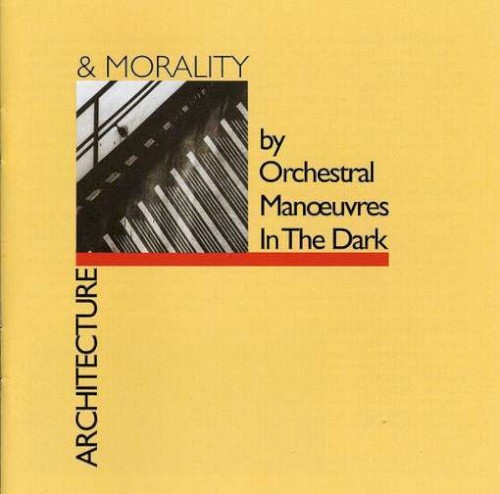
Architecture & Morality (1981)
曲目
- A1The New Stone Age3:18
- A2She’s Leaving3:26
- A3Souvenir3:36
- A4Sealand7:42
- B1Joan of Arc3:46
- B2Joan of Arc (Maid of Orleans)4:11
- B3Architecture & Morality3:37
- B4Georgia3:21
- B5The Beginning and the End3:44
9 首 · 约 37 分钟 · 依据 1981 US 发行的版本,在 MusicBrainz 看这个版本。
介绍
这个词条没有中文维基百科条目,下面是英文维基百科的原文。
Architecture & Morality is the third studio album by the English electronic band Orchestral Manoeuvres in the Dark (OMD), released on 6 November 1981 by Dindisc. Inspired by religious music, the group sought to broaden their musical palette by utilising elaborate choral samples, the Mellotron, and other new instruments to create a more naturalistic, emotive sound. The artwork was designed by longtime OMD collaborator Peter Saville, along with associate Brett Wickens, while its title was derived from the book Morality and Architecture by David Watkin.
Architecture & Morality reached number three on the UK Albums Chart, and was a top-10 entry across Europe. The record met with lukewarm reviews, but garnered acclaim from critics and other artists in the following years. It has been recognised as a seminal album of its era and the synth-pop genre, appearing in rankings of the best records of 1981 and the wider decade. Architecture & Morality has also been featured in "all-time" lists, including the book 1001 Albums You Must Hear Before You Die.
The record became a commercial success, selling over four million copies and spawning three international hit singles – "Souvenir", "Joan of Arc" and "Maid of Orleans" – which together sold eight million copies. OMD have staged multiple tours based around the album.
Background
During the initial sessions for Architecture & Morality, OMD were looking for a new musical direction. Frontman Andy McCluskey, a longtime atheist, told how the band "found a lot of influence in the emotional power of religious music". McCluskey informed Melody Maker at the time, "I haven't gone and 'got God'... It's just trying to understand why people need religion and believe in it." The group spent two months recording at The Manor Studio, Shipton-on-Cherwell, with additional recording completed at the band's own Gramophone Suite in Liverpool. Mixing took place at Mayfair Studios, London. Instrumentalist Martin Cooper left and re-joined the group during the making of the album, missing the bulk of the sessions. During his absence he formed Godot with former OMD session musician David Hughes.
A catalyst in the development of OMD's new sound was Hughes' use of the band's studio to manipulate choral samples he had recorded; the album is noted for making liberal use of those samples, as well as of the Mellotron, a mechanical tape-replay keyboard. The group introduced other new instruments, including prominent guitars on opening track "The New Stone Age", whose sound was intended to startle the OMD audience. All of these measures combined to produce a more naturalistic, emotive sound than on previous OMD releases.
According to the album's credits, its title was suggested to the band by Martha Ladly (formerly of Martha and the Muffins), who had read the 1977 book Morality and Architecture by David Watkin. Ladly, who was also a designer, was at the time the girlfriend of Peter Saville, the album's sleeve designer. McCluskey felt the title Architecture & Morality represented the interplay between the human and mechanical aspects of OMD: "We had the 'architecture', which was the technology, the drum machines, the rigid playing, the attempt to break out of the box by playing specifically crafted sounds, and the 'morality', the organic, the human, the emotional touch, which we brought naturally."
"Souvenir" was the first track to be written for the album. "Sealand" was named after the Royal Air Force's Sealand base on the Wirral; it is also a nod to the Neu! song "Seeland". The sample-heavy title track was compiled in the studio over a three-day period. "The Beginning and the End" was an older composition that the band had previously attempted to record but had shelved due to being unsatisfied with the results. The songs avoided the verse-chorus-verse format, utilising lengthy instrumental passages and substituting choruses with synthesizer lines. Lyrics were largely inspired by historical figures and events, including Joan of Arc, after whom two songs were named. The tenth-through-sixteenth tracks of the remastered edition are bonus tracks and were B-sides from the album's three singles – except for "Gravity Never Failed", which was an out-take from the Architecture & Morality sessions (its original title, "Georgia", was transferred to another song on the record). This track was envisaged as a single, but was not released until it featured as the B-side of "Dreaming" (1988). "Of All the Things We've Made", and a completed version of "The Romance of the Telescope (Unfinished)", would appear on OMD's next album, Dazzle Ships (1983).
The cover artwork was produced by Peter Saville and associate Brett Wickens. Inspirations included "art movements like The Circle, and... mid-century iconic furniture like [Le] Corbusier and [Alvar] Aalto".
正文摘自英文维基百科「Architecture & Morality」,按 CC BY-SA 4.0 使用;删去了参考文献、外部链接、表格和图片;篇幅所限只节选了前面一部分,全文见原条目。
资料卡
- 作品性质
- 音乐专辑
- 表演者
- OMD
- 发行日期
- 1981 年
- 流派
- 合成器流行乐
- 语言
- 英语
- 唱片公司
- Dindisc Records
- 制作人
- OMD
资料来自 Wikidata Q776503(CC0)。
制作名单
- 厂牌
- Epic(目录号 ARE 37721)
制作
- 制作人
- Richard Manwaring(其中 8 首)、OMD(其中 8 首)、Mike Howlett(第 A3、B3、B5 首)
- 工程师
- Howard Gray(第 B1、B2 首)、Brian Tench(第 B1、B2 首)
演奏与演唱
- 演唱
- Paul Humphreys(第 A3 首)
词曲与编曲
- 作曲
- Andy McCluskey(其中 8 首)、Paul Humphreys(第 A2、A4、B3、B4、B5 首)
- 作词
- Andy McCluskey(第 B1、B2 首)
- 词曲
- Martin Cooper(第 A3 首)、Paul Humphreys(第 A3 首)
名单来自 MusicBrainz(CC0)这一发行版本的关系数据,由志愿者录入,不一定齐全。
更多资料与乐评
在哪听
OMD 的其他专辑
艺人页 ›




相似的专辑




同在 1981 年发行