乐单
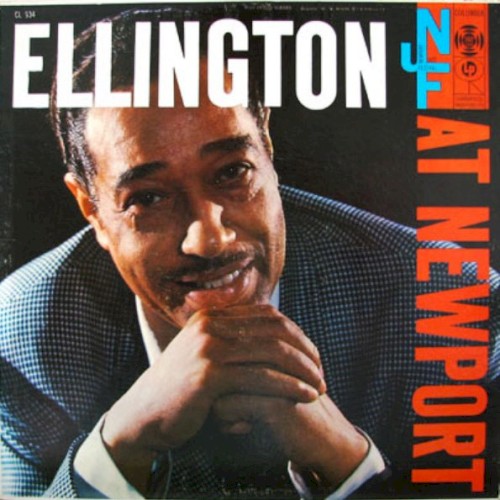
Ellington at Newport (1956)
曲目
- A1Newport Jazz Festival Suite: Festival Junction10:09
- A2Newport Jazz Festival Suite: Blues to Be There8:05
- A3Newport Jazz Festival Suite: Newport Up5:33
- B1Jeep's Blues5:12
- B2Diminuendo and Crescendo in Blue14:57
5 首 · 约 44 分钟 · 依据 1956 US 发行的版本,在 MusicBrainz 看这个版本。
介绍
这个词条没有中文维基百科条目,下面是英文维基百科的原文。
Ellington at Newport is a 1956 live jazz album by Duke Ellington and his band of their 1956 concert at the Newport Jazz Festival, a concert which revitalized Ellington's flagging career. Jazz promoter George Wein describes the 1956 concert as "the greatest performance of [Ellington's] career... It stood for everything that jazz had been and could be." It is included in the book 1001 Albums You Must Hear Before You Die, which ranks it "one of the most famous... in jazz history". The original release was partly recreated in the studio after the Ellington Orchestra's festival appearance.
Ellington released a follow-up album also recorded at the Newport Jazz Festival, Newport 1958, two years later.
In 2022, the album was selected by the Library of Congress for preservation in the United States National Recording Registry as being "culturally, historically, or aesthetically significant".
Context
Many big bands folded by the mid-1950s, but Ellington kept his band working, occasionally doing shows in ice-skating rinks to stay busy. The Duke Ellington Orchestra did European tours during the early 1950s, and Ellington was chiefly supporting the band himself through royalties earned on his popular compositions of the 1920s to the 1940s. At the time of the festival, the band did not even have a record deal. Afterwards, Ellington once again had a contract with Columbia Records.
Performance
Beginning
Duke and his orchestra arrived to play at the Newport Jazz Festival at a time when jazz festivals were a fairly new innovation. Ellington's band was the first and last group to play at the Newport Festival. The first, short set began at 8:30 and included "The Star-Spangled Banner", "Black and Tan Fantasy" and "Tea for Two". This set was played without a few of the band's members as they were unable to be found at the start of the show. Bassist Al Lucas replaced Jimmy Woode for the first set.
After performances by the other groups, the remainder of the band was located and the real performance began. Duke asked trumpeter Herbie Jones to join the band on stage, as a ''flop'' insurance in case something went wrong. Duke led off with "Take the 'A' Train", followed by a new composition by Duke and Billy Strayhorn, a suite of three pieces: "Festival Junction", "Blues to Be There", and "Newport Up". This suite was intended to be the showstopper, but the reception was not as enthusiastic as was hoped.
Following the Festival suite, Duke called for Harry Carney's baritone saxophone performance of "Sophisticated Lady". Then the orchestra played "Day In, Day Out". Following this, Duke announced that they were pulling out "some of [their] 1938 vintage": "Diminuendo and Crescendo in Blue" joined by an improvised interval, which Duke announced would be played by tenor saxophonist Paul Gonsalves.
The Gonsalves solo
Ellington had been experimenting with the reworking for several years before the Newport performance; a release of one of his Carnegie Hall concerts of the 1940s presented the two old blues joined by a wordless vocal passage, "Transbluecency," but in time he chose to join the pair by a saxophone solo, handing it to Gonsalves, experimenting with it in shorter performances before the Newport show, where Ellington is believed to have told Gonsalves to blow as long as he felt like blowing when the solo slot came. It came after two choruses of an Ellington piano break at what was formerly the conclusion of "Diminuendo in Blue."
As performed at Newport, the experiment ended up revamping the Ellington reputation and fortune for the rest of Ellington's life. The previous experiments culminated in a 27-chorus solo by Gonsalves — simple, but powerful — backed only by bassist Jimmy Woode, drummer Sam Woodyard, and Ellington himself pounding punctuating piano chords and (with several audible band members as well) hollering urgings-on ("Come on, Paul — dig in! Dig in!") to his soloist. The normally sedate crowd was on their feet dancing in the aisles, reputedly provoked by a striking platinum blonde woman in a black evening dress, Elaine Anderson, getting up and dancing enthusiastically. When the solo ended and Gonsalves collapsed in exhaustion, Ellington himself took over for two choruses of piano solo before the full band returned for the "Crescendo in Blue" portion, finishing with a rousing finale featuring high-note trumpeter Cat Anderson.
Ending
After that performance, pandemonium took over. Duke calmed the crowd by announcing: "If you've heard of the saxophone, then you've heard of Johnny Hodges." Duke's best known alto saxophonist then played two of his most famous numbers in "I Got It Bad (and That Ain't Good)" followed by "Jeep's Blues". Still the crowd refused to disperse so Duke called for Ray Nance to sing "Tulip or Turnip". The festival's organizers tried to cut off the show at this point but once again were met with angry refusals to end the evening.
正文摘自英文维基百科「Ellington at Newport」,按 CC BY-SA 4.0 使用;删去了参考文献、外部链接、表格和图片;篇幅所限只节选了前面一部分,全文见原条目。
资料卡
- 作品性质
- 音乐专辑
- 表演者
- 杜克·艾灵顿
- 发行日期
- 1956 年
- 流派
- 爵士乐
- 语言
- 英语
- 唱片公司
- 哥伦比亚唱片
- 制作人
- George Avakian
资料来自 Wikidata Q1332214(CC0)。
制作名单
- 厂牌
- Columbia
- 录音室
- 录音:Freebody Park(Newport)
演奏与演唱
- 小号
- William “Cat” Anderson、Willie Cook、Ray Nance、克拉克·泰瑞
- 上低音萨克斯
- Harry Carney
- 钢琴
- 杜克·艾灵顿
- 次中音萨克斯
- Paul Gonsalves、Jimmy Hamilton(第 A1、A2、A3、B2 首)
- 中音萨克斯
- Johnny Hodges、Russell Procope(第 A1、A2、A3、B2 首)
- 长号
- Quentin Jackson、Britt Woodman、John Sanders(第 A1、A2、A3、B2 首)
- 低音提琴
- Jimmy Woode
- 鼓
- Sam Woodyard
- 单簧管
- Jimmy Hamilton(第 B1 首)、Russell Procope(第 B1 首)
- valve trombone
- John Sanders(第 B1 首)
词曲与编曲
- 作曲
- 杜克·艾灵顿、Billy Strayhorn(第 A1、A2、A3 首)、Johnny Hodges(第 B1 首)
名单来自 MusicBrainz(CC0)这一发行版本的关系数据,由志愿者录入,不一定齐全。
更多资料与乐评
在哪听
杜克·艾灵顿 的其他专辑
艺人页 ›
相似的专辑