乐单
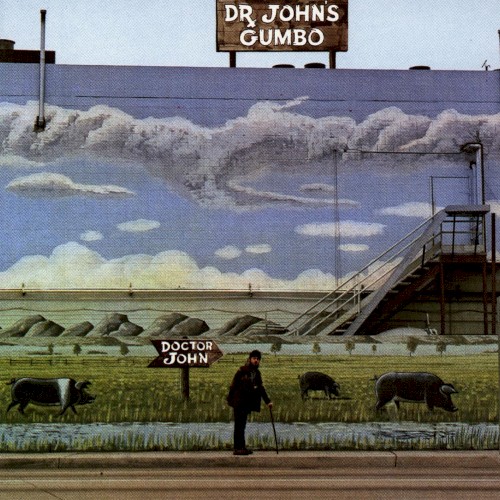
Dr. John's Gumbo (1972)
- 艺人
- 约翰博士
- 发行
- 1972-04-20
- 类型
- 专辑
- 唱片公司
- 阿特科
- 制作人
- 杰瑞·维克斯勒、Harold Battiste
- 版本
- MusicBrainz 上有 7 个发行版本
曲目
- A1Iko Iko4:15
- A2Blow Wind Blow3:15
- A3Big Chief3:26
- A4Somebody Changed the Lock2:43
- A5Mess Around3:13
- A6Let the Good Times Roll3:58
- B1Junko Partner4:30
- B2Stack‐A‐Lee3:29
- B3Tipitina2:09
- B4Those Lonely Lonely Nights2:32
- B5Huey Smith Medley: a) High Blood Pressure / b) Don’t You Just Know It / c) Well I’ll Be John Brown3:19
- B6Little Liza Jane2:59
12 首 · 约 40 分钟 · 依据 1972-04-20 US 发行的版本,在 MusicBrainz 看这个版本。
介绍
这个词条没有中文维基百科条目,下面是英文维基百科的原文。
Dr. John's Gumbo is the fifth album by the New Orleans singer and pianist Dr. John. Released in 1972, it is a tribute to the music of his native city. The album is a collection of classic New Orleans tunes.
In 2012, the album was ranked number 404 on Rolling Stone's list of "The 500 Greatest Albums of All Time". The album cover was shot in front of the huge mural adorning the wall of The Farmer John Company (also seen in the movie Carrie), located at Soto Street and Vernon in Vernon, California. The album was on the Billboard 200 for eleven weeks, charting as high as No. 112 on June 24, 1972.
Background
Whereas his previous album, The Sun, Moon & Herbs (1971), featured a blend of psychedelic rock and Voodoo imagery, this album saw Dr. John return to the musical roots of his hometown, New Orleans. It was co-produced by Harold Battiste and Jerry Wexler, and recorded at Sound City Studios in Van Nuys, California.
Dr. John had been active as a session musician in the New Orleans music scene under his birth name, Mac Rebennack, and was particularly influenced by the music of Professor Longhair. Through this album, he paid tribute to the New Orleans rhythm and blues he had encountered during the late 1940s and 1950s. The album features reinterpretations of classic New Orleans songs, reducing the psychedelic elements prominent on his previous releases in favor of arrangements centered on piano, horns, and the rhythm section. It is regarded as a turning point in Dr. John's career, marking a shift away from the eccentric and mystical stage persona of his early years toward a more straightforward and traditional musical identity rooted in the New Orleans rhythm and blues tradition.
The recording sessions featured several musicians from the New Orleans music scene. Saxophonists Lee Allen and Harold Battiste, cornetist Melvin Lastie, and pianist and organist Ronnie Barron were among the participants. Jimmy Calhoun played bass, while Freddie Staehle played drums. Guitarists Ken Klimak and Alvin Robinson also contributed, and Richard Washington played percussion. Several female vocalists provided backing vocals, adding to the lively atmosphere characteristic of New Orleans rhythm and blues.
The album cover was photographed in front of a large mural on the exterior wall of the Farmer John Company building, near the intersection of Soto Street and Vernon Avenue in Vernon, California. The mural later appeared in the film Carrie.
Critical reception
In a July 1972 review published in Creem, Dave Marsh described the album as Dr. John's fifth release, yet one that felt as though it were his debut. He emphasized its shift away from the Voodoo and psychedelic rock elements found in his earlier work, highlighting its focus on New Orleans rhythm and blues.
AllMusic critic Stephen Thomas Erlewine likewise praised the album for reinterpreting New Orleans classics through a combination of early rock and roll, blues, and rhythm and blues, and regarded it as one of Dr. John's finest works.
Personnel
Dr. John – vocals, piano, cornet; guitar on "Let the Good Times Roll"
Lee Allen – tenor saxophone
Ronnie Barron – organ, electric piano, backing vocals; piano on "Let the Good Times Roll"
- Harold Battiste – saxophone; clarinet on "Somebody Changed the Lock"; vocal and horn arrangements
- Moe Bechamin – saxophone, backing vocals
Sidney George – saxophone; harmonica on "Let the Good Times Roll"
- Dave Lastie – saxophone
- Melvin Lastie – trumpet, cornet
- John Ewing – trombone
- Shirley Goodman, Tami Lynn, Robbie Montgomery, Jessica Smith – backing vocals
- Alvin Robinson – guitar, backing vocals
- Ken Klimak – guitar
- Jimmy Calhoun – bass
- Freddie Staehle – drums, percussion
- Richard "Didimus" Washington – percussion
- Technical
- Harold Battiste – producer
- Jerry Wexler – producer
- Keith Olsen, Gary Brandt – engineer
- Tom Wilkes – design, photography
- Barry Feinstein – design, photography
正文摘自英文维基百科「Dr. John's Gumbo」,按 CC BY-SA 4.0 使用;删去了参考文献、外部链接、表格和图片。
资料卡
- 作品性质
- 音乐专辑
- 表演者
- 约翰博士
- 发行日期
- 1972 年 4 月 20 日
- 流派
- 节奏布鲁斯
- 唱片公司
- 阿特科
- 制作人
- 杰瑞·维克斯勒、Harold Battiste
资料来自 Wikidata Q5304188(CC0)。
制作名单
- 厂牌
- ATCO Records(目录号 SD 7006)
演奏与演唱
- 萨克斯
- Lee Allen、Harold Battiste、Moe Bechamin、Sidney George、David Lastie
- 贝斯
- Jimmy Calhoun
- 吉他
- Ken Klimak、Alvin Robinson、约翰博士(第 A6 首)
- 短号
- Melvin Lastie
- 鼓
- Freddie Staehle
- 打击乐
- Richard "Didimus" Washington
- 和声
- Ronnie Barron、Moe Bechamin、Shirley Goodman、Tami Lynn、Robbie Montgomery、Alvin Robinson、Jesse Smith
- 主唱
- 约翰博士
- 电钢琴
- Ronnie Barron(其中 11 首)
- 风琴
- Ronnie Barron(其中 11 首)
- 钢琴
- 约翰博士(其中 10 首)、Ronnie Barron(第 A6 首)
- 单簧管
- Harold Battiste(第 A4 首)
- 长号
- John Ewing(第 A4 首)
- 口琴
- Sidney George(第 A6 首)
词曲与编曲
- 词曲
- Huey “Piano” Smith(第 A2、B5 首)、Johnny Vincent(第 B4、B5 首)、Junior Gordon(第 A2 首)、约翰博士(第 A4 首)、Ahmet Ertegun(第 A5 首)、[traditional](第 B2 首)、Earl King(第 B4 首)
- 作曲
- Earl King(第 A3、A6 首)、James Crawford, Jr.(第 A1 首)、Barbara Anne Hawkins(第 A1 首)、Rosa Lee Hawkins(第 A1 首)、Robert A. Shad(第 B1 首)、Professor Longhair(第 B3 首)、[traditional](第 B6 首)
- 作词
- James Crawford, Jr.(第 A1 首)、Barbara Anne Hawkins(第 A1 首)、Rosa Lee Hawkins(第 A1 首)、Joan Marie Johnson(第 A1 首)、Earl King(第 A6 首)、Robert A. Shad(第 B1 首)、Professor Longhair(第 B3 首)、[traditional](第 B6 首)
- 编曲
- Archibald(第 B2 首)、约翰博士(第 B5 首)
名单来自 MusicBrainz(CC0)这一发行版本的关系数据,由志愿者录入,不一定齐全。
更多资料与乐评
在哪听
约翰博士 的其他专辑
艺人页 ›
相似的专辑
同在 1972 年发行