乐单
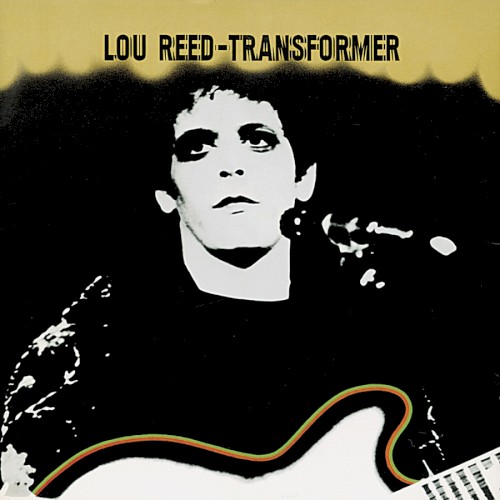
Transformer (1972)
滚石 500(2020) #109滚石 500(2003) #1941001 张专辑
- 艺人
- 卢·里德
- 发行
- 1972-11-08
- 类型
- 专辑
- 唱片公司
- RCA Victor、RCA唱片
- 制作人
- 大卫·鲍伊、麦克・朗森
- 版本
- MusicBrainz 上有 28 个发行版本
曲目
- A1Vicious3:00
- A2Andy’s Chest3:21
- A3Perfect Day3:48
- A4Hangin’ ’Round3:38
- A5Walk on the Wild Side4:17
- B1Make Up3:02
- B2Satellite of Love3:44
- B3Wagon Wheel3:23
- B4New York Telephone Conversation1:36
- B5I’m So Free3:13
- B6Goodnight Ladies4:21
11 首 · 约 37 分钟 · 依据 1972-11-08 US 发行的版本,在 MusicBrainz 看这个版本。
介绍
这个词条没有中文维基百科条目,下面是英文维基百科的原文。
Transformer is the second solo studio album by American musician Lou Reed. Produced by David Bowie and Mick Ronson, the album was released on November 8, 1972 by RCA Records. It is considered an influential landmark of the glam rock genre, anchored by Reed's most successful single, "Walk on the Wild Side", which touched on controversial topics of sexual orientation, gender identity, prostitution, and drug use. Although Reed's self-titled debut solo album had been unsuccessful, Bowie had been an early fan of Reed's former band the Velvet Underground and used his fame to promote Reed, who had not yet achieved mainstream success.
Background
As with its predecessor Lou Reed, Transformer contains songs Reed wrote while in the Velvet Underground (here, four out of eleven). "Andy's Chest" was first recorded by the band in 1969 and "Satellite of Love" demoed in 1970; these versions were released on VU and Peel Slowly and See, respectively. For Transformer, the original up-tempo pace of these songs was slowed down.
"New York Telephone Conversation" and "Goodnight Ladies" were played live during the band's summer 1970 residency at Max's Kansas City; the latter takes its title refrain from the last line of the second section ("A Game of Chess") of T. S. Eliot's modernist poem, The Waste Land: "Good night, ladies, good night, sweet ladies, good night, good night", which is itself a quote from Ophelia in Hamlet.
As in Reed's Velvet Underground days, the connection to artist Andy Warhol remained strong. According to Reed, Warhol told him he should write a song about someone vicious. When Reed asked what he meant by vicious, Warhol replied, "Oh, you know, like I hit you with a flower", resulting in the song "Vicious". Reed wrote in his book, Between Thought and Expression, about his single "Walk on the Wild Side": "They were going to make a musical out of Nelson Algren's book A Walk on the Wild Side. When they dropped the project I took my song and changed the book's characters into people I knew from Warhol's factory. I don’t like to waste things."
Production
Transformer was produced by David Bowie and Mick Ronson, both of whom had been strongly influenced by Reed's work with the Velvet Underground. Bowie had obliquely referenced the Velvet Underground in the cover notes for his album Hunky Dory and regularly performed both "White Light/White Heat" and "I'm Waiting for the Man" in concerts and on the BBC during 1971–1973. He even began recording "White Light/White Heat" for inclusion on Pin Ups, but it was never completed; Ronson ended up using the backing track for his solo album Play Don't Worry in 1974.
Mick Ronson (who was at the time the lead guitarist with Bowie's band, the Spiders from Mars) played a major role in the recording of the album at Trident Studios, London, serving as the co-producer and primary session musician (contributing guitar, piano, recorder and backing vocals), as well as arranger, contributing the string arrangement for "Perfect Day". Reed lauded Ronson's contribution in the Transformer episode of the documentary series Classic Albums, praising the beauty of his work and keeping down the vocal to highlight the strings. The songs on the album are now among Reed's best-known works, including "Walk on the Wild Side", "Perfect Day" and "Satellite of Love", and the album's commercial success elevated him from cult status to become an international star.
Artwork
The cover art was from a Mick Rock photograph that inadvertently became over-exposed as he was printing it in the darkroom. Rock noticed the flaw but decided he liked the serendipitous effect enough to submit the image for the album cover.
According to Rock, "When I showed Lou the contact sheets, he zeroed in on the transformer shot. I made the print myself – as I usually did in those days. The first test I made fell out of focus in the exposure. Lou loved the result. It took me twelve attempts to reproduce this accident for the final larger print for the album cover".
Karl Stoecker (who also shot the first three Roxy Music album covers) took the back cover photo of a woman and a man. The woman is 1960s London supermodel Gala Mitchell. The man is portrayed by Ernie Thormahlen (a friend of Reed). The man appears to have a noticeable erection, although Reed has said this was actually a banana which Thormahlen had stuffed down his jeans before the photo shoot.
正文摘自英文维基百科「Transformer (Lou Reed album)」,按 CC BY-SA 4.0 使用;删去了参考文献、外部链接、表格和图片;篇幅所限只节选了前面一部分,全文见原条目。
资料卡
- 作品性质
- 音乐专辑
- 表演者
- 卢·里德
- 发行日期
- 1972 年 11 月 8 日
- 录制时间
- 1972 年 8 月
- 录音地点
- 三叉戟录音室
- 时长
- 36 分 40 秒
- 流派
- 华丽摇滚
- 语言
- 英语
- 唱片公司
- RCA Victor、RCA唱片
- 制作人
- 大卫·鲍伊、麦克・朗森
资料来自 Wikidata Q631153(CC0)。
制作名单
- 厂牌
- RCA(目录号 LSP-4807)
- 录音室
- 混音:Trident Studios(Soho);录音:Trident Studios(Soho)
制作
- 制作人
- 大卫·鲍伊(第 A1、A2、A3、A5、B2、B4 首)、麦克・朗森(第 A1、A2、A3、A5、B2、B4 首)、卢·里德(第 A5、B2、B4 首)
- 混音
- 大卫·鲍伊(第 A2 首)、卢·里德(第 A2 首)、麦克・朗森(第 A2 首)、Ken Scott(第 A2 首)、Mike Stone(第 A2 首)
演奏与演唱
- 主唱
- 卢·里德
- 大号
- Herbie Flowers(第 B1、B2、B6 首)
- 鼓
- John Halsey(第 A5、B2 首)
- 上低音萨克斯
- Ronnie Ross(第 A5、B6 首)
- 低音提琴
- Herbie Flowers(第 A5 首)
- 电贝斯
- Herbie Flowers(第 A5 首)、Klaus Voormann(第 B2 首)
- 和声
- The Thunder Thighs(第 A5 首)、大卫·鲍伊(第 B2 首)
- 小号
- Trevor Bolder(第 B2 首)
- 电吉他
- 卢·里德(第 B2 首)
- 钢琴
- 麦克・朗森(第 B2 首)
- 竖笛
- 麦克・朗森(第 B2 首)
- 演奏
- Herbie Flowers(第 B6 首)
- 演出
- Herbie Flowers(第 B6 首)
词曲与编曲
- 作曲
- 卢·里德
- 编曲
- 大卫·鲍伊(第 A1、A2、A3、A5、B2、B4 首)、卢·里德(第 A1、A2、A3、A5、B2、B4 首)、麦克・朗森(第 A1、A2、A3、A5、B2、B4 首)、Herbie Flowers(第 B6 首)
- 器乐编曲
- 麦克・朗森
- 作词
- 卢·里德
名单来自 MusicBrainz(CC0)这一发行版本的关系数据,由志愿者录入,不一定齐全。
更多资料与乐评
在哪听
卢·里德 的其他专辑
艺人页 ›


相似的专辑

同在 1972 年发行