乐单
曲目
- 1Sunny Sunday2:37
- 2Sex Kills3:57
- 3How Do You Stop4:09
- 4Turbulent Indigo3:34
- 5Last Chance Lost3:15
- 6The Magdalene Laundries4:04
- 7Not to Blame4:18
- 8Borderline4:48
- 9Yvette in English5:16
- 10The Sire of Sorrow (Job's Sad Song)7:08
10 首 · 约 43 分钟 · 依据 1994 US 发行的版本,在 MusicBrainz 看这个版本。
介绍
这个词条没有中文维基百科条目,下面是英文维基百科的原文。
Turbulent Indigo is the fifteenth album by Canadian singer-songwriter Joni Mitchell, released in 1994.
The album won a Grammy Award for Best Pop Album. John Milward, writing for Rolling Stone, wrote that it was Mitchell's "best album since the mid-'70s".
As of December 2007, the album has sold 311,000 copies in the US.
Background
The album marked her return to Warner Music (formerly WEA) distribution after her previous album, Night Ride Home, was distributed by MCA for its then-newly purchased subsidiary Geffen Records (which, prior to the sale to MCA, had distributed through WEA).
Music
The song "Turbulent Indigo" refers to van Gogh, while describing the mental turmoil both he and Mitchell face in the creative process. The song "Not to Blame" was rumored to be about Mitchell's fellow singer-songwriter and former lover Jackson Browne, who was alleged to have beaten his girlfriend, actress Daryl Hannah.
Mitchell also takes in non-personal issues, notably in the song "Magdalene Laundries", which recounts the sufferings of Irish women once consigned to Magdalen Asylums run by the Roman Catholic Church and made to work in the asylums' laundries. Similarly, the song "Sex Kills" referenced a number of late 20th century topical issues, including violence, AIDS, global warming and consumerism.
Artwork
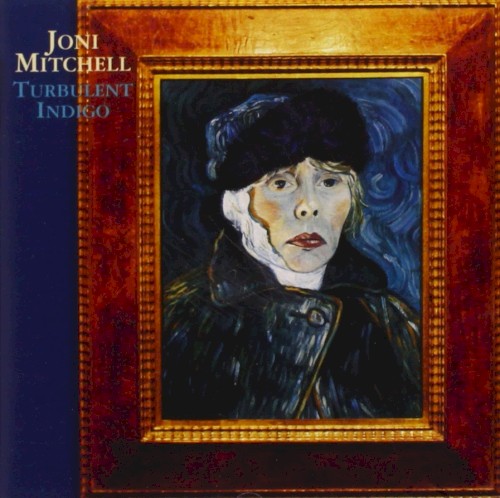
According to Matt Mitchell of Paste Magazine, the album's cover artwork features a self portrait of Mitchell "styl[ing] herself as a Vincent Van Gogh type."
Critical reception
Turbulent Indigo received critical acclaim. Q's Tom Doyle called the album a "welcome return to the atmospherics and acoustic terrain she's best known for", further writing that "The majority of the tracks here recall the wafting soundscapes of 1976's Hejira, with gentle, controlled feedback, Pastorius-styled bass, Wayne Shorter's tumbling saxophone patterns and walls of acoustic guitars providing a dramatic backdrop for Mitchell's bold lyrical imagery."
Personnel
- Joni Mitchell – vocals, guitar, keyboards
- Larry Klein – organ, bass
- Wayne Shorter – soprano saxophone on tracks: 1, 4, 7, 9, 10
Jim Keltner – drums on "Sunny Sunday"
- Carlos Vega – drums on tracks: 3, 4, 7
- Michael Landau – electric guitar on tracks: 2, 3
- Greg Leisz – pedal steel guitar on tracks: 7, 8
Steuart Smith – guitar on "How Do You Stop"
Seal – vocals on "How Do You Stop"
Bill Dillon – synthesizer on "Yvette in English"
Charles Valentino – backing vocals on "Yvette in English"
Kris Kello – backing vocals on "Yvette in English"
正文摘自英文维基百科「Turbulent Indigo」,按 CC BY-SA 4.0 使用;删去了参考文献、外部链接、表格和图片。
资料卡
- 作品性质
- 音乐专辑
- 表演者
- 琼尼·米歇尔
- 发行日期
- 1994 年 10 月 25 日
- 流派
- 另类摇滚、爵士乐民谣
- 语言
- 英语
- 唱片公司
- 庇护所唱片公司
- 制作人
- 琼尼·米歇尔
资料来自 Wikidata Q1091192(CC0)。
制作名单
- 厂牌
- Reprise Records(目录号 9 45786-2)
演奏与演唱
- 演唱
- 琼尼·米歇尔、席尔(第 3 首)
- 贝斯
- Larry Klein(第 1、6、7、8、9 首)
- 高音萨克斯
- 韦恩·肖特(第 1、4、7、9、10 首)
- 吉他
- 琼尼·米歇尔(第 2、4、10 首)
- 键盘
- 琼尼·米歇尔(第 2、4、10 首)、Larry Klein(第 4 首)
- 打击乐
- 琼尼·米歇尔(第 2、4、10 首)、Larry Klein(第 2、10 首)
- 鼓
- Carlos Vega(第 3、4、7 首)、Jim Keltner(第 1 首)
- 电吉他
- Michael Landau(第 2、3 首)、Steuart Smith(第 3、10 首)
- 吉他类
- 琼尼·米歇尔(第 3、5 首)
- 踏板钢棒吉他
- Greg Leisz(第 7、8 首)
- 风琴
- Larry Klein(第 3 首)、Bill Dillon(第 9 首)
- 钢琴
- 琼尼·米歇尔(第 7 首)
- 和声
- Kris Kello(第 9 首)、Charles Valentino(第 9 首)
词曲与编曲
- 作曲
- 琼尼·米歇尔(其中 9 首)、Dan Hartman(第 3 首)、Charlie Midnight(第 3 首)、大卫·克罗斯比(第 9 首)
名单来自 MusicBrainz(CC0)这一发行版本的关系数据,由志愿者录入,不一定齐全。
更多资料与乐评
在哪听
琼尼·米歇尔 的其他专辑
艺人页 ›


相似的专辑



同在 1994 年发行