乐单
曲目
- A1Coyote5:00
- A2Amelia6:00
- A3Furry Sings the Blues5:03
- A4A Strange Boy4:15
- A5Hejira6:35
- B1Song for Sharon8:30
- B2Black Crow4:20
- B3Blue Motel Room5:03
- B4Refuge of the Roads6:37
9 首 · 约 51 分钟 · 依据 1976-11 US 发行的版本,在 MusicBrainz 看这个版本。
介绍
这个词条没有中文维基百科条目,下面是英文维基百科的原文。
Hejira is the eighth studio album by Canadian singer-songwriter Joni Mitchell, released in 1976 on Asylum Records. Its material was written during a period of ongoing travel in late 1975 and early 1976, and reflects Mitchell's experiences on the road during that time. It is characterized by lyrically dense, sprawling songs and musical backing by several jazz-oriented instrumentalists, most prominently fretless bass player Jaco Pastorius, guitarist Larry Carlton, and drummer John Guerin.
The album did not sell as well as its predecessors, peaking at No. 22 in Mitchell's native Canada. It reached No. 13 on the Billboard 200 pop album chart in the United States, where it was certified gold by the RIAA, and No. 11 in the UK, where it attained a silver certification. Critically, the album was generally well received, and in the years since its release, Hejira has been considered one of the high marks of her career. The lead track "Coyote" was released as a single.
Background
According to Mitchell, the album was written during or after three journeys she took in late 1975 and the first half of 1976. The first was a stint as a member of Bob Dylan's Rolling Thunder Revue in late 1975. During this time, she became a frequent cocaine user. Then, in February 1976, Mitchell was scheduled to play about six weeks of concert dates across the US promoting The Hissing of Summer Lawns. However, the relationship between Mitchell and her boyfriend John Guerin (who was her drummer on the string of dates) had soured. Tensions became so fraught that the tour was abandoned about halfway through.
The third trip came soon after when Mitchell traveled across America with two men, one of them a former lover from Australia. This trip inspired six of the songs on the album. She drove with her two friends from Los Angeles to Maine, and then went back to California alone via Florida and the Gulf of Mexico. On her way back home, Mitchell met with the Tibetan Buddhist master Chogyam Trungpa in Colorado, an event she credited with curing her cocaine addiction and leaving her in a selfless "awakened state" that lasted three days.
During some of her solo journeys, Mitchell donned a red wig and sunglasses, and told the various strangers she met that her name was either "Charlene Latimer" or "Joan Black". Despite the disguise, Mitchell was still sometimes recognized. She traveled without a driver's licence and stayed behind truckers, relying on their habit of signaling when the police were ahead of them; consequently, she only drove in daylight hours.
Recording
During the recording of her albums Court and Spark and The Hissing of Summer Lawns, Mitchell had grown increasingly frustrated by the rock session musicians who had been hired to perform her music. "There were grace notes and subtleties and things that I thought were getting kind of buried." The session musicians in turn recommended that Mitchell start looking for jazz instrumentalists to perform on her records. In addition, her relationship with the drummer John Guerin, which lasted through a significant portion of the mid-1970s, influenced her decision to move more towards experimental jazz music and further away from her folk and pop roots.
After recording the basic tracks that would become Hejira, Mitchell met the bassist Jaco Pastorius and they formed an immediate musical connection. Mitchell was dissatisfied with what she called the "dead, distant bass sound" of the 1960s and early 1970s, and was beginning to wonder why the bass always had to play the root of a chord. She overdubbed Pastorius's bass parts on four of the tracks on Hejira and released the album on November 21, 1976.
Dominated by Mitchell's guitar and Pastorius's fretless bass, the album drew on a range of influences but was more cohesive and accessible than some of her later, more jazz-oriented work. "Coyote", "Amelia", and "Hejira" became concert staples, especially after being featured on the live album Shadows and Light, alongside "Furry Sings the Blues" and "Black Crow".
Album title
The album title is an unusual transliteration of the Arabic word more commonly rendered as Hijrah or Hegira, which means "departure" or "exodus", usually referring to the migration of the Islamic prophet Muhammad and his companions from Mecca to Medina in 622. Mitchell later stated that when she chose the title, she was looking for a word that meant "running away with honor". She found the word "hejira" while reading the dictionary, and was drawn to the "dangling j, like in Aja ... it's leaving the dream, no blame".
Cover art
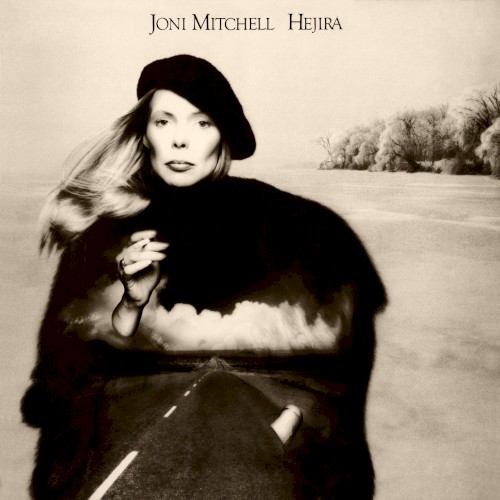
The portrait of Mitchell on the front cover was taken by Norman Seeff and the other photographs were taken by Joel Bernstein at Lake Mendota in Madison, Wisconsin, after an ice storm. The figure skater Toller Cranston appears on the back cover. During a 1994 interview with Rolling Stone, Mitchell cited the cover of Hejira as one of which she was particularly proud: "A lot of work went into that."
正文摘自英文维基百科「Hejira (album)」,按 CC BY-SA 4.0 使用;删去了参考文献、外部链接、表格和图片;篇幅所限只节选了前面一部分,全文见原条目。
资料卡
- 作品性质
- 音乐专辑
- 表演者
- 琼尼·米歇尔
- 发行日期
- 1976 年 11 月
- 流派
- 民谣摇滚、爵士乐民谣、滑顺爵士乐、融合爵士乐
- 唱片公司
- 庇护所唱片公司
- 制作人
- 琼尼·米歇尔
资料来自 Wikidata Q1035073(CC0)。
制作名单
- 厂牌
- Asylum Records(目录号 7E-1087)
- 录音室
- 录音:A&M Recording Studios(Hollywood)
制作
- 混音
- Henry Lewy、琼尼·米歇尔
- 录音
- Henry Lewy、Steve Katz
- 母带处理
- Bernie Grundman
- 制作人
- 琼尼·米歇尔
- 助理录音
- Steve Katz
演奏与演唱
- 演唱
- 琼尼·米歇尔
- 吉他
- 琼尼·米歇尔(其中 8 首)、赖瑞·卡尔顿(第 A1、A2、A4、B2 首)
- 贝斯
- 杰可·帕斯透瑞斯(第 A1、A5、B2、B4 首)、Max Bennett(第 A3、B1 首)、Chuck Domanico(第 B3 首)
- 鼓
- John Guerin(第 A3、B1、B3、B4 首)
- 打击乐
- Bobbye Hall(第 A1、A4、A5 首)
- 颤音琴
- Victor Feldman(第 A2 首)
- 口琴
- 尼尔·杨(第 A3 首)
- 单簧管
- Abe Most(第 A5 首)
- 原声吉他
- 赖瑞·卡尔顿(第 B3 首)
- 电吉他
- 琼尼·米歇尔(第 B3 首)
- 铜管
- Chuck Findley(第 B4 首)、汤姆·斯科特(第 B4 首)
词曲与编曲
- 作曲
- 琼尼·米歇尔
- 作词
- 琼尼·米歇尔
包装与设计
- 美术指导
- Glen Christensen
- 平面设计
- 琼尼·米歇尔
- 摄影
- Joel Bernstein、Norman Seeff、Keith Williamson
名单来自 MusicBrainz(CC0)这一发行版本的关系数据,由志愿者录入,不一定齐全。
更多资料与乐评
在哪听
琼尼·米歇尔 的其他专辑
艺人页 ›

相似的专辑


同在 1976 年发行