乐单
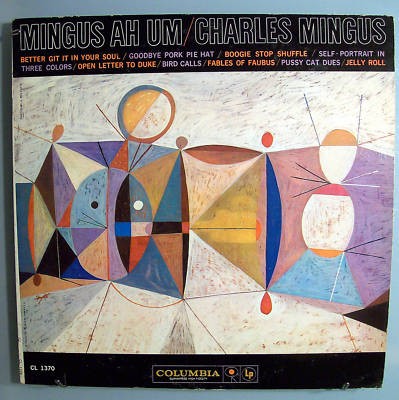
Mingus Ah Um (1959)
曲目
- A1Better Git It in Your Soul7:23
- A2Goodbye Pork Pie Hat4:47
- A3Boogie Stop Shuffle3:44
- A4Self-Portrait in Three Colors3:06
- A5Open Letter to Duke4:56
- B1Bird Calls3:14
- B2Fables of Faubus8:14
- B3Pussy Cat Dues6:29
- B4Jelly Roll4:02
9 首 · 约 46 分钟 · 依据 1959 US 发行的版本,在 MusicBrainz 看这个版本。
介绍
这个词条没有中文维基百科条目,下面是英文维基百科的原文。
Mingus Ah Um is a studio album by the American jazz musician Charles Mingus. It was recorded in May 1959 and released that October through Columbia Records. It was Mingus' first album recorded for Columbia.
The album was inducted into the Grammy Hall of Fame in 2013. It was ranked 380th on the 2020 edition of Rolling Stone's 500 Greatest Albums of All Time. The cover features a painting by S. Neil Fujita.
The title is a corruption of an imaginary Latin declension. It is common for Latin students to memorize Latin adjectives by first saying the masculine nominative (usually ending in "-us"), then the feminine nominative ("-a"), and finally the neuter nominative singular ("-um")—implying a transformation of his name, Mingus, Minga, Mingum.
Composition
The Penguin Guide to Jazz on CD calls this album "an extended tribute to ancestors", and Mingus' musical forebears figure largely throughout. "Better Git It In Your Soul" is inspired by gospel singing and preaching like that which Mingus would have heard as a child, while "Goodbye Pork Pie Hat" is a tribute to saxophonist Lester Young, who died shortly before the album was recorded. The origin and nature of "Boogie Stop Shuffle" is self-referential: a twelve-bar blues with four themes and a boogie bass backing that passes from stop time to shuffle and back.
"Self-Portrait in Three Colors" was originally written for John Cassavetes' first film as director, Shadows, but was not used for budgetary reasons. "Open Letter to Duke" is a tribute to Duke Ellington, and draws on three of Mingus' earlier pieces ("Nouroog", "Duke's Choice", and "Slippers"). "Jelly Roll" is a reference to Jelly Roll Morton and features a quote of Sonny Rollins' "Sonnymoon for Two" during Horace Parlan's piano solo. "Bird Calls", however, "wasn't supposed to sound like Charlie Parker [who was nicknamed "Bird"]. It was supposed to sound like birds – the first part."
"Fables of Faubus" is named after Governor of Arkansas Orval Faubus, infamous for his 1957 stand against the integration of public schools in Little Rock, Arkansas. Columbia Records refused to allow the politically-charged lyrics Mingus had written to be included on the album, and so the song was recorded as an instrumental. In 1961, a version with the lyrics was released on Charles Mingus Presents Charles Mingus as "Original Faubus Fables".
Edited and unedited versions
The original Columbia Records LP release of the album featured edited versions of six of the nine compositions. For these tracks, from one to three minutes of the performances were removed, both to meet the time constraints of the LP format and because producer Teo Macero felt the pieces were more effective in edited form. Unedited versions of these pieces were first released in 1979, on LP. The first widely-available CD edition of the album, 1987's "Columbia Jazz Masterpieces" edition, used the original LP edits. The edited version has been reissued on compact disc subsequent to 1987, including a 2019 release by Mobile Fidelity Sound Lab. The unedited version of the album was first widely released on compact disc in 1998 as part of the Sony Legacy series, and has remained available through additional compact disc reissues.
Reception
Mingus Ah Um was one of fifty recordings chosen by the Library of Congress to be added to the National Recording Registry in 2003. The album was ranked number 380 of the Top 500 Albums of All-Time by Rolling Stone in 2020.
50th anniversary reissue
In 2009, Sony's Legacy Recordings released a special 2-disc 50th Anniversary Edition of Mingus Ah Um. In addition to the complete album, the Legacy Edition includes an alternative take of each of three tracks: "Bird Calls" (4:54), "Better Git It In Your Soul" (8:30), and "Jelly Roll" (6:41). The Legacy Edition of Mingus Ah Um also includes Mingus Dynasty, its companion album recorded later in 1959 (with unedited versions of four tracks - "Slop", "Song With Orange", "Gunslinging Bird", and "Things Ain't What They Used To Be" - shortened on the original LP release, as well as the bonus track "Strollin'"). These alternate takes were originally released on The Complete 1959 CBS Charles Mingus Sessions on the Mosaic label in 1993.
Personnel
John Handy – alto saxophone (1, 6, 7, 9, 10, 11, 12), clarinet (8), tenor saxophone (2)
Booker Ervin – tenor saxophone
Shafi Hadi – tenor saxophone (2, 3, 4, 7, 8, 10), alto saxophone (1, 5, 6, 9, 12)
Willie Dennis – trombone (3, 4, 5, 12)
Jimmy Knepper – trombone (1, 7, 8, 9, 10)
Horace Parlan – piano
Charles Mingus – double bass, piano (10)
Dannie Richmond – drums
正文摘自英文维基百科「Mingus Ah Um」,按 CC BY-SA 4.0 使用;删去了参考文献、外部链接、表格和图片。
资料卡
- 作品性质
- 音乐专辑
- 表演者
- 查尔斯·明格斯
- 发行日期
- 1959 年 10 月
- 录音地点
- CBS30街录音室
- 流派
- 后波普
- 语言
- 没有该语言的内容
- 唱片公司
- 哥伦比亚唱片
- 制作人
- 蒂奥·马塞洛
资料来自 Wikidata Q1787154(CC0)。
制作名单
- 厂牌
- Columbia(目录号 CL 1370)
制作
- 制作人
- Teo Macero(第 A1、A4、B2 首)
演奏与演唱
- 次中音萨克斯
- Booker Ervin、Shafi Hadi(第 A1、A3、A4、B2、B3 首)、John Handy(第 A2 首)
- 低音提琴
- 查尔斯·明格斯
- 钢琴
- Horace Parlan
- 鼓
- Dannie Richmond
- 中音萨克斯
- John Handy(其中 7 首)、Shafi Hadi(第 A5、B1、B4 首)
- 长号
- Jimmy Knepper(第 A1、B2、B3、B4 首)、Willie Dennis(第 A3、A4、A5 首)
- 单簧管
- John Handy(第 B3 首)
词曲与编曲
- 作曲
- 查尔斯·明格斯
名单来自 MusicBrainz(CC0)这一发行版本的关系数据,由志愿者录入,不一定齐全。
更多资料与乐评
在哪听
查尔斯·明格斯 的其他专辑
艺人页 ›
相似的专辑
同在 1959 年发行