乐单
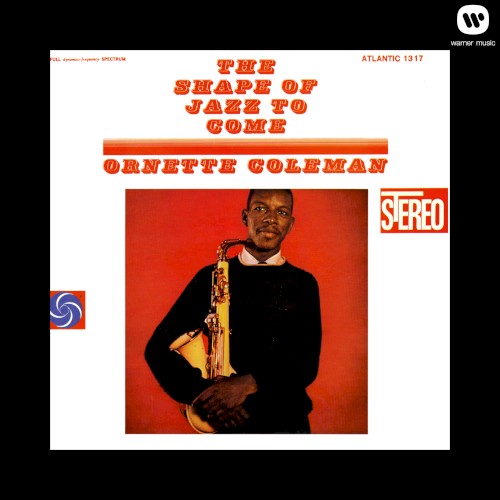
The Shape of Jazz to Come (1959)
滚石 500(2020) #417滚石 500(2003) #246
- 艺人
- 奥尼特·科尔曼
- 发行
- 1959-10
- 类型
- 专辑
- 唱片公司
- 大西洋唱片
- 制作人
- 内苏希·艾特根
- 版本
- MusicBrainz 上有 22 个发行版本
曲目
- A1Lonely Woman5:02
- A2Eventually4:23
- A3Peace9:05
- B1Focus on Sanity6:52
- B2Congeniality6:48
- B3Chronology6:03
6 首 · 约 38 分钟 · 依据 1959 US 发行的版本,在 MusicBrainz 看这个版本。
介绍
这个词条没有中文维基百科条目,下面是英文维基百科的原文。
The Shape of Jazz to Come is the third studio album by the American jazz musician Ornette Coleman. Released on Atlantic Records in November 1959, it was his debut on the label and his first album featuring the quartet of himself, trumpeter Don Cherry, bassist Charlie Haden, and drummer Billy Higgins. The recording session for the album took place on May 22, 1959, at Radio Recorders in Hollywood. Although Coleman initially wished for the album to be titled Focus on Sanity after its fourth track, producer Nesuhi Ertegun suggested the final title, feeling that it would give consumers "an idea about the uniqueness of the LP."
In 2012, the Library of Congress added The Shape of Jazz to Come to the National Recording Registry. The album was included in all three editions of the Rolling Stone list of the 500 greatest albums of all time. AllMusic called it one of the 20 essential free jazz albums. The album was inducted into the Grammy Hall of Fame in 2015.
Background
From 1948 to 1958, Coleman moved between New Orleans, his hometown of Fort Worth, Texas, and Los Angeles, working various jobs and developing his own unique sound that was often met with hostility. His approach initially made it difficult for him to make ends meet by playing music. While employed as an elevator operator in Los Angeles, he studied music theory and harmony and developed an idiosyncratic take on country blues and folk forms.
Coleman's big break came in Los Angeles when he caught the attention of bassist Percy Heath and pianist John Lewis of the Modern Jazz Quartet. Lewis encouraged Coleman and his trumpeter, Don Cherry, to attend the Lenox School of Jazz summer program in Massachusetts in 1959, at which Lewis was the director. Lewis also secured Coleman a deal with Atlantic Records, which paid his tuition at the Lenox School. Though both Coleman and Cherry were already rather accomplished by this point in their careers, Lewis wanted to use their attendance at Lenox to generate buzz amongst jazz circles. Their presence at the school was not without friction amongst students and faculty alike, but in the end, their attending the school accomplished what Lewis hoped to achieve. Coleman was subsequently booked by Lewis to play at the 1959 Monterey Jazz Festival in California.
In June 1959, Coleman suggested to Atlantic jazz producer Nesuhi Ertegun that he was considering abandoning music in order to study religion. Ertegun, confident of Coleman's potential, urged him to reconsider.
Content
Coleman's quartet, like Gerry Mulligan's, was unusual in that it did not employ a chordal instrument such as a piano or guitar. Each composition contains a brief thematic statement, then several minutes of free improvisation, followed by a repetition of the main theme. While this resembles the conventional head-solo-head structure of bebop, it abandons the use of chord structures. The Shape of Jazz to Come found Coleman and his quartet elaborating on the sound and themes he had been developing throughout his career.
One prominent feature of Coleman's signature sound was that he played a plastic Grafton saxophone, which contributed to the harshness of his timbre. He coined the term "harmolodic", a combination of harmony, movement, and melody, to describe his philosophy of improvisation which heavily emphasized melody rather than harmony. It was early in his career, in an attempt to further emphasize focus on melody over harmony, that he stopped including a piano as a part of his ensembles.
Coleman continues with this tradition on The Shape of Jazz to Come, dispensing with harmonic accompaniment and focusing solely on improvised melodies and variations on themes and motifs. His use of microtonal intervals was central to his sound, and he even went as far as to suggest that the same pitch should sound different when played in different contexts, stating that "jazz is the only music in which the same note can be played night after night, but differently each time". The album was a breakthrough and helped to establish the free jazz movement. Later avant-garde jazz was often very different from Coleman's work, but the work helped to lay the foundation upon which much subsequent avant-garde and free jazz would be built.
"Lonely Woman"
The album contains one of the few Coleman compositions to achieve jazz standard status, "Lonely Woman". Coleman was moved to compose the song when, while on a lunch break from his job in a department store stock room in Los Angeles in the early 1950s, he came across a photograph of a woman in a gallery. Coleman describes the photograph as follows: In the background there was everything you could imagine that was wealthy – all in her background – but she was so sad. And I said, 'Oh my goodness. I understand this feeling. I have not experienced this wealth, but I understand the feeling.' I went home and wrote 'Lonely Woman'... I related the condition to myself, wrote this song, and ever since it has grown and grown and grown.
正文摘自英文维基百科「The Shape of Jazz to Come」,按 CC BY-SA 4.0 使用;删去了参考文献、外部链接、表格和图片;篇幅所限只节选了前面一部分,全文见原条目。
资料卡
- 作品性质
- 音乐专辑
- 表演者
- 奥尼特·科尔曼
- 发行日期
- 1959 年 10 月
- 流派
- 自由爵士
- 唱片公司
- 大西洋唱片
- 制作人
- 内苏希·艾特根
资料来自 Wikidata Q930325(CC0)。
制作名单
- 厂牌
- Atlantic(目录号 1317)
制作
- 录音
- Dayton “Bones” Howe
演奏与演唱
- 短号
- Don Cherry
- 中音萨克斯
- 奥尼特·科尔曼
- 低音提琴
- 查理·海登
- 鼓
- Billy Higgins
词曲与编曲
- 作曲
- 奥尼特·科尔曼
名单来自 MusicBrainz(CC0)这一发行版本的关系数据,由志愿者录入,不一定齐全。
更多资料与乐评
在哪听
奥尼特·科尔曼 的其他专辑
艺人页 ›




相似的专辑





同在 1959 年发行