乐单
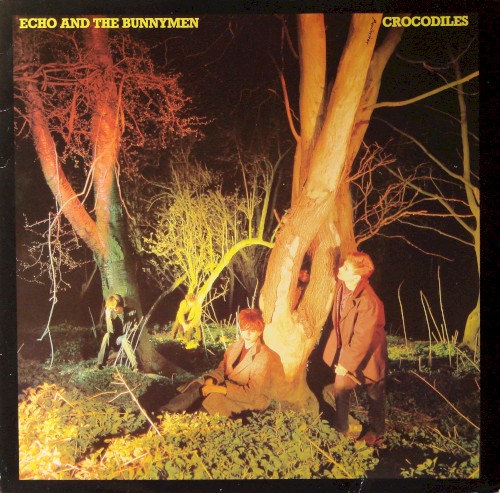
Crocodiles (1980)
曲目
- A1Going Up3:59
- A2Do It Clean2:47
- A3Stars Are Stars2:48
- A4Pride2:42
- A5Monkeys2:50
- A6Crocodiles2:41
- B1Rescue4:30
- B2Villiers Terrace2:46
- B3Read It in Books2:33
- B4Pictures on my Wall2:54
- B5All That Jazz2:49
- B6Happy Death Men4:57
12 首 · 约 38 分钟 · 依据 1980 US 发行的版本,在 MusicBrainz 看这个版本。
介绍
这个词条没有中文维基百科条目,下面是英文维基百科的原文。
Crocodiles is the debut album by the English post-punk band Echo & the Bunnymen. It was released on 18 July 1980 in the United Kingdom and on 17 December 1980 in the United States. The album reached number 17 on the UK Albums Chart. "Pictures on My Wall" and "Rescue" had previously been released as singles.
Recorded at Eden Studios in London and at Rockfield Studios near Monmouth, Crocodiles was produced by Bill Drummond and David Balfe, while Ian Broudie had already produced the single "Rescue". The album received favourable reviews from the music press, receiving four out of five stars by both Rolling Stone and Blender magazines.
Background and recording
Echo & the Bunnymen formed in 1978 and originally consisted of Ian McCulloch (vocals and rhythm guitar), Will Sergeant (lead guitar), Les Pattinson (bass) and a drum machine. They released their debut single, "The Pictures on My Wall", in May 1979 on the independent label Zoo Records. The band then signed with WEA subsidiary label Korova and were persuaded to employ a drummer. Pete de Freitas subsequently joined the band, and in early 1980 they recorded their second single, "Rescue". The single was recorded at Eden Studios in London and produced by fellow Liverpudlian and ex-member of Big in Japan Ian Broudie.
A British tour followed in June 1980 before the band went to Rockfield Studios to record their debut album. Despite talk of the American singer Del Shannon being asked to produce the album, it was produced by the band's manager Bill Drummond and his business partner and The Teardrop Explodes keyboard player David Balfe. The recording of the album only took three weeks, but Pattinson was surprised by the boring nature of the recording process: "There was a lot of hanging about. I didn't get all the 'drop-ins' and 'edits' bit."
Music and lyrics
The music on Crocodiles is generally dark and moody: In 1980, the British music magazine NME described McCulloch's lyrics as "scattered with themes of sorrow, horror, and despair, themes that are reinforced by stormy animal/sexual imagery" and American music magazine Creem described Crocodiles as "a moody, mysterious, fascinating record." In 1981, music journalist David Fricke, writing for Rolling Stone magazine, said, "Instead of dope, McCulloch trips out on his worst fears: isolation, death and emotional bankruptcy."
In his 2005 book Rip It Up and Start Again: Post Punk 1978–1984, British music journalist Simon Reynolds describes the sound of the album as "pared and sparse." He goes on to describe Pattinson's "granite basslines" carrying the melody; Sergeant's guitar playing as "jagged-quartz" and avoiding "anything resembling a solo, apart from the odd flinty peal of lead playing"; de Freitas' drumming as minimal and "surging urgency"; and McCulloch's vocals as having "precocious authority." Reynolds describes the songs as being rooted in "doubt, anguish, despair" while the "tightness and brightness of their sound transmits contradictory sensations of confidence, vigour and euphoria." He also describes how the line "Stars are stars and they shine so hard" from the track "Stars Are Stars" showed how the band felt no embarrassment in their wish to be famous. In 1989 McCulloch told Reynolds how, as a teenager, he felt there was "a big movie camera in the sky." McCulloch described the opening line of the track "Going Up" – "Ain't thou watching my film" – as a terrible line, and he went on to say "It was meant to be tongue in cheek, but that was what spurred me on."
Cover
The cover photograph is one of a series taken by photographer Brian Griffin in the woods near Rickmansworth, Hertfordshire at night. The photos show themes of introspection, despair and confusion. Describing the cover photo, music journalist Chris Salewicz said, "[...] the Bunnymen are placed in poses of histrionic despair in a near-neurotically gothic woodland that evokes memories of elfin glades and fabled Arthurian legends." Creem magazine said, "The cover art suggests four boys dazed and confused in a drugged dream, a surreal where-are-we landscape. The Bunnymen's images are of loneliness, disconnection, a world gone awry."
Originally the band wanted the pictures to include burning stakes, but given the possible KKK connotations, they settled for moody lighting instead. However, McCulloch was pleased with the cover, saying "the cover [...] is better to look at than the Mona Lisa." Sergeant was less happy, saying that he "was pissed off that there was a solo picture of [McCulloch] on the back cover."
In the book The KLF: Chaos, Magic and the Band Who Burned a Million Pounds by John Higgs, Bill Drummond says that he saw the face of "Echo", an imagined giant rabbit, in the cover design.
正文摘自英文维基百科「Crocodiles (album)」,按 CC BY-SA 4.0 使用;删去了参考文献、外部链接、表格和图片;篇幅所限只节选了前面一部分,全文见原条目。
资料卡
- 作品性质
- 音乐专辑
- 表演者
- 回音与兔人乐队
- 发行日期
- 1980 年 7 月 18 日
- 流派
- 后朋克、新迷幻音乐
- 语言
- 英语
- 唱片公司
- Korova
- 制作人
- 伊恩·布劳迪
资料来自 Wikidata Q914583(CC0)。
制作名单
- 厂牌
- Sire Records(目录号 [none])、Korova(目录号 SRK 6096)
- 录音室
- 录音:Rockfield Studios(Monmouth);录音:Eden Studios(Chiswick)
制作
- 工程师
- Hugh Jones(其中 10 首)、Rod Houison(第 A4、B1 首)
- 制作人
- 变色龙乐队(其中 10 首)、Ian Broudie(第 A4、B1 首)
词曲与编曲
- 词曲
- Ian McCulloch、Pete de Freitas(其中 11 首)、Les Pattinson(其中 11 首)、Will Sergeant(其中 11 首)、Julian Cope(第 B3 首)
名单来自 MusicBrainz(CC0)这一发行版本的关系数据,由志愿者录入,不一定齐全。
更多资料与乐评
在哪听
回音与兔人乐队 的其他专辑
艺人页 ›


相似的专辑
同在 1980 年发行