乐单
曲目
- A1Concierto de Aranjuez16:23
- A2Will O’ the Wisp3:50
- B1The Pan Piper3:57
- B2Saeta5:03
- B3Solea12:14
5 首 · 约 41 分钟 · 依据 1960-08 US 发行的版本,在 MusicBrainz 看这个版本。
介绍
这个词条没有中文维基百科条目,下面是英文维基百科的原文。
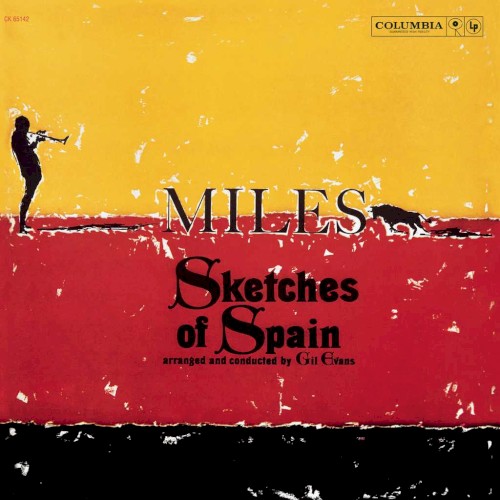
Sketches of Spain is a studio album by American jazz musician Miles Davis, released on July 18, 1960, by Columbia Records. Recording took place between November 1959 and March 1960 at Columbia's 30th Street Studio in New York City. An extended version of the second movement of Joaquín Rodrigo's Concierto de Aranjuez (1939) is included, as well as a piece called "Will o' the Wisp", from Manuel de Falla's ballet El amor brujo (1914–1915). Sketches of Spain is regarded as an exemplary recording of third stream, a musical fusion of jazz, European classical, and styles from world music.
Background
Miles Davis's wife Frances insisted he accompany her to a performance by flamenco dancer Roberto Iglesias. Inspired by the performance, Davis bought every flamenco album he could buy from the Colony Records shop in New York City.
The album pairs Davis with arranger and composer Gil Evans, with whom he had collaborated on several other projects, on a program of compositions largely derived from the Spanish folk tradition. Evans explained: [We] hadn't intended to make a Spanish album. We were just going to do the Concierto de Aranjuez. A friend of Miles gave him the only album in existence with that piece. He brought it back to New York and I copied the music off the record because there was no score. By the time we did that, we began to listen to other folk music, music played in clubs in Spain... So we learned a lot from that and it ended up being a Spanish album. The Rodrigo, the melody is so beautiful. It's such a strong song. I was so thrilled with that.
The folk songs in the album were inspired by recordings made by Alan Lomax in Galicia and Andalusia, which were released in 1955 by Columbia Masterworks. Sketches of Spain album was also the first Miles Davis album to be produced by Teo Macero, who would later produce many of Davis's works.
Concierto de Aranjuez
The opening piece, taking up almost half the record, is an arrangement by Gil Evans and Miles Davis of the adagio movement of Concierto de Aranjuez, a concerto for guitar by the contemporary Spanish composer Joaquín Rodrigo. Following the faithful introduction of the concerto's guitar melody on flugelhorn, Evans's arrangement turns into a "quasi-symphonic, quasi-jazz world of sound", according to his biographer. The middle of the piece contains a "chorus" by Evans unrelated to the concerto but "echoed" in the other pieces on the album. The original melody then reappears in a darker mode.
Davis plays flugelhorn and later trumpet, attempting to connect the various settings musically. Davis commented at rehearsal, "The thing I have to do now is make things connect, make them mean something in what I play around it". Davis thought the concerto's adagio melody was "so strong" that "the softer you play it, the stronger it gets, and the stronger you play it, the weaker it gets", and Evans concurred.
According to Davis's biographer Jack Chambers, the contemporary critical response to the arrangement was not surprising, especially given the scarcity of anything resembling a jazz rhythm in most of the piece. Martin Williams wrote that "the recording is something of a curiosity and a failure, as I think a comparison with any good performance of the movement by a classical guitarist would confirm". The composer Rodrigo was also not impressed, but royalties from the arrangement brought him "a lot of money", according to Evans.
Davis had not sought permission to record the Concierto from Joaquín Rodrigo, the piece's composer, and the label did not attempt to seek his permission. Rodrigo's wife, Victoria Kamhi in her memoir described the recording as "an act of piracy." Rodrigo tried unsuccessfully to sue the Spanish Society of Authors and Publishers (SGAE) for authorising Davis' version, but lost on the basis that Davis had granted author's rights to Rodrigo, despite not having sought permission. "Rodrigo changed his mind and came to accept the subsequent jazz recordings of his music in part because the legal terms of use were resolved (Ediciones Joaquín Rodrigo now owns the Gil Evans arrangement), but also in part because these versions, far from obliterating the original guitar concerto, have helped disseminate it."
正文摘自英文维基百科「Sketches of Spain」,按 CC BY-SA 4.0 使用;删去了参考文献、外部链接、表格和图片;篇幅所限只节选了前面一部分,全文见原条目。
资料卡
- 作品性质
- 音乐专辑
- 表演者
- 迈尔斯·戴维斯
- 发行日期
- 1960 年 7 月 18 日
- 录音地点
- CBS30街录音室
- 时长
- 41 分 19 秒
- 流派
- 冷爵士乐
- 语言
- 没有该语言的内容
- 唱片公司
- 哥伦比亚唱片
- 制作人
- 蒂奥·马塞洛
资料来自 Wikidata Q926812(CC0)。
制作名单
- 厂牌
- Columbia(目录号 CS 8271)
- 录音室
- 录音:CBS 30th Street Studio(Manhattan);录音:Columbia Studios(New York)
演奏与演唱
- 指挥
- 吉尔·埃文斯
- 低音单簧管
- Danny Bank
- 长笛
- Al Block、Harold Feldman(第 A2、B1、B2、B3 首)、Eddie Caine(第 A1 首)
- 圆号
- Jim Buffington、Tony Miranda(第 A2、B1、B2、B3 首)、Joseph Singer(第 A2、B1、B2、B3 首)、John Barrows(第 A1 首)、Earl Chapin(第 A1 首)
- 低音提琴
- 保罗·钱伯斯
- 鼓
- Jimmy Cobb
- 小号
- Bernie Glow、Ernie Royal、Johnny Coles(第 A2、B1、B2、B3 首)、迈尔斯·戴维斯(第 A1 首)、Taft Jordan(第 A1 首)、Louis R. Mucci(第 A1 首)
- 长号
- Dick Hixson、Frank Rehak
- 打击乐
- Elvin Jones、José Mangual(第 A1、A2、B1、B2 首)
- 竖琴
- Janet Putnam
- 双簧管
- Romeo Penque、Harold Feldman(第 A1 首)
- 大号
- Bill Barber(第 A2、B1、B2、B3 首)、James McAllister(第 A1 首)、Jim McAllister(第 A1 首)
- 铜管
- 迈尔斯·戴维斯(第 A2、B1、B2、B3 首)
- 大管
- Jack Knitzer(第 A2、B1、B2、B3 首)
- 富鲁格号
- 迈尔斯·戴维斯(第 A1 首)、Al Block(第 A1 首)
- 单簧管
- Harold Feldman(第 A1 首)
词曲与编曲
- 编曲
- 吉尔·埃文斯
- 作曲
- 吉尔·埃文斯(第 B1、B2、B3 首)、华金·罗德里戈(第 A1 首)、Manuel de Falla(第 A2 首)
- 作词
- Gregorio Martínez Sierra(第 A2 首)
名单来自 MusicBrainz(CC0)这一发行版本的关系数据,由志愿者录入,不一定齐全。
更多资料与乐评
在哪听
迈尔斯·戴维斯 的其他专辑
艺人页 ›
相似的专辑