乐单
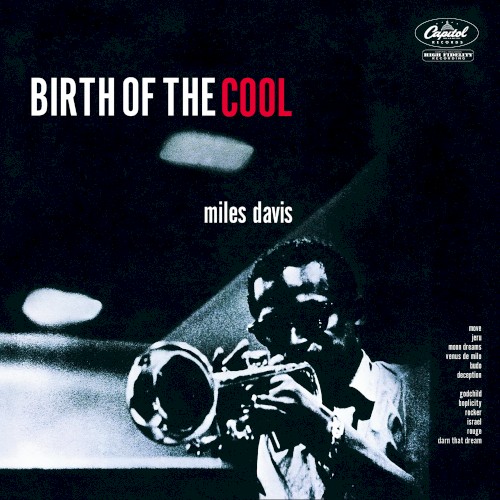
迈尔斯·戴维斯:酷的诞生 (1957)
曲目
- A1Move2:32
- A2Jeru3:10
- A3Moon Dreams3:17
- A4Venus de Milo3:10
- A5Budo2:32
- A6Deception2:45
- B1Godchild3:07
- B2Boplicity2:59
- B3Rocker3:03
- B4Israel2:15
- B5Rouge3:13
11 首 · 约 32 分钟 · 依据 1957-02 US 发行的版本,在 MusicBrainz 看这个版本。
介绍
这个词条没有中文维基百科条目,下面是英文维基百科的原文。
Birth of the Cool is a compilation album by the American jazz trumpeter and bandleader Miles Davis. It was released in February or March 1957 on Capitol Records. It compiles twelve tracks recorded by Davis's nonet for the label over the course of three sessions during 1949 and 1950.
Featuring unusual instrumentation and several notable musicians, the music consisted of innovative arrangements influenced by Afro-American music and classical music techniques, and marked a major development in post-bebop jazz. As the title suggests, these recordings are considered seminal in the history of cool jazz. Most of them were originally released in the 10-inch 78-rpm format and are all approximately three minutes long.
Background
From 1944 to 1948, Miles Davis played in Charlie Parker's quintet. Davis recorded several sides with Parker during this period, most released for the Savoy and Dial labels. Davis's first records released under his own name were recorded with Parker's band, in 1947, and were more arranged and rehearsed than Parker's usual approach to recording. By 1948, Davis had three years of bebop playing under his belt, but he struggled to match the speed and ranges of the likes of Gillespie and Parker, choosing instead to play in the mid range of his instrument. In 1948, becoming increasingly concerned about growing tensions within the Parker quintet, Davis left the group and began looking for a new band to work with.
At the same time, arranger Gil Evans began hosting gatherings of like-minded, forward-looking musicians at his small basement apartment on 55th Street in Manhattan, three blocks from the jazz nightclubs of 52nd Street. Evans had gained a reputation in the jazz world for his orchestration of bebop tunes for the Claude Thornhill orchestra in the mid-1940s. Keeping an open door policy, Evans's apartment came to host many of the young jazz artists of late-1940s New York. The participants discussed the future of jazz, including a proposed group with a new sound. According to jazz historian Ted Gioia:
[The participants] were developing a range of tools that would change the sound of contemporary music. In their work together, they relied on a rich palette of harmonies, many of them drawn from European impressionist composers. They explored new instrumental textures, preferring to blend the voices of the horns like a choir rather than pit them against each other as the big bands had traditionally done with their thrusting and parrying sections. They brought down the tempos of their music ... they adopted a more lyrical approach to improvisation ...
Before recording in the studio, the band played a two-week engagement at New York City's Royal Roost club in September 1948. In the audience was Pete Rugolo, who signed the group to record for Capitol. Recordings from two nights made for a WMCA broadcast were eventually released decades later.
Recording
The nonet recorded 12 tracks for Capitol during three sessions over nearly a year and a half. Davis, Lee Konitz, Gerry Mulligan, and Bill Barber were the only musicians who played on all three sessions, though the instrumental lineup was constant excepting the omission of piano and the addition of Kenny Hagood on March 9. The first session was on January 21, 1949, recording four tracks: Mulligan's "Jeru" and "Godchild"; Denzil Best's "Move"; and "Budo" by Davis and Bud Powell, the last two arranged by John Lewis. Jazz critic Richard Cook hypothesizes that Capitol, wanting to get a good start, recorded these numbers first because they were the catchiest tunes in the nonet's small repertoire. That date Kai Winding replaced Zwerin on trombone, Al Haig replaced Lewis on piano, and Joe Shulman replaced McKibbon on bass.
The second recording date was April 22, 1949, when Davis substituted for Fats Navarro in Tadd Dameron's band with Charlie Parker during the interim. The band returned to the studio with five changes in personnel: J. J. Johnson on trombone, Sandy Siegelstein on French horn, Nelson Boyd on bass, Kenny Clarke on drums, and Lewis on piano. At this session, the nonet recorded Mulligan's "Venus de Milo", Lewis's "Rouge", Carisi's "Israel", and "Boplicity", a collaboration between Davis and Evans, credited to the pseudonym "Cleo Henry".
The band did not return to the studio again until March 9, 1950. Davis did not call the band for any rehearsals or live performances between the second and third recording dates. This piano-less date featured Mulligan's arrangement of Eddie DeLange and Jimmy Van Heusen's "Darn That Dream", "Rocker", and "Deception", and Evans's arrangement of Chummy MacGregor's "Moon Dreams", which had been released in a jazz arrangement by Glenn Miller and the AAF Band in 1944 on V-Disc. The band saw more substitutions, with Gunther Schuller on French horn and Al McKibbon on bass. Hagood sang on "Darn That Dream."
正文摘自英文维基百科「Birth of the Cool」,按 CC BY-SA 4.0 使用;删去了参考文献、外部链接、表格和图片;篇幅所限只节选了前面一部分,全文见原条目。
资料卡
- 作品性质
- 音乐专辑
- 表演者
- 迈尔斯·戴维斯
- 发行日期
- 1957 年
- 时长
- 35 分 29 秒
- 流派
- 冷爵士乐
- 语言
- 英语
- 唱片公司
- Capitol唱片
- 制作人
- Pete Rugolo
资料来自 Wikidata Q804018(CC0)。
制作名单
- 厂牌
- Capitol Records(目录号 T 762)
- 录音室
- 录音:WOR Studios(New York);工程:WOR Studios(New York)
演奏与演唱
- 大号
- Bill Barber
- 小号
- 迈尔斯·戴维斯
- 中音萨克斯
- 李·柯尼兹
- 上低音萨克斯
- 杰瑞·穆勒根
- 鼓
- 麦斯·罗区(其中 7 首)、肯尼·克拉克(第 A4、B2、B4、B5 首)
- 长号
- J.J. Johnson(其中 7 首)、Kai Winding(第 A1、A2、A5、B1 首)
- 钢琴
- 约翰·刘易斯(其中 7 首)、Al Haig(第 A1、A2、A5、B1 首)
- 圆号
- Junior Collins(第 A1、A2、A5、B1 首)、Sanford J. Siegelstein(第 A4、B2、B4、B5 首)、Gunther Schuller(第 A3、A6、B3 首)
- 低音提琴
- Joe Shulman(第 A1、A2、A5、B1 首)、Nelson Boyd(第 A4、B2、B4、B5 首)、Al McKibbon(第 A3、A6、B3 首)
词曲与编曲
- 编曲
- 杰瑞·穆勒根(第 A2、A4、A6、B1、B3 首)、约翰·刘易斯(第 A1、A5、B5 首)、吉尔·埃文斯(第 A3、B2 首)、John Carisi(第 B4 首)
- 作曲
- 杰瑞·穆勒根(第 A2、A4、B3 首)、迈尔斯·戴维斯(第 A5、A6 首)、Denzil Best(第 A1 首)、Chummy MacGregor(第 A3 首)、Johnny Mercer(第 A3 首)、巴德·鲍威尔(第 A5 首)、George Wallington(第 B1 首)、吉尔·埃文斯(第 B2 首)、Cleo Henry(第 B2 首)、John Carisi(第 B4 首)、约翰·刘易斯(第 B5 首)
名单来自 MusicBrainz(CC0)这一发行版本的关系数据,由志愿者录入,不一定齐全。
更多资料与乐评
在哪听
迈尔斯·戴维斯 的其他专辑
艺人页 ›
相似的专辑