乐单
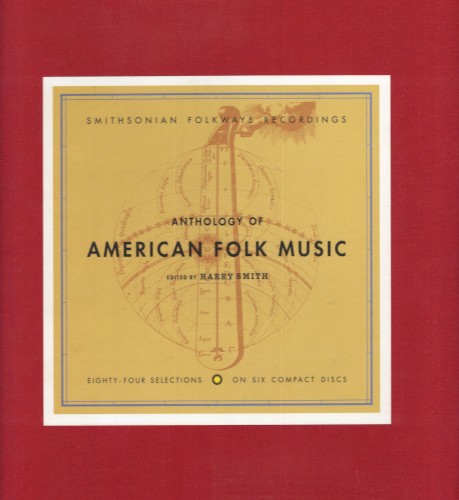
Anthology of American Folk Music (1997)
曲目
第 1 张 · CD · Volume One: Ballads
- 1Henry Lee3:29
- 2Fatal Flower Garden2:58
- 3The House Carpenter3:17
- 4Drunkard’s Special3:16
- 5Old Lady and the Devil3:05
- 6The Butcher's Boy3:05
- 7The Wagoner’s Lad3:06
- 8King Kong Kitchie Kitchie Ki‐Me‐O3:10
- 9Old Shoes and Leggins3:02
- 10Willie Moore3:17
- 11A Lazy Farmer Boy3:00
- 12Peg and Awl3:00
- 13Ommie Wise3:12
- 14My Name Is John Johanna3:13
第 2 张 · CD · Volume One: Ballads
- 1Bandit Cole Younger2:57
- 2Charles Giteau3:06
- 3John Hardy Was a Desperate Little Man2:58
- 4Gonna Die With My Hammer in My Hand3:27
- 5Stackalee3:01
- 6White House Blues3:31
- 7Frankie3:29
- 8When That Great Ship Went Down2:59
- 9Engine 1433:20
- 10Kassie Jones6:16
- 11Down on Penny’s Farm2:50
- 12Mississippi Boweavil Blues3:10
- 13Got the Farm Land Blues3:17
第 3 张 · CD · Volume Two: Social Music
- 1Sail Away Lady2:58
- 2The Wild Wagoner3:17
- 3Wake Up Jacob2:55
- 4La Danseuse2:57
- 5Georgia Stomp2:48
- 6Brilliancy Medley3:02
- 7Indian War Whoop3:13
- 8Old Country Stomp2:55
- 9Old Dog Blue3:04
- 10Saut Crapaud2:50
- 11Arcadian One‐Step3:00
- 12Home Sweet Home3:00
- 13The Newport Blues2:58
- 14Moonshiner’s Dance, Part One2:40
第 4 张 · CD · Volume Two: Social Music
- 1You Must Be Born Again1:31
- 2Oh Death Where Is Thy Sting1:29
- 3Rocky Road2:45
- 4Present Joys2:53
- 5This Song of Love2:59
- 6Judgement2:25
- 7He Got Better Things for You2:55
- 8Since I Laid My Burden Down3:19
- 9John the Baptist3:05
- 10Dry Bones3:01
- 11John the Revelator3:21
- 12Little Moses3:14
- 13Shine on Me3:04
- 14Fifty Miles of Elbow Room2:44
- 15In the Battlefield for My Lord3:20
第 5 张 · CD · Volume Three: Songs
- 1The Coo Coo Bird2:57
- 2East Virginia3:01
- 3Minglewood Blues3:44
- 4I Woke Up One Morning in May3:04
- 5James Alley Blues3:07
- 6Sugar Baby2:58
- 7I Wish I Was a Mole in the Ground3:22
- 8Mountaineer’s Courtship2:44
- 9The Spanish Merchant's Daughter3:18
- 10Bob Lee Junior Blues3:11
- 11Single Girl, Married Girl2:47
- 12La vieux soulard et sa femme3:11
- 13Rabbit Foot Blues2:58
- 14Expressman Blues3:02
第 6 张 · Enhanced CD · Volume Three: Songs
- 1Poor Boy Blues2:25
- 2Feather Bed3:16
- 3Country Blues3:00
- 499 Year Blues3:07
- 5Prison Cell Blues2:48
- 6See That My Grave Is Kept Clean2:55
- 7C’est si triste sans lui3:02
- 8Way Down the Old Plank Road3:02
- 9Buddy Won’t You Roll Down the Line3:15
- 10Spike Driver Blues3:17
- 11K.C. Moan2:34
- 12Train on the Island3:01
- 13The Lone Star Trail3:15
- 14Fishing Blues2:47
84 首 · 约 257 分钟 · 依据 1997-08-19 US 发行的版本,在 MusicBrainz 看这个版本。
介绍
这个词条没有中文维基百科条目,下面是英文维基百科的原文。
Anthology of American Folk Music is a three-volume compilation album released in August 1952 by Folkways Records. It was compiled by American polymath Harry Smith from his own collection of 78 rpm records. It consists of eighty-four recordings of American folk, blues and country music made and issued from 1926 to 1933 by a variety of performers, divided into three categories: "ballads", "social music", and "songs".
The anthology sold relatively poorly, with no notable early coverage besides a minor mention in Sing Out! in 1958. However, it eventually became regarded as a landmark and influential release, particularly for the 1950s and 1960s American folk music revival. In 2003, Rolling Stone ranked it at number 276 on their list of The 500 Greatest Albums of All Time. In 2005, it was inducted into the National Recording Registry by the Library of Congress.
Background
Harry Smith was a West Coast filmmaker, magickian and bohemian eccentric. As a teenager he started collecting old blues, jazz, country, Cajun, and gospel records and accumulated a large collection of 78s, those being the only medium at the time.
In 1947, he met with Moses Asch, with an interest in selling or licensing the collection to Asch's label, Folkways Records. Smith wrote that he selected recordings from between "1927, when electronic recording made possible accurate music reproduction, and 1932, when the Great Depression halted folk music sales." When the Anthology was released, neither Folkways nor Smith possessed the licensing rights to these recordings, some of which had initially been issued by record companies that were still in existence, including Columbia. The anthology thus technically qualifies as a high profile bootleg. Folkways would later obtain some licensing rights, although the Anthology would not be completely licensed until the 1997 Smithsonian reissue. Asch had a "reputation for releasing copyrighted songs without going through the proper legal channels."
Sequencing
Smith divided the collection into three, two record volumes: Ballads, Social Music, and Songs. The first volume consists of ballads including many American versions of Child Ballads taken from the English folk tradition. Each song tells a story about a specific event or time, and Smith may have made some effort to organize them to suggest a historical narrative, a theory suggested by the fact that many of the first songs in this volume are old English folk ballads while the closing songs deal with the hardships of being a farmer in the 1920s.
The first record in the Social Music volume mostly consists of music that was likely performed at social gatherings and dances with many of the songs being instrumentals. The second record in the volume consists of religious and spiritual songs, including some Gospel songs.
The volume of Songs consists of regular songs, dealing with everyday life. Critic Greil Marcus describes them as being about "marriage, labor, dissipation, prison, and death."
Smith's booklet in the original release refers to three additionally planned volumes made up of music up until 1950. Although none were released during his lifetime, a fourth volume was released posthumously in 2000. Entitled Labor Songs, this volume centers around work songs and union songs. The album contains later material than the original three volumes, anthologizing material recorded as late as 1940.
Design
Smith himself designed and edited the anthology and wrote the liner notes, which are almost as well known as the music, using an unusual fragmented, collage method that presaged some postmodern artwork. He also penned short synopses of the songs which read like newspaper headlines. For the song "King Kong Kitchie Kitchie Ki-Me-O" by Chubby Parker, a song about a mouse marrying a frog, Smith notes: "Zoologic Miscegeny Achieved in Mouse Frog Nuptials, Relatives Approve."
Each of the three sets carries the same cover art, a Theodore de Bry etching of an instrument Smith referred to as the Celestial Monochord, taken from a mystical treatise by scientist/alchemist Robert Fludd. The etching is printed over a different color background for each volume of the set: blue, red and green. Smith incorporated both the music and the art into his own unusual cosmology. He considered each of these colors as corresponding to an alchemical classical element: water, fire, and air, respectively. The fourth Labour volume (released later by Revenant) is colored yellow to represent the element earth.
Release and reissues
Folkways originally released the Anthology as three double-LP boxed sets in August 1952. It sold relatively poorly initially. By 1953, Folkways had sold only fifty albums, forty-seven of which went to libraries and colleges and for a time, it was out of print because of copyright issues.
正文摘自英文维基百科「Anthology of American Folk Music」,按 CC BY-SA 4.0 使用;删去了参考文献、外部链接、表格和图片;篇幅所限只节选了前面一部分,全文见原条目。
资料卡
- 作品性质
- 音乐专辑
- 表演者
- 群星
- 发行日期
- 1952 年
- 流派
- 乡村音乐、布鲁斯
- 唱片公司
- 民谣唱片
- 所属系列
- Anthology of American Folk Music
资料来自 Wikidata Q4771901(CC0)。
制作名单
- 厂牌
- Smithsonian Folkways(目录号 SFW 40090)
- 录音室
- 录音:Victor’s Church Studio(Camden);录音:Brunswick Recording Studio(New York);录音:Bristol Sessions Recordings(United States)
制作
- 编选
- Harry Everett Smith
- 制作人
- Ralph Peer(第 11、12 首)
演奏与演唱
- 演唱
- [unknown](第 1、2、13、14、15 首)、Sara Carter(第 3、9、12、11 首)、Clarence Ashley(第 3、12、1 首)、Buell Kazee(第 6、7、2 首)、Blind Lemon Jefferson(第 13、5、6 首)、Garley Foster(第 12、13 首)、Kelly Harrell(第 14、2 首)、密西西比·约翰·赫特(第 7、10 首)、Henry Thomas(第 8、14 首)、Rev. J.M. Gates(第 1、2 首)、Alabama Sacred Harp Singers(第 3、4 首)、Bessie Johnson(第 7、8 首)、Melinda Taylor(第 7、8 首)、Bascom Lamar Lunsford(第 10、7 首)、Dock Boggs(第 6、3 首)、Joe Falcon(第 12、7 首) 等 20 人
- 小提琴(民间)
- Posey Rorer(第 11、14、2、6 首)、Ophy Breaux(第 11、12、7 首)
- 吉他
- Mother Maybelle Carter(第 3、9、12、11 首)、Cléoma Falcon(第 11、12、7 首)、Blind Lemon Jefferson(第 13、5、6 首)、Garley Foster(第 12、13 首)、Alfred Steagall(第 14、2 首)、密西西比·约翰·赫特(第 7、10 首)、[unknown](第 2、3 首)、Henry Thomas(第 8、14 首)、Will Shade(第 7、10 首)、Dick Justice(第 1 首)、James D. Touchstone(第 2 首)、Coley Jones(第 4 首)
- five-string banjo
- Buell Kazee(第 6、7、2 首)、Bascom Lamar Lunsford(第 10、7 首)、Clarence Ashley(第 3 首)
- 手风琴
- Joe Falcon(第 11、12、7 首)
- 口琴
- Ernest Stoneman(第 9、8 首)、Garley Foster(第 12、13 首)、Noah Lewis(第 3、2 首)
- 班卓琴
- Dock Walsh(第 12、13 首)、Raymond D. Hundley(第 14、2 首)、Gus Cannon(第 3、2 首)、Dock Boggs(第 6、3 首)、Uncle Dave Macon(第 8、9 首)
- 排箫
- Henry Thomas(第 8、14 首)
- syrinx
- Henry Thomas(第 8、14 首)
- 主唱
- Henry Thomas(第 8、14 首)
- 三角铁
- [unknown](第 11、15 首)
- 簧风琴
- [unknown](第 3、4 首)
- 竖琴齐特琴
- Sara Carter(第 12、11 首)
- jug
- Gus Cannon(第 3、2 首)
- 男中音
- Ernest Stoneman(第 8、9 首)
- 女高音
- Hattie Stoneman(第 8、9 首)
- 卡祖笛
- Ben Ramey(第 10、11 首)
- 钢棒吉他
- Hubert Nelson(第 2 首)
词曲与编曲
- 作曲
- [traditional](其中 13 首)
- 作词
- [traditional](其中 13 首)
- 词曲
- [traditional](第 2、13、1、5、12、6 首)
名单来自 MusicBrainz(CC0)这一发行版本的关系数据,由志愿者录入,不一定齐全,人数太多只列了前面一部分。
更多资料与乐评
在哪听
群星 的其他专辑
艺人页 ›


相似的专辑

同在 1997 年发行