乐单
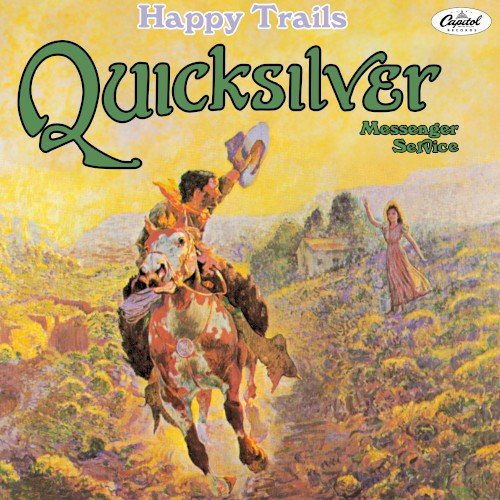
Happy Trails (1969)
曲目
- 1Who Do You Love, Part 13:33
- 2When You Love5:14
- 3Where You Love6:07
- 4How You Love2:45
- 5Which Do You Love1:49
- 6Who Do You Love, Part 25:52
- 7Mona7:01
- 8Maiden of the Cancer Moon2:52
- 9Calvary13:34
- 10Happy Trails1:30
10 首 · 约 50 分钟 · 依据 1969-03 US 发行的版本,在 MusicBrainz 看这个版本。
介绍
这个词条没有中文维基百科条目,下面是英文维基百科的原文。
Happy Trails is the second album of the American band Quicksilver Messenger Service. Most of the album was recorded from two performances at the Fillmore East and Fillmore West, although it is not clear which parts were recorded at which Fillmore. The record was released by Capitol Records in 1969 in stereo.
Album content
The first side of the album consists entirely of a live performance of Bo Diddley's song, "Who Do You Love?". In a self-deprecating poke at the rendition's extended length, it is listed as the "Who Do You Love Suite", with individually titled "movements" which give writing credits to the soloist on each segment. The performance of Bo Diddley's composition breaks down into a guitar solo by Gary Duncan in a style somewhere between jazz and rock (described as "Bloomfield-like") with a walking bass line by Freiberg. It then mellows down into some apparently improvised guitar and bass plucking and sliding, with feedback, handclapping and audience participation 'almost like a "found object" out of Dada.' Solos by Cipollina and then Freiberg follow. Then comes a slower, quieter reprise of one verse of the Bo Diddley song, leading to a pianissimo ensemble vocal, followed by a finale in which Elmore changes to a back-beat, while Duncan and Freiberg still play the Bo Diddley beat. Duncan's vocals and Cipollina's lead guitar use call-and-response, and the result is a polyrhythmic rock sound.
The recorded live performance of the "Who Do You Love Suite" was almost 27 minutes long, and some of Gary Duncan's solo ("When You Love") was excised, perhaps due to the space constraints of LPs. At the end, Bill Graham announces, "Quicksilver Messenger Service." According to Mick Skidmore, Cipollina found the critical laud for "Who Do You Love?" baffling, saying "it was just a two-chord jam." (April 2001, Notes to Acadia CD "Copperhead")
The second side of the album contains "Mona", another Bo Diddley song, and two instrumental compositions by Duncan, "Maiden of the Cancer Moon" and "Calvary", all of which segue. The three songs were originally parts of a single continuous live performance. Both Cipollina and Duncan take guitar solos on "Mona". The live recording of "Calvary" was abridged shortly after the end of "Maiden of the Cancer Moon" and a studio version was recorded and substituted. The ironic comment at the beginning of side two, "This here next one's rock 'n' roll," was also added in the studio.
The lead guitar on "Maiden of the Cancer Moon" is played by Cipollina. This is clearly a scored piece, as opposed to the improvisational guitar playing on "Mona."
"Calvary" was originally called the "F-Sharp Thing". It has been described as "acid-flamenco", but it is definitely not flamenco music. It does resemble orchestral or symphonic music, and it is not readily classifiable as rock, jazz or blues. In the studio, Quicksilver took the themes of Duncan's piece and redid them with an extended introduction, a different cadenza by Duncan, guitar and bass feedback, a brief interlude that rises out of the feedback, and a closing melody, played staccato, that fades out. There are a variety of percussion instruments used besides the standard drum kit: tympani, a tam-tam, a whip, tubular bells, bar chimes (or perhaps the newly invented mark tree), a triangle or a bell, and güiro. In addition, Duncan lays down his electric guitar to play an acoustic guitar during the brief interlude, and then takes up the electric once again. The band also sings wordless vocals in harmony. Duncan shouts, "Call it anything you want!", while the track begins and fades out with "shhh" vocals. The album sleeve says that "Calvary" was recorded "live" at Golden State Recorders, meaning that nothing was overdubbed. There was also substantial editing and additional overdubbing done at Golden State Recorders to both sides of the record.
As a coda, the band performs the theme tune from Roy Rogers' western television show, which lends its title to the album. "Happy Trails" has "clip-clop percussion, piano and drawling vocals by Elmore[.]" There is no bass on this track; Freiberg plays a honky-tonk piano part.
Reception
While briefly remarking that all four songs on the second side are excellent, Greil Marcus devoted most of his review in Rolling Stone to extensive discussion of the side-long rendition of "Who Do You Love?", which he deemed "one of the best rock and roll recordings to emerge from San Francisco, a performance that captures all the excitement and grandeur of the great days of the scene in a way that is almost too fine to be real." He particularly noted that, "They use the infamous Bo Diddley rhythm not as a crutch, not as something for the rhythm section to play with while the lead takes it; Quicksilver finds dimensions of that 'bump buddy bump bump — bump bump' beat that no one has even suggested before, as they stretch it, bend it, move around it, as a motif or a bridge, as an idea rather than as a pattern."
正文摘自英文维基百科「Happy Trails (album)」,按 CC BY-SA 4.0 使用;删去了参考文献、外部链接、表格和图片;篇幅所限只节选了前面一部分,全文见原条目。
资料卡
- 作品性质
- 音乐专辑
- 表演者
- 水银信使
- 发行日期
- 1969 年 3 月 29 日
- 流派
- 迷幻摇滚
- 语言
- 英语
- 唱片公司
- Capitol唱片
资料来自 Wikidata Q754693(CC0)。
制作名单
- 厂牌
- Capitol Records(目录号 ST-120)
演奏与演唱
- 吉他
- John Cipollina、Gary Duncan
- 鼓类乐器
- Greg Elmore
- 贝斯
- David Freiberg
词曲与编曲
- 作曲
- 波·迪德利(第 1、6、7 首)、Gary Duncan(第 2、8、9 首)、Greg Elmore(第 3 首)、John Cipollina(第 4 首)、David Freiberg(第 5 首)、Dale Evans(第 10 首)
- 作词
- 波·迪德利(第 1、6、7 首)、Gary Duncan(第 8、9 首)、Dale Evans(第 10 首)
名单来自 MusicBrainz(CC0)这一发行版本的关系数据,由志愿者录入,不一定齐全。
更多资料与乐评
在哪听
水银信使 的其他专辑
艺人页 ›
相似的专辑
同在 1969 年发行