乐单
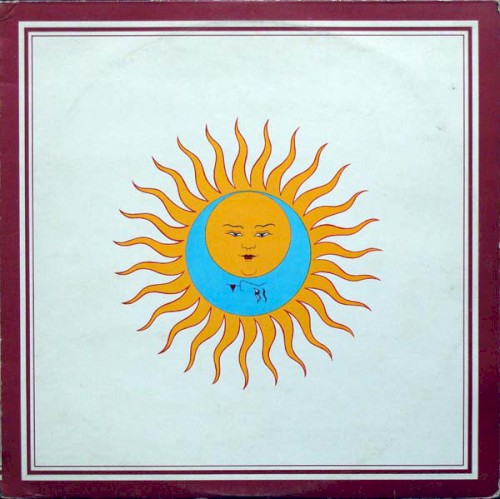
肉冻中的百灵鸟舌 (1973)
曲目
- A1Larks’ Tongues in Aspic, Part One13:36
- A2Book of Saturday2:59
- A3Exiles7:37
- B1Easy Money7:51
- B2The Talking Drum7:28
- B3Larks’ Tongues in Aspic, Part Two7:10
6 首 · 约 47 分钟 · 依据 1973 US 发行的版本,在 MusicBrainz 看这个版本。
介绍
这个词条没有中文维基百科条目,下面是英文维基百科的原文。
Larks' Tongues in Aspic is the fifth studio album by the English progressive rock band King Crimson, released on 23 March 1973 through Island Records in the UK and Atlantic Records in the United States and Canada. It marked the debut of a new incarnation of King Crimson, featuring co-founder and guitarist Robert Fripp along with four new members: bass guitarist and vocalist John Wetton, violinist and keyboardist David Cross, drummer Bill Bruford, and percussionist Jamie Muir. It is a key album in the band's evolution, drawing on Eastern European modernist classical music and free improvisation as central influences.
Background
At the end of the tour to promote King Crimson's previous album, Islands, Fripp parted company with the three other members of the band (Mel Collins, Boz Burrell and Ian Wallace). Collins has stated that he was asked to stay on with the new lineup of the band but decided not to. The previous year had also seen the ousting of the band's lyricist and artistic co-director Peter Sinfield. Fripp had cited a developing musical and sometimes personal incompatibility with the other members. He was now writing starker music drawing on influences such as Béla Bartók, Igor Stravinsky, Jimi Hendrix and free improvisation.
In order to pursue these ideas, Fripp first recruited bass guitarist and vocalist John Wetton, a longstanding friend of the band who had lobbied to join at least once before but had joined Family in the meantime. The second recruit was Jamie Muir, a free-improvising percussionist who had previously been performing in the Music Improvisation Company with Derek Bailey and Evan Parker, as well as in Sunship (with Alan Gowen and Allan Holdsworth) and Boris (with Don Weller and Jimmy Roche, both later of jazz-rock band Major Surgery). Muir occasionally played a conventional drum kit, but more often used a range of small percussion instruments.
On drums, Fripp recruited Bill Bruford of Yes. Another longstanding King Crimson admirer, Bruford felt that he had done all he could with Yes at that point. He was keen to leave the band before they embarked on their Close to the Edge tour, believing that the experimentation-oriented King Crimson would be a more expansive outlet for his musical ideas. The final member of the new band was David Cross, a violinist, keyboardist and occasional flute player.
Production
Larks' Tongues in Aspic showed several significant changes in King Crimson's sound. Having previously relied on woodwinds as significant melodic and textural instruments, the band now replaced them with Cross' violin. Muir's percussion rig featured eccentric instrumentation including chimes, bells, mbira, musical saw, shakers, rattles, found objects (such as sheet metal, toys and baking trays), an autoharp, and miscellaneous drums and chains. The Mellotron, a staple part of King Crimson's instrumentation since their debut album, was retained for this new phase, played by Fripp and Cross; both also played the Hohner Pianet electric piano. The instrumental pieces carried strong jazz fusion and European free-improvisation influences, and some aggressive portions verging on heavy metal.
Wetton and Muir played additional violin and trombone respectively on occasion at early gigs; Wetton and Cross contributed additional piano and flute respectively to the track "Exiles". As Muir left the group in February 1973, shortly after the album was completed and before they could embark on a supporting tour, Larks' Tongues in Aspic would be the only King Crimson album to feature this lineup.
"Easy Money" was composed piecemeal, with Fripp writing the verses and Wetton later adding the chorus.
The album title came from Muir, who thought that it aptly described the music. "It may or may not be an actual dish available at your neighborhood delicatessen," Fripp stated, "but what it means to me is something precious which is stuck, but visible. Something precious, which is encased in form."
The album spawned the concert staple "Exiles", whose Mellotron introduction had been adapted from an instrumental piece called "Mantra" which the band's original lineup had performed throughout 1969. At that time, as well as in late 1972, the melody was played by Fripp on guitar. In addition, a section of "Larks' Tongues in Aspic, Part One" was reworked from a piece entitled "A Peacemaking Stint Unrolls", which was recorded by the Islands-era band and released in 2010 as a bonus track on that album's 40th anniversary edition.
Release and reissues
The album peaked at number 20 on the UK Albums Chart and at number 61 on the US Billboard album chart. In 2012 Larks' Tongues in Aspic was issued as part of the King Crimson 40th Anniversary Series, including the release of an expansive box set subtitled "The Complete Recordings". This CD, DVD-A and Blu-ray set includes every available recording of the short-lived five-man line-up, through live performances and studio sessions.
正文摘自英文维基百科「Larks' Tongues in Aspic」,按 CC BY-SA 4.0 使用;删去了参考文献、外部链接、表格和图片;篇幅所限只节选了前面一部分,全文见原条目。
资料卡
- 作品性质
- 音乐专辑
- 表演者
- 深红之王
- 发行日期
- 1973 年 3 月 23 日
- 时长
- 46 分 37 秒
- 流派
- 交响摇滚
- 语言
- 英语
- 唱片公司
- 小岛唱片
- 制作人
- 深红之王
资料来自 Wikidata Q725114(CC0)。
制作名单
- 厂牌
- Atlantic(目录号 SD 7263)
- 录音室
- 母带:Atlantic Studios(Midtown Manhattan);录音:Command Studios(London)
制作
- 工程师
- Nick Ryan(第 A2、B1、B3 首)、Andy Hendriksen(第 A2 首)
- 制作人
- 深红之王
演奏与演唱
- 小提琴
- David Cross(第 A2 首)
- 吉他
- 罗伯特·弗里普(第 A2 首)
- 演唱
- 约翰·韦顿(第 A2 首)
- 鼓
- 比尔·布鲁佛
- 美乐特朗
- David Cross、罗伯特·弗里普
- 中提琴
- David Cross
- 打击乐
- Jamie Muir
- 贝斯
- 约翰·韦顿
词曲与编曲
- 作曲
- 罗伯特·弗里普、约翰·韦顿(第 A1、A2、B1、B2 首)、David Cross(第 A1、A3、B2 首)、比尔·布鲁佛(第 A1、B2 首)、Jamie Muir(第 A1、B2 首)、Richard Palmer‐James(第 A3 首)
- 作词
- Richard Palmer‐James(第 A2、A3、B1 首)
名单来自 MusicBrainz(CC0)这一发行版本的关系数据,由志愿者录入,不一定齐全。
更多资料与乐评
在哪听
深红之王 的其他专辑
艺人页 ›
相似的专辑


同在 1973 年发行