乐单
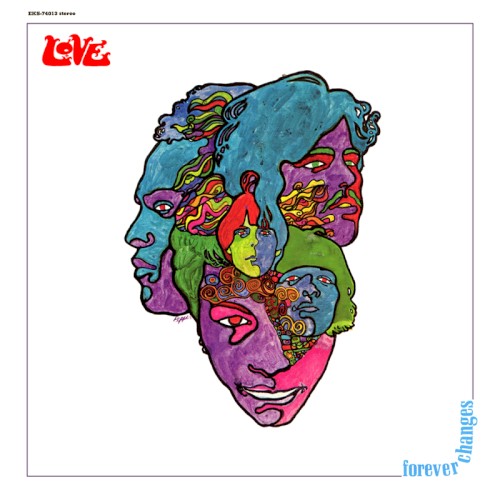
Forever Changes (1967)
滚石 500(2020) #180滚石 500(2003) #401001 张专辑
- 艺人
- Love
- 发行
- 1967-11-01
- 类型
- 专辑
- 唱片公司
- 艾丽卡唱片、犀牛娱乐公司
- 制作人
- Bruce Botnick
- 版本
- MusicBrainz 上有 24 个发行版本
曲目
- A1Alone Again Or3:15
- A2A House Is Not a Motel3:25
- A3Andmoreagain3:15
- A4The Daily Planet3:25
- A5Old Man2:57
- A6The Red Telephone4:45
- B1Maybe the People Would Be the Times or Between Clark and Hilldale3:30
- B2Live and Let Live5:24
- B3The Good Humor Man He Sees Everything Like This3:00
- B4Bummer in the Summer2:20
- B5You Set the Scene6:49
11 首 · 约 42 分钟 · 依据 1967 US 发行的版本,在 MusicBrainz 看这个版本。
介绍
这个词条没有中文维基百科条目,下面是英文维基百科的原文。
Forever Changes is the third studio album by the American rock band Love, released in November 1967 by Elektra Records. The album saw the group embrace a subtler folk-influenced sound based around acoustic guitars and orchestral arrangements, while primary songwriter Arthur Lee explored darker themes alluding to mortality and his growing disillusionment with the era's counterculture. It was the final album recorded by the original band lineup; after its completion, guitarist Bryan MacLean left the group acrimoniously, and Lee subsequently dismissed the other members.
Forever Changes had only moderate success on the album charts upon release, peaking at No. 154 in the US and No. 24 in the UK. In subsequent years, it has become recognized as an influential document of 1960s psychedelia and named among the greatest albums of all time by a variety of publications.
Background
For Da Capo, Love's second studio album, the band expanded from five members to seven in order to take on a more jazz-influenced style. Shortly after the album's release, however, bandleader Arthur Lee decided the experiment had run its course and fired drummer-turned-keyboardist Alban "Snoopy" Pfisterer and saxophonist and flautist Tjay Cantrelli. This left a lineup of Lee (lead vocals), Bryan MacLean (rhythm guitar), Johnny Echols (lead guitar), Ken Forssi (bass), and Michael Stuart (drums).By 1967, the band was facing major internal conflicts. The members were growing apart and, as a result, rehearsing and performing less. Lee's relationship with MacLean, Love's other songwriter, was deteriorating. In a 1992 interview, Lee spoke of him and MacLean "competing a bit like Lennon and McCartney to see who would come up with the better song. It was part of our charm. Everybody had different behaviour patterns. Eventually, the others couldn't cut it".
Love were also at odds with their label, Elektra Records. After recording Da Capo, the band attempted for a third time to sever their contract with the label. The resulting May 1967 agreement required them to produce one more album. Throughout 1967, Lee also grew envious of the success of fellow Elektra band the Doors, whom he had been integral in getting signed. However, it has been countered that the Doors were more willing to work on the road than Lee, who expressed a fear of leaving the band's home city, Los Angeles.
Inspiration
Lee's material for Forever Changes was drawn from his lifestyle and environment, which contrasted greatly from the typical hippie culture of the time. The songs reflected upon dark themes, such as paranoia, the Vietnam War, race issues in the US, societal breakdown, and the negative effects of drug use. In his 33 1/3 book on the album, Andrew Hultkrans explained Lee's frame of mind at the time: "Arthur Lee was one member of the '60s counterculture who didn't buy flower-power wholesale, who intuitively understood that letting the sunshine in wouldn't instantly vaporize the world's (or his own) dark stuff". With the band in disarray, and increasingly concerned over his own mortality, Lee envisioned Forever Changes as a lament to his memory.
Recording and style
Having already engineered the group's first two albums, Bruce Botnick was enlisted to oversee the production of the third album along with Lee. Botnick, who had also worked with Buffalo Springfield, invited Neil Young to co-produce the album, but Young, after initially agreeing, excused himself from the project. As Botnick recalled, "Neil really had the burning desire to go solo and realize his dream without being involved in another band". It was reported that Young arranged the song "The Daily Planet", but he denied any involvement.
According to AllMusic, the band embraced "a more gentle, contemplative, and organic sound on Forever Changes," with much of the album "built around interwoven acoustic guitar textures and subtle orchestrations, with strings and horns both reinforcing and punctuating the melodies." Elektra Records founder Jac Holzman had suggested that Love "advance backwards" by embracing the more subtle approach of folk music, and Lee, while typically independent in his musical directions, accepted the suggestion. Stephen M. Deusner of Pitchfork stated that Lee paired his "dark, discomfiting lyrics" with music that draws from rock, psychedelia, folk, pop, classical, and mariachi influences without being reducible to any of those labels.
正文摘自英文维基百科「Forever Changes」,按 CC BY-SA 4.0 使用;删去了参考文献、外部链接、表格和图片;篇幅所限只节选了前面一部分,全文见原条目。
资料卡
- 作品性质
- 音乐专辑
- 表演者
- Love
- 发行日期
- 1967 年 11 月
- 录制时间
- 1967 年 6 月 9 日、1967 年 9 月 25 日
- 时长
- 42 分 51 秒
- 流派
- 迷幻摇滚、民谣摇滚
- 语言
- 英语
- 唱片公司
- 艾丽卡唱片、犀牛娱乐公司
- 制作人
- Bruce Botnick
- 获奖
- 格莱美名人堂(2007)
资料来自 Wikidata Q1002861(CC0)。
制作名单
- 厂牌
- Elektra(目录号 EKL-4013)
- 录音室
- 录音:Sunset Sound(Hollywood)
制作
- 工程师
- Bruce Botnick
- 制作人
- Bruce Botnick、Arthur Lee
演奏与演唱
- 主唱
- Arthur Lee(其中 10 首)、Bryan MacLean(第 A1、A5 首)
- 鼓
- Michael Stuart-Ware(其中 9 首)、Hal Blaine(第 A3、A4 首)
- 贝斯
- Ken Forssi(其中 8 首)、Carol Kaye(第 A3、A4 首)
- 钢琴
- Don Randi(第 A3、A4、A5、B4 首)
- 键盘
- Don Randi(第 A3、A4 首)
- 电吉他
- Billy Strange(第 A3、A4 首)
- 电贝斯
- Ken Forssi(第 A1 首)
- 原声吉他
- Bryan MacLean(第 A1 首)
- 羽管键琴
- Don Randi(第 A6 首)
词曲与编曲
- 作曲
- Arthur Lee(其中 9 首)、Bryan MacLean(第 A1、A5 首)
- 作词
- Arthur Lee(其中 9 首)、Bryan MacLean(第 A1、A5 首)
- 器乐编曲
- David Angel(第 A1 首)
- 编曲
- 尼尔·杨(第 A4 首)
名单来自 MusicBrainz(CC0)这一发行版本的关系数据,由志愿者录入,不一定齐全。
更多资料与乐评
在哪听
Love 的其他专辑
艺人页 ›


相似的专辑
同在 1967 年发行