乐单
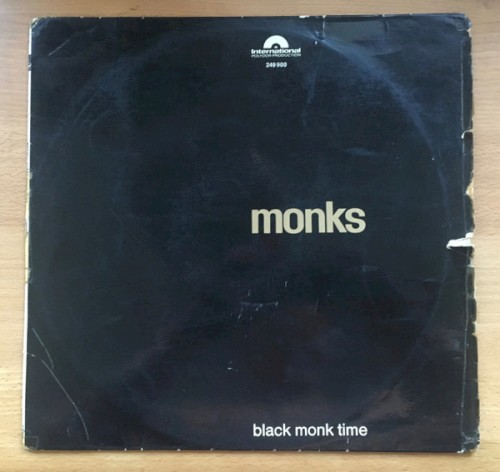
Black Monk Time (1966)
- 艺人
- The Monks
- 发行
- 1966
- 类型
- 专辑
- 唱片公司
- International Polydor Production
- 版本
- MusicBrainz 上有 9 个发行版本
曲目
- A1Monk Time2:47
- A2Shut Up3:14
- A3Boys Are Boys and Girls Are Choice1:26
- A4Higgle-Dy-Piggle-Dy2:31
- A5I Hate You3:35
- A6Oh, How to Do Now3:17
- B1Complication2:24
- B2We Do Wie Du2:12
- B3Drunken Maria1:46
- B4Love Came Tumblin’ Down2:30
- B5Blast Off!2:15
- B6That’s My Girl2:27
12 首 · 约 30 分钟 · 依据 1966 DE 发行的版本,在 MusicBrainz 看这个版本。
介绍
这个词条没有中文维基百科条目,下面是英文维基百科的原文。
Black Monk Time is the only studio album by the German-based American garage rock band the Monks, released in March 1966 through Polydor Records. It was later recognized by music critics as a forerunner to punk rock.
Black Monk Time was ranked number 56 on Spin magazine's list of the "Top 100 Alternative Albums of the 1960s" and number 127 on Pitchfork's list of the best albums of the 1960s, and has been featured on The Word's "Hidden Treasure: Great Underrated Albums of Our Time", as well as the Sunday Herald's "The 103 Best Albums Ever, Honest" and the book 1001 Albums You Must Hear Before You Die.
Background
Formed by five American GIs stationed in Gelnhausen, West Germany, in 1964, the Monks, originally known as the Torquays, were signed by a German management team composed of Karl Remy, Walther Niemann, and Günther and Kiki Aulich, who originally spotted the band at a show in Stuttgart. Bassist Eddie Shaw stated: "We were getting our haircuts when Roger [Johnston] decided to have a tonsure. That's when we all decided to do it. Our manager Karl said, 'That's it!'" The other members were initially wary of this look, but they all eventually adopted tonsures, black religious habits, and cinctures and renamed themselves "the Monks", with local newspapers labeling them "the anti-beatles". The group also altered their sound significantly, incorporating feedback, an electric banjo guitar, drums with no cymbals, fuzz bass, anti-war lyrics, and a general emphasis on rhythm.
Black Monk Time was recorded in November 1965 in Cologne, with Jimmy Bowien producing, and released by Polydor Records in March 1966. "Complication" b/w "Oh, How to Do Now" was released as a single to promote the album, but neither release garnered commercial success.
Music
According to Stephen M. Deusner of Paste, "The Monks were all rhythm section, with every instrument clicking into a tense lockstep punctuated by Gary Burger’s wild-man yelps and Dave Day's electrified banjo—an instrument as distinct as the Thirteenth Floor Elevators’ electric jug. In their lusty frivolity, The Monks find a measure of gravity and outrage." Their style was self-described as "Über-beat". In 2011, bassist Eddie Shaw described their musical process in an interview:
To develop something new we developed a process known as deconstructing and reconstructing, laying down bass and drum patterns to be added to, by the other instruments. We made best use of each individual’s tendencies and abilities. In fact we made it very minimalist – single loud/distorted bass notes on the beat – drums with no cymbals except for accents – banjo rock and roll chords because it was a hard trashy sound – guitar, using the feedback – and organ playing beats and wild solos. All instruments were played as rhythm instruments.
Critic Alexis Petridis of The Guardian cited Roger Johnston's drumming on the album as a precursor to the later German krautrock movement, noting an early form of the motorik beat in his "tightly wound playing".
Critical reception
Black Monk Time was initially ignored upon release but has since become widely recognized as a landmark proto-punk album. In a retrospective review for About.com, Anthony Carew called it "possibly the first punk record" and "one of the 'missing links' of alternative music history", also citing it as an influence on the German krautrock movement. Andrew Perry wrote in The Daily Telegraph in 2009: "it's hard to imagine how this primitive and often nightmarish music could have been allowed to be made at that particular time and place. [...] It may not be to every taste but, lurching according to its own sublimely clueless logic, it has a purity and heedlessness which can never be repeated." According to Len Comaratta of Uncut, "there's really nothing that can dull the impact of hearing the Monks' music for the first time." Paste magazine described the album as "[eleven] songs of brash grooves and unearthly garage rock that show no signs of hobby or pastime." In his book, The Rough Guide to Rock, writer Peter Buckley had said Black Monk Time has not "aged one iota. If anything, it has gotten stranger".
Music historian Kelley Stoltz described the Monks as a group that "overwhelms the listener with a sound they termed 'over-beat' - at their worst it is totally oddball freakrock that sounds like a pleasurable argument". Stoltz concluded that the band had "outsexed the [Sex] Pistols" ten years before punk emerged.
正文摘自英文维基百科「Black Monk Time」,按 CC BY-SA 4.0 使用;删去了参考文献、外部链接、表格和图片;篇幅所限只节选了前面一部分,全文见原条目。
资料卡
- 作品性质
- 音乐专辑
- 表演者
- The Monks
- 发行日期
- 1966 年 3 月
- 流派
- 车库摇滚
- 语言
- 英语
- 唱片公司
- International Polydor Production
资料来自 Wikidata Q735414(CC0)。
制作名单
- 厂牌
- International Polydor Production(目录号 249 900)
制作
- 制作人
- Jimmy Bowien(其中 11 首)
词曲与编曲
- 词曲
- Gary Burger(其中 11 首)、Larry Clark(其中 11 首)、Dave Day(其中 11 首)、Roger Johnston(其中 11 首)、Eddie Shaw(其中 11 首)
- 作曲
- Gary Burger(第 B2 首)、Larry Clark(第 B2 首)、Dave Day(第 B2 首)、Roger Johnston(第 B2 首)、Eddie Shaw(第 B2 首)
- 作词
- Gary Burger(第 B2 首)、Larry Clark(第 B2 首)、Dave Day(第 B2 首)、Roger Johnston(第 B2 首)、Eddie Shaw(第 B2 首)
名单来自 MusicBrainz(CC0)这一发行版本的关系数据,由志愿者录入,不一定齐全。
更多资料与乐评
在哪听
相似的专辑




同在 1966 年发行