乐单
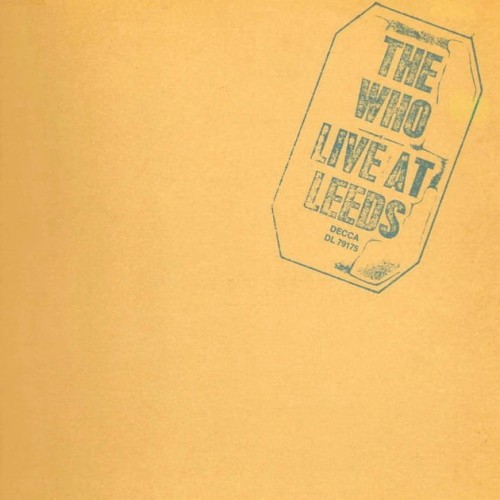
Live at Leeds (1970)
滚石 500(2020) #327滚石 500(2003) #1701001 张专辑
- 艺人
- 谁人
- 发行
- 1970-05-16
- 类型
- 专辑
- 唱片公司
- 迪卡唱片公司
- 制作人
- Jon Astley
- 版本
- MusicBrainz 上有 32 个发行版本
曲目
- A1Young Man Blues4:51
- A2Substitute2:21
- A3Summertime Blues3:30
- A4Shakin’ All Over4:30
- B1My Generation14:35
- B2Magic Bus7:55
6 首 · 约 38 分钟 · 依据 1970-05-16 US 发行的版本,在 MusicBrainz 看这个版本。
介绍
这个词条没有中文维基百科条目,下面是英文维基百科的原文。
Live at Leeds is the first live album by the English rock band the Who, recorded at the University of Leeds Refectory on 14 February 1970 and released on 11 May 1970, by Decca and MCA in the United States and by Track and Polydor in the United Kingdom. It is the band's only live album that was recorded with the classic line-up of lead vocalist Roger Daltrey, guitarist Pete Townshend, bassist John Entwistle and drummer Keith Moon.
The Who were looking for a way to follow up their 1969 album Tommy, and had recorded several shows on tours supporting that album, but disliked the sound. Consequently, they booked the show at Leeds University, along with one at Hull City Hall the following day, specifically to record a live album. Six songs were taken from the Leeds show, and the cover was pressed to look like a bootleg recording. The sound was significantly different from Tommy and featured hard rock arrangements that were typical of the band's live shows. Live at Leeds has been reissued on several occasions and in several formats. Since its release, it has been ranked by several music critics as one of, if not the greatest, live album and rock recording of all time.
Background
By the end of the 1960s, particularly after releasing Tommy in May 1969, the Who had become cited by many as one of the best live rock acts in the world. According to biographer Chris Charlesworth, "a sixth sense seemed to take over", leading them to "a kind of rock nirvana that most bands can only dream about". The band were rehearsing and touring regularly, and Townshend had settled on using the Gibson SG Special as his main stage instrument; its lightweight and thin body allowed him to play faster than other guitars. He began using Hiwatt amplifiers that allowed him to get a variety of tones simply by adjusting the guitar's volume level.
The group were concerned that Tommy had been promoted as "high art" by manager Kit Lambert and thought their stage show stood in equal importance to that album's rock-opera format. The group returned to England at the end of 1969 with a desire to release a live album from concerts recorded earlier in the US. However, Townshend balked at the prospect of listening to all the accumulated recordings to decide which would make the best album, and, according to Charlesworth, instructed sound engineer Bob Pridden to burn the tapes, an order Townshend retrospectively called "one of the stupidest decisions of my life."
Two shows were consequently scheduled, one at the University of Leeds and the other in Hull, for the express purpose of recording and releasing a live album. The Leeds concert was booked and arranged by Simon Brogan, who later became an assistant manager on tour with Jethro Tull. The shows were performed on 14 February 1970 at Leeds and on 15 February at Hull, but technical problems with the recordings from the Hull gig—the bass guitar had not been recorded on some of the songs—made it all the more necessary for the show from the 14th to be released as the album. Townshend subsequently mixed the live tapes, intending to release a double album, but then decided on a single album with six tracks. The full show opened with Entwistle's "Heaven And Hell" and included most of Tommy, but these were left off the album in place of earlier hits and more obscure material. According to David Hepworth, because there was no microphone pointed towards the audience, crowd noise was a "distant presence, as distant as the traffic outside," making the recording "a faithful account of what the band played and nothing more."
Songs
The album opens with "Young Man Blues", an R&B tune that was a standard part of the Who's stage repertoire at the time. It was extended to include an instrumental jam with stop-start sections. "Substitute", a 1966 single for the band, was played similarly to the studio version. "Summertime Blues" was rearranged to include power chords, a key change, and Entwistle singing the authority figure lines (e.g.: "Like to help you son, but you're too young to vote") in a deep-bass voice. "Shakin' All Over" was arranged similar to the original, but the chorus line was slowed down for effect, and there was a jam session in the middle.
Side two begins with a 15-minute rendition of "My Generation", which was greatly extended to include a medley of other songs and various improvisations. These include a brief extract of "See Me, Feel Me" and the ending of "Sparks" from Tommy, and part of "Naked Eye" that was recorded for the follow-up album Lifehouse (which was ultimately abandoned in favour of Who's Next). The album closes with "Magic Bus", which included Daltrey playing harmonica and an extended ending to the song.
正文摘自英文维基百科「Live at Leeds」,按 CC BY-SA 4.0 使用;删去了参考文献、外部链接、表格和图片;篇幅所限只节选了前面一部分,全文见原条目。
资料卡
- 作品性质
- 音乐专辑
- 表演者
- 谁人
- 发行日期
- 1970 年 5 月 16 日
- 录音地点
- University of Leeds Refectory(1970)
- 时长
- 36 分 24 秒
- 流派
- 摇滚乐、硬式摇滚
- 语言
- 英语
- 唱片公司
- 迪卡唱片公司
- 制作人
- Jon Astley
资料来自 Wikidata Q685345(CC0)。
制作名单
- 厂牌
- Decca Records(目录号 DL 79175)
- 录音室
- 录音:University Refectory(Leeds)
制作
- 制作人
- 谁人(第 A3、B2 首)、Kit Lambert(第 A3 首)
词曲与编曲
- 作曲
- 皮特·汤申德(第 A2、B1、B2 首)、Mose Allison(第 A1 首)、Frederick Heath(第 A4 首)、Johnny Kidd(第 A4 首)
- 作词
- 皮特·汤申德(第 A2、B1、B2 首)、Frederick Heath(第 A4 首)、Johnny Kidd(第 A4 首)
- 词曲
- Jerry Capehart(第 A3 首)、艾迪·科克兰(第 A3 首)
名单来自 MusicBrainz(CC0)这一发行版本的关系数据,由志愿者录入,不一定齐全。
更多资料与乐评
在哪听
谁人 的其他专辑
艺人页 ›

相似的专辑
同在 1970 年发行