乐单
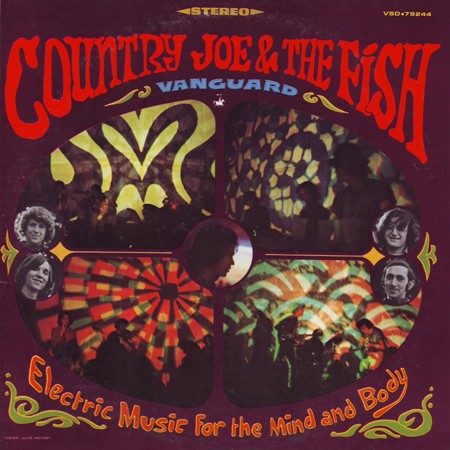
Electric Music for the Mind and Body (1967)
- 艺人
- 乡村老乔与鱼乐团
- 发行
- 1967-04
- 类型
- 专辑
- 唱片公司
- Vanguard唱片
- 制作人
- Samuel Charters
- 版本
- MusicBrainz 上有 8 个发行版本
曲目
- A1Flying High2:41
- A2Not So Sweet Martha Lorraine4:24
- A3Death Sound4:26
- A4Porpoise Mouth2:51
- A5Section 437:26
- B1Super Bird2:07
- B2Sad and Lonely Times2:26
- B3Love2:24
- B4Bass Strings5:03
- B5The Masked Marauder3:12
- B6Grace7:04
11 首 · 约 44 分钟 · 依据 1967-04 US 发行的版本,在 MusicBrainz 看这个版本。
介绍
这个词条没有中文维基百科条目,下面是英文维基百科的原文。
Electric Music for the Mind and Body is the debut album by the American psychedelic rock band Country Joe and the Fish. Released in May 1967 on the Vanguard label, it was one of the first psychedelic albums to come out of the San Francisco Bay Area.
Tracks from the LP, especially "Section 43", "Grace", and "Not So Sweet Martha Lorraine", were played on progressive FM rock stations like KSAN and KMPX in San Francisco, often back-to-back. A version of the song "Love" was performed at the 1969 Woodstock Festival.
Background
Country Joe and the Fish were originally formed in 1965 by Country Joe McDonald and Barry Melton as an acoustic folk/jugband duo. This embryonic version of the group, supplemented by Carl Shrager, Bill Steele and Mike Beardslee, recorded an initial EP in September of that year which was released as a "talking issue" of Rag Baby magazine a month later. The EP featured early versions of "I-Feel-Like-I'm-Fixin-to-Die Rag" and "Superbird", both of which would be re-recorded for the first two albums, along with two Peter King tracks. By January 1966 the group had expanded into a semi-electric six-piece, with the transition to a fully electric rock band happening after several members attended a Paul Butterfield Blues Band and Jefferson Airplane show at UC Berkeley on April 16. On June 6, this version of the group cut a self-titled second EP at Berkeley's Sierra Sound Laboratories; released that July, it featured three songs ("Section 43", "Thing Called Love", and "Bass Strings"), all of which would be re-recorded for the debut album. The EP was pressed four times and proved very popular, which resulted in record company attention; in early November 1966 the group were set to record a third EP when they were discovered and signed to Vanguard records by producer Samuel Charters.
Songs and recording
In late November 1966 the group began trial recordings for the album at Sierra Sound Laboratories, but clashes between Joe and drummer John Francis Gunning led to the latter's abrupt firing. His replacement, Gary "Chicken" Hirsh, joined the group in time for an extended period of rehearsals at The Barn in the Santa Cruz Mountains in the weeks before Christmas 1966, where the new lineup gelled.
Recording sessions for the album proper took place on four-track machines during the first week of February 1967 at Sierra Sound, produced by Charters. The instrumental backings to the songs were largely played live in the studio, with Joe's later vocal overdubs recorded with the lights out due to his self-consciousness at having the others look at him while singing.
The first songs recorded on February 1 were "Not So Sweet Martha Lorraine", chosen as the lead single that April, and "Bass Strings", which had originally appeared on the second EP. According to Joe, the subject of "Lorraine" was a compendium of several different women although he professed to not particularly like the song, and wondered how it became popular. The group were nervous to sing "Bass Strings" as the lyrics admitted they all smoked marijuana, which was a felony at the time. In the song Joe urges his pals to "pass that reefer round," and at the end of the track Joe can be heard whispering the letters "L-S-D".
On February 2, "Porpoise Mouth" (known as "Happiness Is A Porpoise Mouth" on the stereo pressing) and "The Masked Marauder" were committed to tape. Of the former, Joe stated "It was shocking to write about an erection, and I couldn't believe that I'd actually done that and sung it. The song was clever in the way that it shifts from 3/4 to 6/8." "The Masked Marauder" is a multi-sectional instrumental which was the newest thing written for the album, developed during the December 1966 Barn rehearsals. The next day, "Death Sound" (known as "Death Sound Blues" on the stereo pressing), "Love" and "Grace" were tackled. "Death Sound" was one of the earliest songs penned, an acid-blues number with dark themes of death. "Love" had been another early song written by the whole band and recorded for the self-titled second EP as "Thing Called Love", although it appears here in a faster rearrangement with a soul backbeat and lead vocal by Melton. "Grace" was Joe's ode to Grace Slick, the lead singer of Jefferson Airplane.Joe had met her while she was in her earlier band, the Great Society, and wanted to give her better material to sing. The song was influenced by Japanese music and employed a number of sonic additions including bells, chimes, water sound effects, and increasing echo delay, getting slower as it progresses.
正文摘自英文维基百科「Electric Music for the Mind and Body」,按 CC BY-SA 4.0 使用;删去了参考文献、外部链接、表格和图片;篇幅所限只节选了前面一部分,全文见原条目。
资料卡
- 作品性质
- 音乐专辑
- 表演者
- 乡村老乔与鱼乐团
- 发行日期
- 1967 年
- 流派
- 迷幻摇滚
- 语言
- 英语
- 唱片公司
- Vanguard唱片
- 制作人
- Samuel Charters
- 下一部
- I-Feel-Like-I'm-Fixin'-to-Die
资料来自 Wikidata Q912276(CC0)。
制作名单
- 厂牌
- Vanguard(目录号 VSD-79244)
制作
- 制作人
- Sam Charters(第 B1 首)
演奏与演唱
- 贝斯
- Bruce Barthol(第 B1 首)
- 吉他
- David Bennett Cohen(第 B1 首)、Barry Melton(第 B1 首)
- 鼓
- Gary "Chicken" Hirsh(第 B1 首)
- 主唱
- Country Joe McDonald(第 B1 首)
词曲与编曲
- 词曲
- Country Joe McDonald、Bruce Barthol(第 B3 首)、David Bennett Cohen(第 B3 首)、John Francis Gunning(第 B3 首)、Gary "Chicken" Hirsh(第 B3 首)、Barry Melton(第 B3 首)
名单来自 MusicBrainz(CC0)这一发行版本的关系数据,由志愿者录入,不一定齐全。
更多资料与乐评
在哪听
乡村老乔与鱼乐团 的其他专辑
艺人页 ›
相似的专辑
同在 1967 年发行