乐单
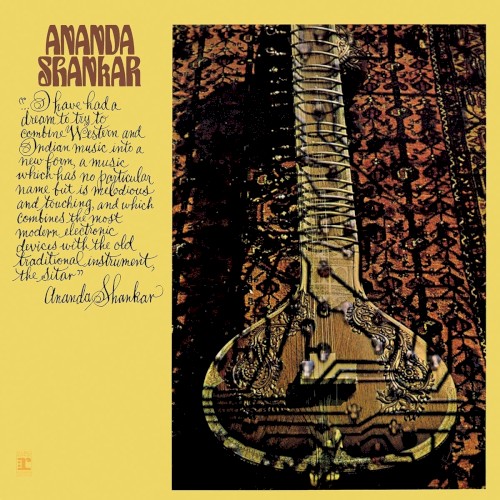
Ananda Shankar (1970)
曲目
- A1Jumpin' Jack Flash3:36
- A2Snow Flower2:49
- A3Light My Fire3:32
- A4Mamata (Affection)3:09
- A5Metamorphosis6:50
- B1Sagar (The Ocean)13:17
- B2Dance Indra3:53
- B3Raghupati3:28
8 首 · 约 41 分钟 · 依据 1970 US 发行的版本,在 MusicBrainz 看这个版本。
介绍
这个词条没有中文维基百科条目,下面是英文维基百科的原文。
Ananda Shankar is the debut album by the Indian musician Ananda Shankar, the son of dancer and choreographer Uday Shankar and the nephew of the Indian classical musician Ravi Shankar. It was released in 1970 on the Reprise record label. The album fuses Indian music with Western rock and electronic music, and was among the first works in the rock genre by an Indian musician. Consisting mainly of instrumental recordings featuring sitar and Moog synthesizer, it includes a cover version of the Rolling Stones' 1968 hit song "Jumpin' Jack Flash" and a thirteen-minute Indian-style piece titled "Sagar (The Ocean)".
Ananda Shankar followed a series of sitar-based releases by artists hoping to capitalise on the mid-1960s raga rock trend. Initially conceived as a collaboration with guitarist Jimi Hendrix, it was instead recorded in Los Angeles by Shankar with contributors such as synthesizer exponent Paul Lewinson. In the decades since the LP's release, "Jumpin' Jack Flash" became a popular club hit, while the album has been recognised for its influence on world music fusion, particularly the East–West styles developed in the UK. It is one of the albums featured in Robert Dimery's book 1001 Albums You Must Hear Before You Die.
Background
The son of Indian dance pioneer Uday Shankar, Ananda Shankar left Bombay in the late 1960s for California, where his uncle, Indian classical musician and composer Ravi Shankar, had been based since 1967. Ananda spent time in San Francisco before settling in Los Angeles, where he became immersed in the psychedelic music scene. A trained sitarist, he began playing with rock guitarist Jimi Hendrix, who suggested that they record an album together in 1968. According to Shankar, he thought about it for three days but declined Hendrix's offer, reasoning that "it wouldn't be my music. So I made the album alone."
Shankar envisioned a musical form that blended Indian classical music with Western rock and electronic styles. Although fusing rock or pop with Indian influences was common among Western artists during the psychedelic era, particularly after the Beatles had included sitar on their 1965 song "Norwegian Wood", Shankar was among the first Indian musicians to attempt it. The album was produced by Alex Hassilev, who secured the support of Reprise Records. Hassilev said he was interested in the potential of a project that combined sitar, Moog synthesizer and percussion, having produced the 1967 album The Zodiac: Cosmic Sounds, which was one of the first to feature a Moog. Shankar's main collaborator was Paul Lewinson, a keyboard player who had mastered the Moog system set up at Hassilev's home.
Recording
Recording for Ananda Shankar took place in the basement studio at Hassilev's house, on West Knoll Drive in Hollywood. The engineer and co-producer was James Lowe, formerly the vocalist of the psychedelic rock band the Electric Prunes. Aside from Pranish Khan on tabla, all the contributors were Western musicians playing rock instrumentation; Lowe termed them "our own 'wrecking crew'". Among the participants were Jerry Scheff, the bassist in Elvis Presley's touring band, and drummers Mike Botts and Joe Pollard. The other musicians were guitarists Drake Levin and Dick Rosmini, and bass player Mark Tulin, Lowe's former bandmate in the Electric Prunes.
The majority of the songs were co-written by Shankar and Lewinson, who was also credited as musical arranger. According to Hassilev, the potential for improvisation among the musicians was limited by the difficulties presented by the Moog synthesizer. The inclusion of cover versions of the Rolling Stones' "Jumpin' Jack Flash" and the Doors' "Light My Fire" was another compromise. These two tracks ensured that the album would have instant appeal for a rock audience in the manner of the various sitar-based LPs that had resulted from the popularity of raga rock since 1966, including Raga Rock by Harihar Rao and Big Jim Sullivan's Sitar Beat and Lord Sitar. Among the original material on Ananda Shankar, psychedelic influences were especially evident in "Snow Flower", while the thirteen-minute "Sagar (The Ocean)" was the closest to the Indian classical style. For "Raghupati", which was an adaptation of an Indian folk song, ten of Shankar's friends participated in the recording, playing and supplying the chanted chorus.
正文摘自英文维基百科「Ananda Shankar (album)」,按 CC BY-SA 4.0 使用;删去了参考文献、外部链接、表格和图片;篇幅所限只节选了前面一部分,全文见原条目。
资料卡
- 作品性质
- 音乐专辑
- 表演者
- Ananda Shankar
- 发行日期
- 1970 年
- 流派
- 拉格摇滚、印度流行音乐
- 语言
- 没有该语言的内容
- 唱片公司
- 重复唱片
资料来自 Wikidata Q698880(CC0)。
制作名单
- 厂牌
- Reprise Records(目录号 RS 6398)
制作
- 工程师
- John Horton
- 制作人
- Alex Hassilev、Thaddeus James Lowe
词曲与编曲
- 编曲
- Paul Lewinson
- 词曲
- 米克·贾格尔(第 A1 首)、基思·理查兹(第 A1 首)、John Densmore(第 A3 首)、Robby Krieger(第 A3 首)、Ray Manzarek(第 A3 首)、詹姆斯·道格拉斯·“吉姆”·莫里森(第 A3 首)
- 作曲
- Paul Lewinson(第 A2 首)、Ananda Shankar(第 A2 首)
名单来自 MusicBrainz(CC0)这一发行版本的关系数据,由志愿者录入,不一定齐全。
更多资料与乐评
在哪听
相似的专辑

同在 1970 年发行