乐单
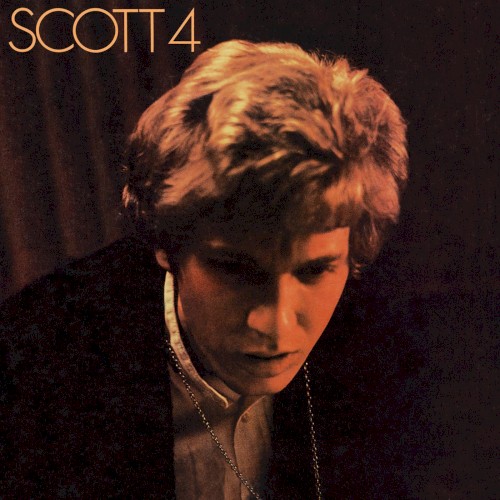
Scott 4 (1969)
曲目
- A1The Seventh Seal4:57
- A2On Your Own Again1:48
- A3The World’s Strongest Man2:19
- A4Angels of Ashes4:20
- A5Boy Child3:37
- B1Hero of the War2:25
- B2The Old Man’s Back Again (Dedicated to the Neo‐Stalinist Regime)3:43
- B3Duchess2:49
- B4Get Behind Me3:12
- B5Rhymes of Goodbye3:04
10 首 · 约 32 分钟 · 依据 1969-11 GB 发行的版本,在 MusicBrainz 看这个版本。
介绍
这个词条没有中文维基百科条目,下面是英文维基百科的原文。
Scott 4 is the fifth solo studio album (the fourth to include original material) by American musician Scott Walker, released on November 7, 1969. The album was released under his birth name, Scott Engel, and failed to chart. Reissues have been released under his stage name. It has since received praise as one of Walker's best works.
Content
Scott 4 was the first Walker album to consist solely of self-penned songs. The preceding Scott (1967), Scott 2 (1968) and Scott 3 (1969) albums had each featured a mixture of originals and covers, including several translations of Jacques Brel songs, which were later collected to form the album Scott Walker Sings Jacques Brel (1981). Scott 4 also features slightly less ornate orchestral arrangements than its predecessors, opting instead for a more skeletal, folk-inspired sound with greater emphasis on the rhythm section.
The opening track, "The Seventh Seal", is based on the 1957 film of the same name by filmmaker Ingmar Bergman. The second track on side two, "The Old Man's Back Again (Dedicated to the Neo-Stalinist Regime)", refers to the 1968 Warsaw Pact invasion of Czechoslovakia.
The Albert Camus quote, "A man's work is nothing but this slow trek to rediscover, through the detours of art, those two or three great and simple images in whose presence his heart first opened", appears on the back of the album sleeve. The quote derives from Camus' essay "Between Yes and No", published in 1958.
Engel said the album tried to "link lyrics by Sartre, Camus and Yevtushenko to Bartok modal lines."
Release and reception
Scott 4 was released by Philips Records on 7 November 1969 in the United Kingdom. The album failed to chart and was deleted soon after.
It has been speculated that Walker's decision to release the album under his birth name of Scott Engel contributed to its chart failure. All subsequent re-issues of the album have been released under his stage name. After being out of print for over 20 years, the album was first re-issued in 1992 on CD, alongside the first CD re-issues of Scott, Scott 2 and Scott 3.
Critical
In a contemporary review for New Musical Express published November 29, 1969, Graham Coxhill stated, "Scott 4 [...] is released next week, and if there has ever been a better album by a male singer, it certainly hasn't come my way." He concluded, "I don't think Scott has yet found his musical resting place, but to judge by Scott 4, he has outgrown his self-indulgent, two-fingers-to-the-world phase, and at last he's hit on some fine music which a public can enjoy and of which he can justifiably feel proud."
A writer for Observer-Leader commented how Engel singing solely original compositions throughout the "exciting" album "creates quite an impact", believing the singer would win new appreciation but also lose fans who preferred his Walker Brothers image, adding: "If you care to sit, listen and accept his preachings, then count yourselves among the new Scott Engel fans." Reviewing Scott 4, the Sunday Mirror believed the change of stage name was irrelevant because "this is the most sincere vocal sound both sides of the Atlantic". The Lincolnshire Echo believed it was stylistically similar to Engel's previous three albums, with impressive vocals over a full orchestral backing, finally characterising the album as "sophisticated pop".
Mark Lager, in a retrospective review, wrote that it is "arguably the best album of his career, you can hear from the first notes of the opening track that he was ambitiously and boldly pushing both his lyrics and soundscapes into a stronger terrain. 'Seventh Seal' is an Ennio Morriconesque epic. His lyrics in 'Angels of Ashes' are spiritual and share similarities with Rainer Maria Rilke's Duino Elegies. 'Boy Child' contains celestial, ghostly orchestration. 'Old Man's Back Again' is arguably Scott Walker's most powerful song. David Bowie was heavily influenced and inspired by Scott Walker not only in his deep, baritone vocals but also in his own Cold War contemplations in the instrumentals of Low. On 'Get Behind Me', the soaring gospel choir and sublime orchestrations joined with his own soulful and stunning vocals make this a magnificent masterpiece." Reviewing the 1992 reissue, Select critic Andrew Perry rated Scott 4 five stars out of five and called it a "total classic", believing the songs to be "grand-scale in their efforts to pin down sheer, sad emotion to beautiful words and music." Ian Harrison, also of Select, noted how the album contains "barmy, fatalist sublimities" like "The Seventh Seal".
Legacy
Scott 4 subsequently came to be regarded as one of Walker's strongest works and has been acknowledged in the book 1001 Albums You Must Hear Before You Die. It was voted number 760 in the third edition of Colin Larkin's All Time Top 1000 Albums (2000). It has also been praised by the members of Radiohead.
Personnel
Peter Knight – accompaniment director (1, 4, 6, 7)
Wally Stott – accompaniment director (2, 5)
Keith Roberts – accompaniment director (3, 8–10)
John Franz – producer
正文摘自英文维基百科「Scott 4」,按 CC BY-SA 4.0 使用;删去了参考文献、外部链接、表格和图片;篇幅所限只节选了前面一部分,全文见原条目。
资料卡
- 作品性质
- 音乐专辑
- 表演者
- 斯科特·沃克
- 发行日期
- 1969 年
- 流派
- 巴洛克流行
- 语言
- 英语
- 唱片公司
- 飞利浦唱片、方塔纳唱片
资料来自 Wikidata Q1286461(CC0)。
制作名单
- 厂牌
- Philips(目录号 844 248 BY)、Philips(目录号 SBL 7913)、Philips(目录号 SBL.7913)
制作
- 制作人
- John Franz
- 工程师
- Keith Grant(第 A1、A2、A5、B2 首)、Adrian Kerridge(第 A1、A2、A5、B2 首)
词曲与编曲
- 作曲
- 斯科特·沃克(其中 7 首)
- 作词
- 斯科特·沃克(其中 7 首)
- 词曲
- 斯科特·沃克(第 B1、B2、B4 首)
名单来自 MusicBrainz(CC0)这一发行版本的关系数据,由志愿者录入,不一定齐全。
更多资料与乐评
在哪听
斯科特·沃克 的其他专辑
艺人页 ›
相似的专辑

同在 1969 年发行