乐单
曲目
- A1Born on the Bayou5:10
- A2Bootleg2:58
- A3Graveyard Train8:32
- B1Good Golly Miss Molly2:39
- B2Penthouse Pauper3:37
- B3Proud Mary3:07
- B4Keep On Chooglin’7:40
7 首 · 约 34 分钟 · 依据 1969-01-05 US 发行的版本,在 MusicBrainz 看这个版本。
介绍
这个词条没有中文维基百科条目,下面是英文维基百科的原文。
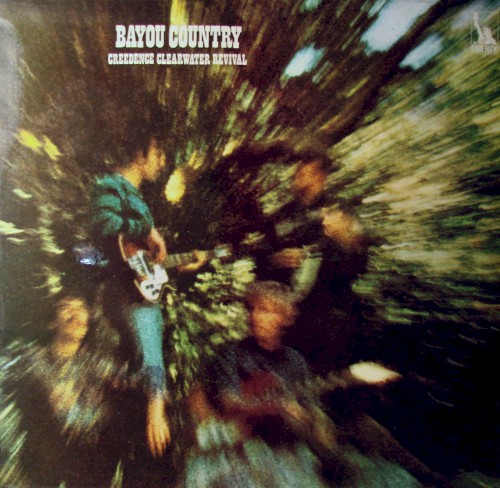
Bayou Country is the second studio album by the American rock band Creedence Clearwater Revival (CCR), released by Fantasy Records on January 15, 1969, and was the first of three albums CCR released in that year. Bayou Country reached No. 7 on the Billboard 200 chart and produced the band's first No. 2 hit single, "Proud Mary".
Background
After ten years of struggling as the Blue Velvets and the Golliwogs, singer/guitarist John Fogerty, his brother guitarist Tom Fogerty, bassist Stu Cook, and drummer Doug Clifford scored a No. 11 hit single with "Susie Q" in June 1968 under the name Creedence Clearwater Revival. Their self-titled album peaked at No. 52 on the Billboard albums chart.
Despite their new-found success, however, seeds of discontent among the four members had already been planted due to John Fogerty assuming control of the band at just about every level. "There was a point at which we had done the first album. Everybody had listened to my advice. I don't think anybody thought too much about it," Fogerty recalled to Michael Goldberg of Rolling Stone in 1993. "But in making the second album, Bayou Country, we had a real confrontation. Everybody wanted to sing, write, make up their own arrangements, whatever, right? This was after ten years of struggling. Now we had the spotlight. Andy Warhol's fifteen minutes of fame. 'Susie Q' was as big as we'd ever seen. Of course, it really wasn't that big...I didn't want to go back to the carwash."
In 2007, the singer elaborated to Joshua Klein of Pitchfork, "I determined, we're on the tiniest record label in the world, there's no money behind us, we don't have a manager, there's no publicist. We basically had none of the usual star-making machinery, so I said to myself I'm just going to have to do it with the music...Basically I wanted to do what the Beatles had done. I sensed that I just had to do it myself."
Songwriting
Bayou Country contains one of John Fogerty's most heralded songs, "Proud Mary", which peaked at No. 2 on the singles chart. In a 1969 interview, Fogerty said that he wrote it in the two days after he was discharged from the National Guard. In the liner notes for the 2008 expanded reissue of Bayou Country, Joel Selvin explained that the riffs for "Proud Mary", "Born on the Bayou", and "Keep on Chooglin'" were conceived by Fogerty at a concert in the Avalon Ballroom, and "Proud Mary" was arranged from parts of different songs, one of which was about a "washerwoman named Mary". The line "Left a good job in the city" was written following Fogerty's discharge from the National Guard, and the line "rollin' on the river" was from a movie by Will Rogers. In the Macintosh program "Garage Band", Fogerty explained that he liked Beethoven's Fifth Symphony, and wanted to open a song with a similar intro, referring to the way "Proud Mary" opens with the repeated C chord to A chord. In 1998, Fogerty admitted to Harold Steinblatt of Guitar World that he knew the composition was "my first really good song. I was 23 years old, I believe, and I'd been kind of playing at music for 10 years. But I recognized the importance of 'Proud Mary' immediately." In the same interview, Fogerty stated that the guitar solo was "me trying to be Steve Cropper," the guitarist from Booker T. & the M.G.s. The song was acclaimed almost immediately, with Solomon Burke scoring a minor hit with it in 1969 and a radically rearranged version appearing on Ike and Tina Turner's 1971 LP Workin' Together. Bob Dylan told Rolling Stone in a 1969 interview that it was his favorite song of the year. In 2012, Fogerty recalled to Uncut's David Cavanagh that he was extremely focused at the time, honing his songwriting with a single-mindedness that led to a proficient string of hits:
I would sit in my little apartment - which was very sparse - and stare at the wall. That's how I wrote. I would stare at it all night. There was nothing hanging on the wall, because I didn't have any money for paintings. It was just a beige wall. It was a blank slate, a blank canvas. But it was also exciting. I could go anywhere and do anything because I was a writer. I was conjuring that place deep in my soul that was me.
The swampy album opener "Born on the Bayou" was conceived in the same setting, with Fogerty explaining to Lynne Margolis of American Songwriter in 2013:
正文摘自英文维基百科「Bayou Country (album)」,按 CC BY-SA 4.0 使用;删去了参考文献、外部链接、表格和图片;篇幅所限只节选了前面一部分,全文见原条目。
资料卡
- 作品性质
- 音乐专辑
- 表演者
- 克里登斯清水复兴合唱团
- 发行日期
- 1969 年 1 月 5 日
- 时长
- 33 分 48 秒
- 流派
- 南方摇滚
- 语言
- 英语
- 唱片公司
- E.G.唱片
- 制作人
- 约翰·弗格蒂
资料来自 Wikidata Q791564(CC0)。
制作名单
- 厂牌
- Fantasy(目录号 8387)
制作
- 制作人
- 约翰·弗格蒂
演奏与演唱
- 吉他
- Tom Fogerty(第 A1、B1、B3 首)、约翰·弗格蒂(第 A1、B3 首)
- 鼓
- Doug Clifford(第 A1、B3 首)
- 贝斯
- Stu Cook(第 A1、B3 首)
- 康加鼓
- 约翰·弗格蒂(第 A1 首)
- 牛铃
- 约翰·弗格蒂(第 A1 首)
- 演出
- 克里登斯清水复兴合唱团(第 A1 首)
- 演唱
- 约翰·弗格蒂(第 B3 首)
词曲与编曲
- 编曲
- 约翰·弗格蒂
- 作曲
- 约翰·弗格蒂(第 A1、A2、A3、B2、B3、B4 首)
- 作词
- 约翰·弗格蒂(第 A1、A2、B3、B4 首)
- 词曲
- Robert “Bumps” Blackwell(第 B1 首)、John Marascalco(第 B1 首)
名单来自 MusicBrainz(CC0)这一发行版本的关系数据,由志愿者录入,不一定齐全。
更多资料与乐评
在哪听
克里登斯清水复兴合唱团 的其他专辑
艺人页 ›
相似的专辑
同在 1969 年发行