乐单
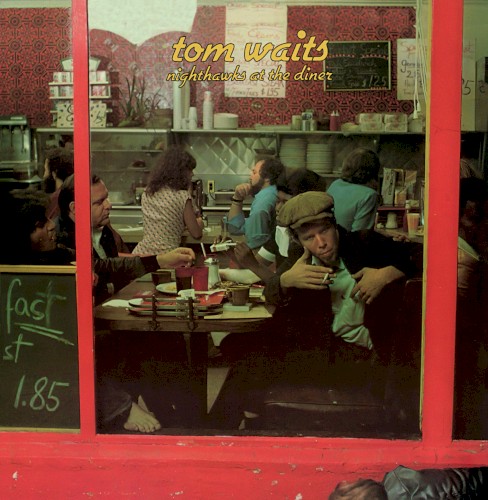
Nighthawks at the Diner (1975)
曲目
第 1 张 · 12" Vinyl
- A1[opening intro]2:59
- A2Emotional Weather Report3:43
- A3[intro]2:18
- A4On a Foggy Night3:49
- A5[intro]1:55
- A6Eggs and Sausage (in a Cadillac With Susan Michelson)4:13
- B1[intro]3:22
- B2Better Off Without a Wife3:53
- B3Nighthawk Postcards (From Easy Street)11:27
第 2 张 · 12" Vinyl
- C1[intro]0:55
- C2Warm Beer and Cold Women5:21
- C3[intro]0:48
- C4Putnam County7:34
- C5Spare Parts I (A Nocturnal Emission)6:23
- D1Nobody2:49
- D2[intro]0:41
- D3Big Joe and Phantom 3096:30
- D4Spare Parts II and Closing5:14
18 首 · 约 74 分钟 · 依据 1975-10-21 US 发行的版本,在 MusicBrainz 看这个版本。
介绍
这个词条没有中文维基百科条目,下面是英文维基百科的原文。
Nighthawks at the Diner is the third studio album by singer and songwriter Tom Waits, released on October 21, 1975, on Asylum Records. It was recorded over four sessions in July in the Los Angeles Record Plant studio in front of a small invited audience set up to recreate the atmosphere of a jazz club. The album peaked at 164 on the Billboard 200, the highest place Waits had held at the time, and was certified silver by the BPI in 2010. It has received critical acclaim for its successful mood-setting, capturing of the jazz-club atmosphere and characterization.
Background
The title was inspired by Edward Hopper's 1942 painting Nighthawks. The album's working title had been "Nighthawk Postcards from Easy Street," but was shortened to Nighthawks at the Diner, which is the opening line to "Eggs and Sausage (In a Cadillac with Susan Michelson)". The cover, designed by Cal Schenkel, evokes the mood of the painting.
Recording
The album was recorded at Record Plant Los Angeles on July 30 and 31, 1975. Waits opens the album by calling the venue Raphael's Silver Cloud Lounge. Bones Howe recalled:
"We did it as a live recording, which was unusual for an artist so new [...] Herb Cohen and I both had a sense that we needed to bring out the jazz in Waits more clearly. Tom was a great performer on stage [...] So we started talking about where we could do an album that would have a live feel to it. We thought about clubs, but the well-known ones like The Troubadour were toilets in those days. Then I remembered that Barbra Streisand had made a record at the old Record Plant Studios, when they were on 3rd Street near Cahuenga Boulevard [...] There was a room there that she got an entire orchestra into. Back in those days they would just roll the consoles around to where they needed them. So Herb and I said let's see if we can put tables and chairs in there and get an audience in and record a show."
Howe was mostly responsible for organizing the band for the "live show", and creating the right atmosphere for the record.
"I got Michael Melvoin on piano, and he was one of the greatest jazz arrangers ever; I had Jim Hughart on bass, Bill Goodwin on drums and Pete Christlieb on sax. It was a totally jazz rhythm section. Herb gave out tickets to all his friends, we set up a bar, put potato chips on the tables and we had a sell-out, two nights, two shows a night, July 30 and 31, 1975. I remember that the opening act was a stripper. Her name was Dewana and her husband was a taxi driver. So for her the band played bump-and-grind music – and there's no jazz player who has never played a strip joint, so they knew exactly what to do. But it put the room in exactly the right mood. Then Waits came out and sang 'Emotional Weather Report.' Then he turned around to face the band and read the classified section of the paper while they played. It was like Allen Ginsberg with a really, really good band."
Dewana was an old-time burlesque queen whom Tom had met on one of his jaunts to the Hollywood underworld. Jim Hughart, who played upright bass on the recordings, recalled the experience of preparing for and recording the album:
"Preparing for this thing, we had to memorize all this stuff, 'cause Waits had nothing on paper. So ultimately, we spent four or five days in a rehearsal studio going over this stuff. And that was drudgery. But when we did actually get it all prepared and go and record, that was the fastest two days of recording I've ever spent in my life. It was so fun. Some of the tunes were not what you'd call jazz tunes, but for the most part that was like a jazz record. This was a jazz band. Bill Goodwin was a drummer who was associated with Phil Woods for years. Pete Christlieb is one of the best jazz tenor players who ever lived. And my old friend, Mike Melvoin, played piano. There's a good reason why it was accepted as a jazz record."
During the track "Nighthawk Postcards (From Easy Street)", Waits ad-libs lines from "That's Life", a hit for Frank Sinatra.
Reception
Nighthawks at the Diner charted on the Billboard 200, where it peaked at 164. This was the highest position he had ever held at the time. His next album, Small Change, would be his highest charting with Asylum Records, with whom he would part company in 1981. Nighthawks is currently certified Silver by the BPI.
正文摘自英文维基百科「Nighthawks at the Diner」,按 CC BY-SA 4.0 使用;删去了参考文献、外部链接、表格和图片;篇幅所限只节选了前面一部分,全文见原条目。
资料卡
- 作品性质
- 音乐专辑
- 表演者
- 汤姆·威茨
- 发行日期
- 1975 年 10 月 21 日
- 时长
- 1 小时 13 分
- 流派
- 爵士乐、朗诵诗
- 语言
- 英语
- 唱片公司
- 庇护所唱片公司
- 制作人
- 波尼斯·豪威
资料来自 Wikidata Q921629(CC0)。
制作名单
- 厂牌
- Asylum Records(目录号 7E-2008)
- 录音室
- 录音:The Record Plant(Hollywood)
制作
- 工程师
- Dayton “Bones” Howe
- 制作人
- Dayton “Bones” Howe
演奏与演唱
- 演唱
- 汤姆·威茨
- 低音提琴
- Jim Hughart(其中 15 首)
- 鼓
- Bill Goodwin(其中 13 首)
- 次中音萨克斯
- Pete Christlieb(其中 11 首)
- 钢琴
- 汤姆·威茨(其中 9 首)、Mike Melvoin(第 A1、A2、A4、B3、C5、D4 首)
- 吉他
- 汤姆·威茨(第 A3、A4、D2、D3 首)
- 电钢琴
- Mike Melvoin(第 A6、B2、C2、C4 首)
词曲与编曲
- 作曲
- 汤姆·威茨(其中 9 首)、Tommy Faile(第 D3 首)
- 作词
- 汤姆·威茨(其中 9 首)、Tommy Faile(第 D3 首)
- 词曲
- 汤姆·威茨(第 C5 首)、Chuck E. Weiss(第 C5 首)
名单来自 MusicBrainz(CC0)这一发行版本的关系数据,由志愿者录入,不一定齐全。
更多资料与乐评
在哪听
汤姆·威茨 的其他专辑
艺人页 ›
相似的专辑
同在 1975 年发行