乐单
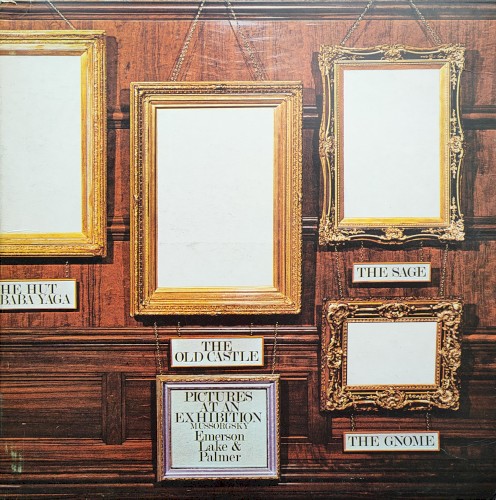
Pictures at an Exhibition (1971)
曲目
- A1Promenade2:46
- A2The Gnome5:40
- A3Promenade1:24
- A4The Sage5:06
- A5The Old Castle4:27
- A6Blues Variation6:02
- B1Promenade1:30
- B2The Hut of Baba Yaga1:16
- B3The Curse of Baba Yaga4:58
- B4The Hut of Baba Yaga1:11
- B5The Great Gates of Kiev / Nutrocker11:00
11 首 · 约 45 分钟 · 依据 1971-11 GB 发行的版本,在 MusicBrainz 看这个版本。
介绍
这个词条没有中文维基百科条目,下面是英文维基百科的原文。
Pictures at an Exhibition is a live album by English progressive rock band Emerson, Lake & Palmer, released in the United Kingdom in November 1971 by Island Records and in the United States in January 1972 by Cotillion Records. It features the group's adaptation of Pictures at an Exhibition, the piano suite by Modest Mussorgsky, performed at Newcastle City Hall on 26 March 1971.
The album concludes with the concert's encore, "Nut Rocker", a rock adaptation of The Nutcracker originally arranged by Kim Fowley and recorded by B. Bumble and the Stingers in 1962.
Pictures at an Exhibition went to number 3 on the UK Albums Chart and number 10 on the US Billboard 200. In 2001, it was reissued as a remastered edition that included a studio version of the piece recorded in 1993.
Background
In February 1971, Emerson, Lake & Palmer finished recording their second studio album Tarkus. They resumed touring in the following month, which began with a UK leg that included a show at Newcastle City Hall, Newcastle on 26 March. The tour's setlist included their arrangement of the classical suite Pictures at an Exhibition by Modest Mussorgsky, which had been performed since their live debut in August 1970. Keyboardist Keith Emerson had attended an orchestral performance of the suite several years before, and bought a copy of the score. He pitched the idea of performing the suite to singer/bassist/guitarist Greg Lake and drummer Carl Palmer, who agreed to adapt it. Both members contributed their own arrangements and additions to the suite.
The band had already recorded and filmed a live performance of the piece at the Lyceum Theatre in London, on 9 December 1970, and planned a live album release around August 1971. However, their dissatisfaction with the picture, editing, and audio led to the decision to record another show. Palmer deemed the film "shocking" which lacked any contemporary filming technique, and said the absence of engineer Eddy Offord to control the sound contributed to its substandard quality. The date at Newcastle City Hall was chosen for the new recording, and Palmer recalled the "amazing atmosphere" of the concert. Emerson said the venue was chosen as the band were popular there, and hoped to use its pipe organ. He was granted permission, but had to promise the Musician's Union he would not stick knives on the console, which he had done since he was in The Nice. The band paid for the recording costs themselves, with the aim of producing the best quality version. They arrived at Newcastle at 10am and underwent rehearsals and checks for several hours. The Lyceum concert film had a limited theatrical release, which Palmer said was only due to the fact that a group friend was in charge and let them release it.
The album was recorded using the mobile recording unit from Pye Records. The opening section, "Promenade", features Emerson playing a Harrison & Harrison pipe organ which was installed at the venue in 1928. The organ console is some way above stage level, at the top of a stepped terrace typically used for choral performances. Palmer's drum roll connecting "Promenade" to the following section was added to give Emerson time to return to his keyboards.
Arrangement
The band's arrangement of the suite uses only four of the ten parts in Mussorgsky's suite, along with the linking "Promenade" sections. The suite was performed live as one continuous piece, with new, group-written sections linking Mussorgsky's original themes.
Note that Mussorgsky's original compositions are listed in bold:
"Promenade": Pipe organ solo by Emerson at the Harrison & Harrison pipe organ of the auditorium; followed by a drum roll
- "The Gnome": Group instrumental adaptation featuring fuzz bass, Hammond and Moog
- "Promenade": Hammond organ and soft vocal, followed by a short synthesizer solo
"The Sage": A new picture drawn by Lake solely on acoustic guitar in the mood of a medieval minnesang, it works as a sort of romantic prelude to "The Old Castle"
"The Old Castle": Begins with Emerson squeezing out whoops and whistles from the Moog's ribbon controller, followed by an accelerated adaptation of the original theme played by the full band
"Blues Variation": a Hammond-driven twelve-bar blues credited to the group, borrowing themes from "The Old Castle" and those that Emerson had previously performed with The Nice on their version of "My Back Pages"
- "Promenade": Full group instrumental version of the primary theme
- "The Hut of Baba Yaga": Full group instrumental adaptation
"The Curse of Baba Yaga": Lake adapts a section of Mussorgsky's music on fuzz/wah-wah bass, followed by a group-penned section with lyrics/vocal climaxing on a siren-like Moog solo
"The Hut of Baba Yaga": Full group reprise of the earlier "Hut" theme
"The Great Gates of Kiev": with lyrics/vocal added by the group and an extended climax featuring Emerson dragging his Hammond organ across the stage to produce feedback
正文摘自英文维基百科「Pictures at an Exhibition (Emerson, Lake & Palmer album)」,按 CC BY-SA 4.0 使用;删去了参考文献、外部链接、表格和图片;篇幅所限只节选了前面一部分,全文见原条目。
资料卡
- 作品性质
- 音乐专辑
- 表演者
- 爱默生、雷克与帕玛
- 发行日期
- 1971 年 11 月
- 录音地点
- Newcastle City Hall(1971)
- 时长
- 53 分 24 秒
- 流派
- 交响摇滚、跨界音乐、歌剧
- 语言
- 英语
- 唱片公司
- 小岛唱片
- 制作人
- 格雷格·雷克
资料来自 Wikidata Q769424(CC0)。
制作名单
- 厂牌
- Island(目录号 HELP 1)
词曲与编曲
- 作曲
- 基思·埃默森(第 A6 首)、格雷格·雷克(第 A6 首)、Carl Palmer(第 A6 首)
名单来自 MusicBrainz(CC0)这一发行版本的关系数据,由志愿者录入,不一定齐全。
更多资料与乐评
在哪听
爱默生、雷克与帕玛 的其他专辑
艺人页 ›
相似的专辑
同在 1971 年发行