乐单
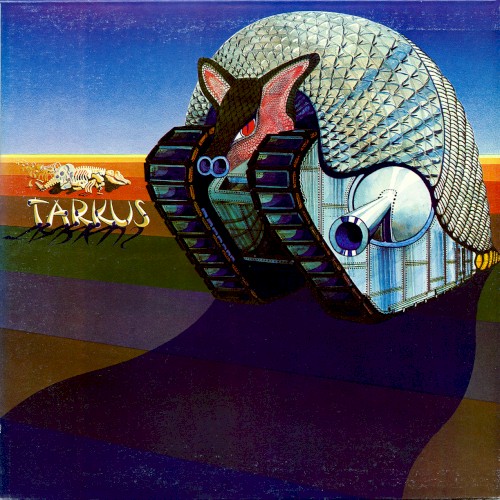
Tarkus (1971)
曲目
- A1Eruption2:44
- A2Stones of Years3:44
- A3Iconoclast1:16
- A4Mass3:12
- A5Manticore1:52
- A6Battlefield3:52
- A7Aquatarkus4:04
- B1Jeremy Bender1:50
- B2Bitches Crystal3:58
- B3The Only Way (Hymn)3:49
- B4Infinite Space (Conclusion)3:20
- B5A Time and a Place3:02
- B6Are You Ready Eddy?2:10
13 首 · 约 39 分钟 · 依据 1971-06-14 US 发行的版本,在 MusicBrainz 看这个版本。
介绍
这个词条没有中文维基百科条目,下面是英文维基百科的原文。
Tarkus is the second studio album by English progressive rock band Emerson, Lake & Palmer, released on 4 June 1971 by Island Records. Following their debut tour across Europe during the second half of 1970, the group paused touring commitments in January 1971 to record a new album at Advision Studios in London. Greg Lake produced the album with Eddy Offord as engineer.
Side one features the 20-minute conceptual title track written by keyboardist Keith Emerson, the opening of which created friction between Lake and Emerson that almost split the group, but Lake agreed to pursue it and contributed musical ideas for it and wrote the lyrics. Side two features a collection of unrelated tracks of different styles. The artwork was designed by William Neal.
Tarkus went to number one on the UK Albums Chart, becoming the only album by the band to do so. It was a top 10 album worldwide, including the US, where it peaked at number 9. The album reached gold certification in the UK and US, the latter for 500,000 copies sold. It has been reissued and remastered several times, including a new stereo and 5.1 surround sound edition by Steven Wilson, with bonus and previously unreleased tracks from the original sessions, released in 2012.
Background and recording
After their debut live gigs in August 1970, the band toured across the UK and Europe for the rest of the year, during which their debut album, Emerson, Lake & Palmer, was released. While on tour, Emerson found that he and drummer Carl Palmer were exploring more complex rhythmic ideas. He took patterns that Palmer was playing on his practice drum pads and found that they complemented runs that he had developed on the piano, and used this as a basis for material on Tarkus. The group approached the album by having a centrepiece track in order to establish a concept, but a definite story or idea for it had not been discussed at this stage.
The group paused touring commitments in December 1970 and set the following month aside to record. As with their debut, the band recorded at Advision Studios in London with Lake handling the production duties and Eddy Offord returning as engineer. Early into the sessions Emerson presented the basis of the title track to Lake and Palmer; Lake was less than enthusiastic with its direction and threatened to leave the group. A subsequent meeting amongst the band and their management convinced Lake to stay, and he went on to contribute to the track and most of the other songs on the album including the lyrics, for which he used the artwork as inspiration. Although Lake thought the opening was "too demonstrative" for the sake of being clever, he did not want to split the group over such an issue and got into the album as recording went on. The band could only work out "Tarkus" during the January 1971 studio sessions, so they booked further time at Advision in February to work on side two, for which they had no material prepared.
Songs
Side one
Side one is occupied by the 20-minute title track which has seven sections. It was written by Emerson, with Lake credited for "Battlefield" and contributions to "Stones of Years" and "Mass". It is a conceptual piece in which its narrative remains ambiguous and open to interpretation, but the artwork depicts the Tarkus character in the form of an armadillo tank hybrid who is born and loses a fight with a manticore, which concludes with the appearance of an aquatic version of Tarkus named Aquatarkus. Lake said the song is about "the futility of conflict, expressed in this context in terms of soldiers and war — but it's broader than that. The words are about revolution, the revolution that's gone, that has happened. Where has it got anybody? Nowhere." He added that the songs concern "the hypocrisy of it all" and the closing march "a joke".
Emerson wrote the first musical ideas for "Tarkus" from a 108 rhythm that Palmer had played on his practice drum pad backstage at a gig. He composed the entire piece in six days on his upright piano at his London apartment, and wrote the score on manuscript. After the band rehearsed it for six days, they put it to tape; Emerson said once Lake and Palmer had mastered the 54 and 108 rhythms, "everything else flowed." Emerson transposed "a fleeting run of one bar" from the Allegro of Sergei Prokofiev's Piano Concerto No. 3 to bridge a transition between two parts of "Eruption". The section is played in a 54 time signature which was a "frustrating" meter for Lake to play. Emerson wanted the "Aquatarkus" section to have a sound that resembled a snorkel tube as he was into scuba diving at the time, so he generated one from his Moog synthesizer and played it during the marching beat. The group would not record a longer track in the studio until 1973, with the 29-minute "Karn Evil 9".
正文摘自英文维基百科「Tarkus」,按 CC BY-SA 4.0 使用;删去了参考文献、外部链接、表格和图片;篇幅所限只节选了前面一部分,全文见原条目。
资料卡
- 作品性质
- 音乐专辑
- 表演者
- 爱默生、雷克与帕玛
- 发行日期
- 1971 年 6 月 14 日
- 录制时间
- 1971 年 1 月
- 录音地点
- Advision Studios
- 时长
- 38 分 55 秒
- 流派
- 交响摇滚、迷幻摇滚
- 唱片公司
- 小岛唱片
- 制作人
- 格雷格·雷克
资料来自 Wikidata Q920627(CC0)。
制作名单
- 厂牌
- Cotillion(目录号 SD 9900)
- 录音室
- 录音:Advision Studios(Fitzrovia)
制作
- 工程师
- Eddy Offord(第 B1、B2、B3、B4、B5、B6 首)
- 制作人
- 格雷格·雷克(第 B1、B2、B3、B4、B5、B6 首)
词曲与编曲
- 作曲
- 基思·埃默森(其中 12 首)、Carl Palmer(第 B4、B5、B6 首)、格雷格·雷克(第 A6、B6 首)
- 作词
- 格雷格·雷克(其中 8 首)
名单来自 MusicBrainz(CC0)这一发行版本的关系数据,由志愿者录入,不一定齐全。
更多资料与乐评
在哪听
爱默生、雷克与帕玛 的其他专辑
艺人页 ›

相似的专辑
同在 1971 年发行