乐单
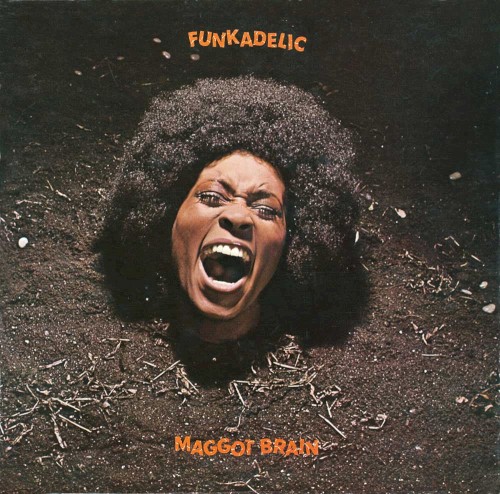
Maggot Brain (1971)
滚石 500(2020) #136滚石 500(2003) #4861001 张专辑
- 艺人
- 放克疯
- 发行
- 1971-07-12
- 类型
- 专辑
- 唱片公司
- Westbound唱片
- 版本
- MusicBrainz 上有 15 个发行版本
曲目
- A1Maggot Brain10:20
- A2Can You Get to That2:50
- A3Hit It and Quit It3:50
- A4You and Your Folks, Me and My Folks3:37
- B1Super Stupid3:57
- B2Back in Our Minds2:38
- B3Wars of Armageddon9:43
7 首 · 约 37 分钟 · 依据 1971-07-12 US 发行的版本,在 MusicBrainz 看这个版本。
介绍
这个词条没有中文维基百科条目,下面是英文维基百科的原文。
Maggot Brain is the third studio album by the American funk rock band Funkadelic, released by Westbound Records in July 1971. It was produced by bandleader George Clinton and recorded at United Sound Systems in Detroit during late 1970 and early 1971. The album was the final LP recorded by the original Funkadelic lineup; after its release, founding members Tawl Ross (guitar), Billy Nelson (bass), and Tiki Fulwood (drums) left the band for various reasons.
The album charted on the Billboard R&B Top 20. It is perhaps best known for its ten-minute title track, largely consisting of an improvised solo by guitarist Eddie Hazel. In 2009, Pitchfork named it the 17th best album of the 1970s. In 2020, Rolling Stone ranked Maggot Brain the 136th greatest album of all time in its updated list.
Music and lyrics
The album opens with a spoken word monologue by Funkadelic bandleader George Clinton, which refers to "the maggots in the mind of the universe". According to legend, the opening title track was recorded in one take when Clinton, under the influence of LSD, told lead guitarist Eddie Hazel to play as if he had just learned his mother was dead; Clinton instructed him "to picture that day, what he would feel, how he would make sense of his life, how he would take a measure of everything that was inside him and let it out through his guitar". Though several other musicians performed on the track, Clinton de-emphasized them in the final mix so that the focus would be on Hazel. Hazel utilized fuzz and wah effects, inspired by his idol Jimi Hendrix, on the track; Clinton subsequently added delay and other effects during the mixing process, saying: "I Echoplexed it back on itself three or four times. That gave the whole thing an eerie feel, both in the playing and in the sound effects." Critics have described the solo as "lengthy, mind-melting" and "an emotional apocalypse of sound."
The subsequent five tracks have been described as "sour harmony-group meditations heavy with bass, keyboard and class consciousness," with the band exploring a "psychedelic/funk fusion." "Can You Get to That" features Isaac Hayes' backing vocal group Hot Buttered Soul, and contains elements of folk blues and gospel music. "You and Your Folks, Me and My Folks" explores the need for interracial unity and platonic love, and features electronically distorted drums. "Super Stupid" was described by Pitchfork as a "tale of a dumbass junkie set to a tune Black Sabbath would have been proud of." The nine-minute closing track "Wars of Armageddon" has been described as a "freak-out" jam, and makes use of "paranoid, psychedelic sound effects and crowd sounds." Popular music scholar Yuval Taylor described it as "a burning hot prefiguring" of the music that Miles Davis would perform on his 1975 live album Agharta.
Release
Title and packaging
Reportedly, "Maggot Brain" was the nickname of Hazel. Other sources say the title is a reference to band leader George Clinton finding his brother Robert's "decomposed dead body, skull cracked, in an apartment in Newark, New Jersey."
The cover artwork depicts a screaming black woman's head coming out of the earth; it was photographed by Joel Brodsky and features model Barbara Cheeseborough. The album's liner notes are a polemic on fear provided by the Process Church of the Final Judgement. According to author Rickey Vincent, the organization's alleged association with the Manson Family, along with the album's foreboding themes and striking artwork, lent Funkadelic the image of a "death-worshipping black rock band."
Commercial performance and aftermath
Westbound Records released Maggot Brain in July 1971. It peaked at number 108 on the Billboard 200 and reached the top 20 of the Billboard R&B album charts, but did not reach the UK Albums Chart.
After the album was released, Funkadelic effectively disbanded. Drummer Tiki Fulwood was fired due to drug use; guitarist Tawl Ross reportedly had a traumatic drug experience after getting into an "acid eating contest, then snorting some raw speed, before completely flipping out", and did not perform with the group again; and bassist Billy Nelson quit over a money dispute with Clinton. Subsequently, only Clinton, Hazel, and keyboardist Bernie Worrell remained from the original Funkadelic lineup.
A 2005 reissue included three bonus tracks, among them an alternate mix of "Maggot Brain" featuring more of the full band.
Reception
Initial reviews
Reviewing for Rolling Stone in September 1971, Vince Aletti negatively described Maggot Brain as "a shattered, desolate landscape with few pleasures," competently performed but "limited." He was particularly critical of the record's second side, panning it as "dead-end stuff". Village Voice critic Robert Christgau offered qualified praise, calling the title-track "druggy, time-warped super-schlock" and describing "Can You Get to That" as featuring "a rhythm so pronounced and eccentric it could make Berry Gordy twitch to death"; he added that "the funk pervades the rest of the album, but not to the detriment of other peculiarities."
正文摘自英文维基百科「Maggot Brain」,按 CC BY-SA 4.0 使用;删去了参考文献、外部链接、表格和图片;篇幅所限只节选了前面一部分,全文见原条目。
资料卡
- 作品性质
- 音乐专辑
- 表演者
- 放克疯
- 发行日期
- 1971 年 7 月 12 日
- 流派
- 放克摇滚、迷幻放克
- 语言
- 英语
- 唱片公司
- Westbound唱片
资料来自 Wikidata Q937641(CC0)。
制作名单
- 厂牌
- Westbound Records(目录号 WB 2007)
制作
- 制作人
- 乔治·克林顿
词曲与编曲
- 词曲
- 乔治·克林顿(第 A1、A2、A3、A4、B1、B3 首)、William “Billy Bass” Nelson(第 A3、A4、B1 首)、艾迪·哈泽尔(第 A1、B1 首)、贝尼·沃雷尔(第 A4、B3 首)、Tawl Ross(第 B1、B3 首)、Ernie Harris(第 A2 首)、Garry Shider(第 A3 首)、Fuzzy Haskins(第 A4 首)、Ramon "Tiki" Fulwood(第 B3 首)
- 作曲
- Fuzzy Haskins(第 B2 首)
- 作词
- Fuzzy Haskins(第 B2 首)
名单来自 MusicBrainz(CC0)这一发行版本的关系数据,由志愿者录入,不一定齐全。
更多资料与乐评
在哪听
放克疯 的其他专辑
艺人页 ›
相似的专辑
同在 1971 年发行