乐单
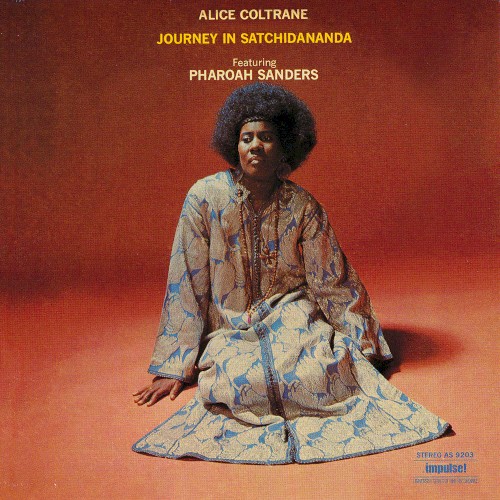
Journey in Satchidananda (1971)
曲目
- A1Journey in Satchidananda6:40
- A2Shiva‐Loka6:38
- A3Stopover Bombay2:54
- B1Something About John Coltrane9:45
- B2Isis and Osiris11:30
5 首 · 约 37 分钟 · 依据 1971 US 发行的版本,在 MusicBrainz 看这个版本。
介绍
这个词条没有中文维基百科条目,下面是英文维基百科的原文。
Journey in Satchidananda is the fourth studio album by the American jazz pianist and harpist Alice Coltrane, released in February 1971 on Impulse! Records. The first four tracks were recorded at Coltrane's home studio in Dix Hills, New York, in November 1970, while "Isis and Osiris" was recorded live at the Village Gate in Greenwich Village in July of that year. Coltrane is joined on the album by saxophonist Pharoah Sanders, bassists Cecil McBee and Charlie Haden, and drummer Rashied Ali. Vishnu Wood also appears on oud on "Isis and Osiris", while the studio recordings also feature Majid Shabazz on percussion and Tulsi on tanpura.
Journey in Satchidananda marks a transition between Coltrane's first three albums and her subsequent releases, which reveal a more personalized outlook. The album's title and title track reflect the influence of Swami Satchidananda Saraswati, whom Coltrane had studied under and become close to.
"Shiva-Loka", or "realm of Shiva", refers to Shiva's role as the third member of the Hindu trinity, the "dissolver of creation". "Stopover Bombay" refers to a five-week stay in India and Sri Lanka on which Coltrane was due to go in December 1970. "Something About John Coltrane" is based on themes by her late husband. "Isis and Osiris" demonstrates Coltrane's interest in Middle Eastern and North African music and culture. The presence of the tanpura reflects Coltrane's interest in Indian classical music and religion.
Reception
The editors of AllMusic awarded the album five of five stars, with Thom Jurek stating: "This is a remarkable album, and necessary for anyone interested in the development of modal and experimental jazz. It's also remarkably accessible."
The album was ranked number 446 in the 2020 edition of Rolling Stone magazine's 500 Greatest Albums of All Time list. The editors of the list deemed it "a meditative bliss-out like jazz had never seen: part earthy blues and part ethereal mantra, and a potent influence on sonic seekers from Radiohead to Coltrane's grandnephew Flying Lotus."
Pitchfork's Josephine Livingstone gave the album a perfect score, noting that it "pays full tribute to the transformation that [Coltrane] underwent in the late 1960s—as a human being and artist...the very texture of Journey is defined by transition, process, and flow. Its music has no beginning or end. Instead...Coltrane is working with the principle of looping and transcendence."
Writing for Treble, and referring to the loss of Coltrane's husband, Emma Bauchner remarked: "Journey in Satchidananda feels like a culmination of sorts: a collision of loss with newfound understanding and self-expression. The music occupies the liminal spaces between East and West, post-bop and raga, grief and healing, consciousness and transcendence... More than anything, Journey in Satchidananda's magnificent soundscapes carry a deep sense of healing, reflecting Coltrane's own journey and subsequent transformation in the face of grief."
In an article for The Guardian, Jennifer Lucy Allan described the album as "a mid-point between the modal and meditative, where all the parts of her musical being and biography are present," and wrote: "It ought strictly to be called fusion music, with elements taken from Indian music and combined with western traditions, but in Coltrane’s music there are no visible joins – all is bound in cosmic opulence."
Colleen Murphy of Classical Album Sundays described the album as "a truly deep, far out, transformative listening experience," and remarked: "you may also temporarily achieve a higher state of consciousness while listening to this album. Take the journey."
NPR's Sydnee Monday stated: "Almost 50 years after Journey In Satchidananda was released, the album remains a vision of universal healing, spiritual self-preservation in times of trouble and the god that appears when you seek her out."
Personnel
tracks A1 to B1
Alice Coltrane – harp (A1, A2), piano (A3, B1)
- Pharoah Sanders – soprano saxophone, percussion
- Cecil McBee – double bass
- Rashied Ali – drums
- Tulsi Sen Gupta – tanpura
- Majid Shabazz – bells, tambourine
- track B2
- Alice Coltrane – harp
- Pharoah Sanders – soprano saxophone, percussion
- Rashied Ali – drums
- Charlie Haden – double bass
- Vishnu Wood – oud
正文摘自英文维基百科「Journey in Satchidananda」,按 CC BY-SA 4.0 使用;删去了参考文献、外部链接、表格和图片。
资料卡
- 作品性质
- 音乐专辑
- 表演者
- 爱丽丝·科尔特恩
- 发行日期
- 1971 年
- 流派
- 先锋爵士
- 唱片公司
- 冲动!唱片
资料来自 Wikidata Q6296378(CC0)。
制作名单
- 厂牌
- ABC Records(目录号 AS 9023)、impulse!(目录号 AS 9023)、ABC Records(目录号 AS-9203)、impulse!(目录号 AS-9203)
- 录音室
- 录音:The Coltrane Home Studio(Dix Hills);录音:The Village Gate(Greenwich Village)
制作
- 制作人
- 爱丽丝·科尔特恩、Ed Michel
- 录音
- Roy Musgnug、Orville O'Brien
演奏与演唱
- 鼓
- Rashied Ali
- 打击乐
- 菲罗·桑德斯、Majid Shabazz(第 A1 首)
- 高音萨克斯
- 菲罗·桑德斯
- 钢琴
- 爱丽丝·科尔特恩(第 A1、A2、A3、B1 首)
- 贝斯
- Cecil McBee(第 A1、A2、A3、B1 首)、查理·海登(第 B2 首)
- 铃
- Majid Shabazz(第 A1、A2、A3、B1 首)
- 铃鼓
- Majid Shabazz(第 A1、A2、A3、B1 首)
- 坦布拉
- Tulsi(第 A1、A2、A3、B1 首)
- 竖琴
- 爱丽丝·科尔特恩(第 A1 首)
- 鲁特琴
- Tulsi(第 A1 首)
- 乌德琴
- Vishnu Wood(第 B2 首)
词曲与编曲
- 作曲
- 爱丽丝·科尔特恩
名单来自 MusicBrainz(CC0)这一发行版本的关系数据,由志愿者录入,不一定齐全。
更多资料与乐评
在哪听
爱丽丝·科尔特恩 的其他专辑
艺人页 ›

相似的专辑



同在 1971 年发行