乐单
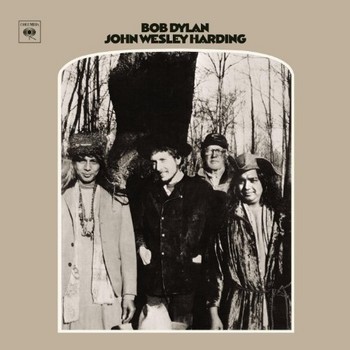
John Wesley Harding (1967)
滚石 500(2020) #337滚石 500(2003) #301
- 艺人
- 鲍勃·迪伦
- 发行
- 1967-12-27
- 类型
- 专辑
- 唱片公司
- 哥伦比亚唱片
- 制作人
- 鲍勃·约翰斯顿
- 版本
- MusicBrainz 上有 25 个发行版本
曲目
- A1John Wesley Harding2:58
- A2As I Went Out One Morning2:49
- A3I Dreamed I Saw St. Augustine3:53
- A4All Along the Watchtower2:32
- A5The Ballad of Frankie Lee and Judas Priest5:36
- A6Drifter’s Escape2:52
- B1Dear Landlord3:16
- B2I Am a Lonesome Hobo3:20
- B3I Pity the Poor Immigrant4:13
- B4The Wicked Messenger2:03
- B5Down Along the Cove2:24
- B6I’ll Be Your Baby Tonight2:36
12 首 · 约 39 分钟 · 依据 1967-12-27 US 发行的版本,在 MusicBrainz 看这个版本。
介绍
这个词条没有中文维基百科条目,下面是英文维基百科的原文。
John Wesley Harding is the eighth studio album by the American singer-songwriter Bob Dylan, released on December 27, 1967, by Columbia Records. Produced by Bob Johnston, the album marked Dylan's return to semi-acoustic instrumentation and folk-influenced songwriting after three albums of lyrically abstract, blues-indebted rock music. John Wesley Harding was recorded around the same time as the home recording sessions with the Band known as The Basement Tapes.
John Wesley Harding was well received by critics and sold well, reaching No. 2 on the U.S. charts and topping the UK charts. Less than three months after its release, John Wesley Harding was certified gold by the RIAA. "All Along the Watchtower" became one of his most popular songs after Jimi Hendrix's rendition was released in the autumn of 1968.
The album was included in Robert Christgau's "Basic Record Library" of 1950s and 1960s recordings, published in Christgau's Record Guide: Rock Albums of the Seventies (1981). In 2003, it was ranked number 301 on Rolling Stone magazine's list of the 500 greatest albums of all time, moving to 303 in the 2012 version of that list, then to 337 in the 2020 version. It was voted number 203 in the third edition of Colin Larkin's book All Time Top 1000 Albums (2000).
The album is named after Texas outlaw John Wesley Hardin, whose name was misspelled.
Recording sessions
Dylan went to work on John Wesley Harding in the fall of 1967. By then, 18 months had passed since the completion of Blonde on Blonde. Dylan spent a substantial amount of time recording the informal basement sessions with the Band in West Saugerties, New York. During that time, he stockpiled a large number of recordings, including many new compositions. He eventually submitted nearly all of them for copyright, but declined to include any of them in his next studio release (Dylan would not release any of those recordings to the commercial market until 1975's The Basement Tapes, by which time some of them had been bootlegged, usually sourced from an easy-to-find set of publisher's demos). Instead, Dylan used a different set of songs for John Wesley Harding.
It is not known when these songs were actually written, but none of them have turned up in the dozens of basement recordings that have since surfaced. Robbie Robertson, the guitarist and principal songwriter of the Band, recalled that "it was just on a kind of whim that Bob went down to Nashville. And there, with just a couple of guys, he put those songs down on tape." Those sessions took place in the autumn of 1967, requiring less than twelve hours over three stints in the studio.
Dylan was once again recording with a band, but the instrumentation was very sparse. During most of the recording, the rhythm section of drummer Kenneth A. Buttrey and bassist Charlie McCoy were the only ones supporting Dylan, who handled all harmonica, guitar, piano, and vocal parts. "I didn't intentionally come out with some kind of mellow sound," Dylan said in 1971. "I would have liked… more steel guitar, more piano. More music… I didn't sit down and plan that sound."
The first session, held on October 17 at Columbia's Studio A, lasted only three hours, with Dylan recording master takes of "I Dreamed I Saw St. Augustine", "Drifter's Escape", and "The Ballad of Frankie Lee and Judas Priest". Dylan returned to the studio on November 6, recording master takes for "All Along the Watchtower", "John Wesley Harding", "As I Went Out One Morning", "I Pity the Poor Immigrant", and "I Am a Lonesome Hobo". Dylan returned for one last session on November 29, completing all of the remaining work.
Sometime between the second and third session, Dylan approached Robertson and keyboardist/saxophonist Garth Hudson to furnish overdubs on the basic tracks, but as Robertson recalled: "We did talk about doing some overdubbing on it, but I really liked it when I heard it and I couldn't really think right about overdubbing on it. So it ended up coming out the way he brought it back."
Dylan had arrived in Nashville with a set of songs similar to the feverish yet pithy compositions that came out of The Basement Tapes. They would be given an austere sound that he and his producer Bob Johnston thought sympathetic to their content. Johnston recalls that "he was staying in the Ramada Inn down there, and he played me his songs and he suggested we just use bass and guitar and drums on the record. I said fine, but also suggested we add a steel guitar, which is how Pete Drake came to be on that record." The final session did break from the status quo by employing Pete Drake on the final two recordings. Cut between 9pm and 12 midnight, "I'll Be Your Baby Tonight" and "Down Along the Cove" would be the only two songs featuring Drake's light pedal steel guitar.
正文摘自英文维基百科「John Wesley Harding」,按 CC BY-SA 4.0 使用;删去了参考文献、外部链接、表格和图片;篇幅所限只节选了前面一部分,全文见原条目。
资料卡
- 作品性质
- 音乐专辑
- 表演者
- 鲍勃·迪伦
- 发行日期
- 1967 年 12 月 27 日
- 时长
- 38 分 24 秒
- 流派
- 民谣摇滚
- 语言
- 英语
- 唱片公司
- 哥伦比亚唱片
- 制作人
- 鲍勃·约翰斯顿
资料来自 Wikidata Q740161(CC0)。
制作名单
- 厂牌
- Columbia(目录号 CS 9604)
- 录音室
- 录音:Columbia Studios(Nashville)
制作
- 工程师
- Charlie Bragg
- 制作人
- Bob Johnston
演奏与演唱
- 主唱
- 鲍勃·迪伦
- 口琴
- 鲍勃·迪伦(第 A1、A4、B5 首)
- 鼓
- Kenny Buttrey(第 A1、A4 首)
- 吉他
- 鲍勃·迪伦(第 A1、A4 首)
- 钢棒吉他
- Pete Drake(第 B5、B6 首)
- 贝斯
- Charlie McCoy(第 A1 首)
- 钢琴
- 鲍勃·迪伦(第 B5 首)
词曲与编曲
- 作曲
- 鲍勃·迪伦
- 作词
- 鲍勃·迪伦
名单来自 MusicBrainz(CC0)这一发行版本的关系数据,由志愿者录入,不一定齐全。
更多资料与乐评
在哪听
鲍勃·迪伦 的其他专辑
艺人页 ›
相似的专辑

同在 1967 年发行