乐单
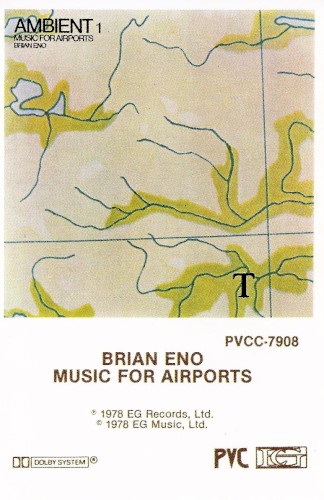
Ambient 1: Music for Airports (1978)
曲目
- A11/117:25
- A22/18:54
- B11/212:06
- B22/210:09
4 首 · 约 49 分钟 · 依据 1978 US 发行的版本,在 MusicBrainz 看这个版本。
介绍
这个词条没有中文维基百科条目,下面是英文维基百科的原文。
Ambient 1: Music for Airports is the sixth studio album by the English musician Brian Eno. It was released in February 1979 through E.G. Records and Polydor Records. It was the first Eno album released under the label of ambient music, a genre intended to "induce calm and a space to think" while remaining "as ignorable as it is interesting". While not Eno's earliest entry in the style, it is credited with popularising the term.
The album consists of four compositions created by layering tape loops of keyboard instruments and voices at differing lengths, and was designed to be continuously looped as a sound installation, with the intent of defusing the anxious atmosphere of an airport terminal as an alternative to "canned" Muzak and easy listening styles.
In 2004, Rolling Stone credited Music for Airports with defining the ambient genre. In 2016, Pitchfork ranked it the greatest ambient album of all time. Eno followed it with Ambient 2: The Plateaux of Mirror (1980), Ambient 3: Day of Radiance (1981) and Ambient 4: On Land (1982).
Background and concept
In 1975, Eno was hospitalised after a car accident. While he recovered at home, his friend Judy Nylon brought him an album of classical harp music and set it playing quietly against the sound of the rain against the window. The sound blended with the rain outside the room and, unable to get up and adjust the volume, Eno allowed it to create an ambience aligned with his fluctuating attention. Alongside this experience, his concept of ambient music would build upon composer Erik Satie's idea of "furniture music" intended to blend into the atmosphere of a room and "mingle with the sound of the knives and forks at dinner" rather than be directly focused upon. Eno considered his album Discreet Music (1975) his first foray into the style.
After spending several hours waiting for a flight at Cologne Bonn Airport and becoming annoyed by its atmosphere, Eno conceived an album of music "designed for airports". He intended for the album to still function within various other situations. He considered ambient music to have been "more a concept than a genre" at the time, mostly created against the context of Muzak. Eno's concept was distinct from elevator music and easy listening's "derivative" background noise approach, and was instead to be used as a means of creating space for thought. In the album's liner notes, Eno explained:
Whereas the extant canned music companies proceed from the basis of regularising environments by blanketing their acoustic and atmospheric idiosyncrasies, Ambient Music is intended to enhance these. And whereas their intention is to `brighten' the environment by adding stimulus to it (thus supposedly alleviating the tedium of routine tasks and levelling out the natural ups and downs of the body rhythms) Ambient Music is intended to induce calm and a space to think. Ambient Music must be able to accommodate many levels of listening attention without enforcing one in particular; it must be as ignorable as it is interesting.
Eno later named the Ray Conniff Singers and the "Borgesian idea" of a self-generated "world in reverse", centred around music, as inspirations.
Recording and composition
Eno began work on Music for Airports while producing the 1977 David Bowie album Low in Berlin. In the studio of the German producer Conny Plank, he recorded individual notes sung by three female German singers. After returning to England, Eno recorded Fred Frith on guitar and Robert Wyatt on piano. Eno turned the recordings into tape loops. Eno said the album was "conceived as deliberately austere and unemotional" and "was essentially made by machines".
With regards to their instrumentation, dynamic range, timbre, harmony, tonality and texture, the tracks are confining and feature a "contained repertory of pitches, gestural shapes, and motivic content that lasts throughout [their] entirety". Variations of timbre are seen when comparing the tracks, such as the warm "1/1" contrasting with the cold and dark "1/2". They are based on irregular repetition rather than a perceptible pulse.
Not wanting the album to be "all bright and cheerful", Eno, a nervous flyer, considered the feelings that arise from being at an airport, including a supposed mortality salience, and hoped the album would bring solace: "Really, it's music to resign you to the possibility of death". John L. Waters described the album as a "logical progression from the work of the experimental and systems-based 'serious' musicians (John White, Gavin Bryars, Christopher Hobbs, Michael Parsons, Michael Nyman) that Eno recorded and championed for his label Obscure". David Stubbs noted similarities to the work of Satie.
正文摘自英文维基百科「Ambient 1: Music for Airports」,按 CC BY-SA 4.0 使用;删去了参考文献、外部链接、表格和图片;篇幅所限只节选了前面一部分,全文见原条目。
资料卡
- 作品性质
- 音乐专辑
- 表演者
- 布莱恩·伊诺
- 发行日期
- 1979 年 2 月
- 时长
- 48 分 32 秒
- 流派
- 氛围音乐、简约音乐
- 语言
- 没有该语言的内容
- 唱片公司
- E.G.唱片、宝丽多唱片公司、维珍
- 制作人
- 布莱恩·伊诺
- 所属系列
- Ambient albums
资料来自 Wikidata Q127100(CC0)。
制作名单
- 厂牌
- PVC Records(目录号 PVCC-7908)
制作
- 工程师
- 布莱恩·伊诺、Dave Hutchins(第 A2、B1 首)、Rhett Davies(第 A1 首)、Conny Plank(第 B2 首)
- 制作人
- 布莱恩·伊诺
演奏与演唱
- 合成器
- 布莱恩·伊诺
- 演唱
- Christa Fast(第 A2、B1 首)、Christine Gomez(第 A2、B1 首)、Inge Zeininger(第 A2、B1 首)
- 钢琴
- 罗伯特·瓦耶特(第 A1 首)
词曲与编曲
- 作曲
- 布莱恩·伊诺、Rhett Davies(第 A1 首)、罗伯特·瓦耶特(第 A1 首)
包装与设计
- 设计 / 插画
- 布莱恩·伊诺
名单来自 MusicBrainz(CC0)这一发行版本的关系数据,由志愿者录入,不一定齐全。
更多资料与乐评
在哪听
布莱恩·伊诺 的其他专辑
艺人页 ›

相似的专辑






同在 1978 年发行