乐单
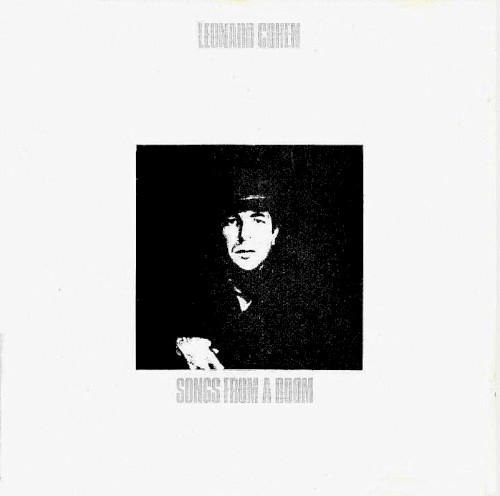
Songs from a Room (1969)
曲目
- A1Bird on the Wire3:26
- A2Story of Isaac3:35
- A3A Bunch of Lonesome Heroes3:13
- A4The Partisan3:26
- A5Seems So Long Ago, Nancy3:40
- B1The Old Revolution4:46
- B2The Butcher3:17
- B3You Know Who I Am3:29
- B4Lady Midnight2:56
- B5Tonight Will Be Fine3:48
10 首 · 约 36 分钟 · 依据 1969-04 US 发行的版本,在 MusicBrainz 看这个版本。
介绍
这个词条没有中文维基百科条目,下面是英文维基百科的原文。
Songs from a Room is the second studio album by Canadian musician Leonard Cohen, released in 1969. It reached No. 63 on the US Billboard Top LPs and No. 2 on the UK charts.
Background
The recording sessions for Songs From a Room began in Hollywood in May 1968 with David Crosby as producer. That didn't work out, and the album was eventually produced at Columbia Studios in Nashville, Tennessee, with producer Bob Johnston (two of the tracks from the Crosby sessions are included as bonus tracks on the 2007 remastered version). Johnston and Cohen had wanted to work together on Cohen's first album, but the studio had assigned Johnston elsewhere. After his experiences with Crosby, Cohen was not keen to continue the project, but after speaking with Johnston, he agreed to carry on as Johnston was prepared to work on achieving the spartan sound Cohen considered appropriate for his songs after the disputes he had with John Simon during the mixing sessions of Songs of Leonard Cohen. At the time, Johnston was best known for producing Bob Dylan, Johnny Cash and Simon and Garfunkel. As Anthony Reynolds observes in his book Leonard Cohen: A Remarkable Life, "Since at this point in time Cohen was something of a hybrid of all of these acts, Cohen moved from the Chelsea in New York City to Franklin, Tennessee, where he lived on a farm 30 miles from Nashville itself. Cohen recorded some demos on the actual farm and otherwise immersed himself in a version of the country life."
Recording
Unlike his augmented debut, Cohen's sophomore effort is austere by comparison, with considerably less drums, and featuring a stripped-down approach that emphasize the words rather than the musical arrangements. In 2001, Cohen admitted to Sylvie Simmons of Mojo, "It's very stark. A lot of my friends who were musical purists had castigated me for the lushness and over-production of my first record and I was determined to do a very simple album." The sessions in Nashville began in the fall of 1968 at Columbia's Studio A on 16th Avenue in Nashville. Johnston enlisted a smaller coterie of musicians than had backed Cohen on his debut album, including Ron Cornelius playing acoustic and electric guitar, Charlie Daniels playing bass, fiddle and acoustic guitar, Elkin "Bubba" Fowler contributing banjo, bass and acoustic guitar, while Johnston himself played keyboards. The album also features some prominent (if strictly ornamental) Jew's harp. As biographer Ira Nadel notes in the 1996 Cohen biography Various Positions, although Cohen still showed signs of insecurity in the recording studio, producer Johnston created a hospitable atmosphere: "In the studio, Daniels and the other musicians were told to listen to Cohen in order to get into the songs. It was like mixing colors; you had to be one of the colors for it to work. Johnston later referred to the album as a painting, not a record, and described his role as 'a musical bodyguard,' protecting Cohen and his music from artificial intrusions and falsification of sound." According to Nadel, Johnston felt that French voices would enhance "The Partisan" so he and Cohen flew to France and overdubbed three female French singers.
Composition
The album contains "Bird on the Wire", one of Cohen's most famous songs. In a 1973 interview with Alastair Pirrie of the New Musical Express, Cohen stated, "The song is so important to me. It's that one verse where I say that I swear by this song, and by all that I have done wrong, I'll make it all up to thee. In that verse it's a vow that I'll try and redeem everything that's gone wrong. I think I've made it too many times now, but l like to keep renewing it." In the liner notes to the 1975 compilation The Best of Leonard Cohen, Cohen wrote about the song: "I always begin my concert with this song. It seems to return me to my duties. It was begun in Greece and finished in a motel in Hollywood around 1969 along with everything else. Some lines were changed in Oregon. I can't seem to get it perfect. Kris Kristofferson informed me that I had stolen part of the melody from another Nashville writer. He also said that he's putting the first couple of lines on his tombstone, and I'll be hurt if he doesn't." In the 1960s, Cohen lived on the Greek island Hydra with his girlfriend Marianne. She has related how she helped him out of a depression by handing him his guitar, whereupon he began composing "Bird on the Wire" – inspired by a bird sitting on one of Hydra's recently installed phone wires, followed by memories of wet island nights. Cohen has described "Bird on the Wire" as a simple country song, and the first recording, by Judy Collins, was indeed done in a country setting. In the book Songwriters on Songwriting, Cohen speaks at length to Paul Zollo about the song:
正文摘自英文维基百科「Songs from a Room」,按 CC BY-SA 4.0 使用;删去了参考文献、外部链接、表格和图片;篇幅所限只节选了前面一部分,全文见原条目。
资料卡
- 作品性质
- 音乐专辑
- 表演者
- 里奥纳德·科恩
- 发行日期
- 1969 年 4 月 7 日
- 时长
- 35 分 38 秒
- 流派
- 民俗音乐
- 语言
- 英语
- 唱片公司
- 哥伦比亚唱片
- 制作人
- 鲍勃·约翰斯顿
- 作曲
- 里奥纳德·科恩
资料来自 Wikidata Q260860(CC0)。
制作名单
- 厂牌
- Columbia(目录号 CS 9767)
制作
- 工程师
- Neil Wilburn、Ed Hudson
- 制作人
- Bob Johnston
演奏与演唱
- 原声吉他
- Ron Cornelius、Charlie Daniels、Bubba Fowler
- 电吉他
- Ron Cornelius
- 贝斯
- Charlie Daniels、Bubba Fowler
- 小提琴
- Charlie Daniels、Bubba Fowler
- 班卓琴
- Bubba Fowler
- 键盘
- Bob Johnston
- 主唱
- 里奥纳德·科恩
词曲与编曲
- 作曲
- 里奥纳德·科恩(其中 9 首)、Anna Marly(第 A4 首)
- 作词
- 里奥纳德·科恩(其中 9 首)、Emmanuel d’Astier de La Vigerie(第 A4 首)
- 译词
- Hy Zaret(第 A4 首)
名单来自 MusicBrainz(CC0)这一发行版本的关系数据,由志愿者录入,不一定齐全。
更多资料与乐评
在哪听
里奥纳德·科恩 的其他专辑
艺人页 ›
相似的专辑
同在 1969 年发行