乐单
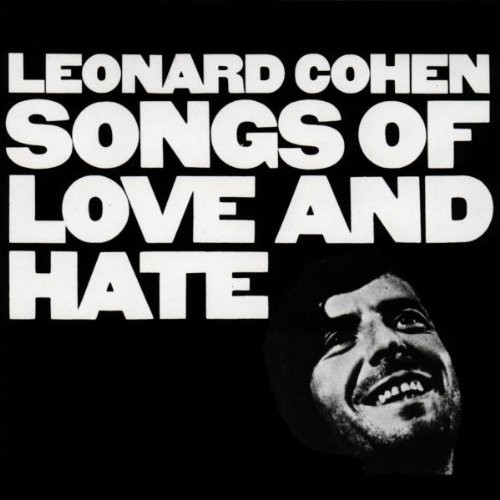
Songs of Love and Hate (1971)
曲目
- A1Avalanche5:02
- A2Last Year’s Man5:59
- A3Dress Rehearsal Rag6:06
- A4Diamonds in the Mine3:51
- B1Love Calls You by Your Name5:40
- B2Famous Blue Raincoat5:10
- B3Sing Another Song, Boys6:12
- B4Joan of Arc6:21
8 首 · 约 44 分钟 · 依据 1971 US 发行的版本,在 MusicBrainz 看这个版本。
介绍
这个词条没有中文维基百科条目,下面是英文维基百科的原文。
Songs of Love and Hate is the third studio album by Canadian singer-songwriter Leonard Cohen. Produced by Bob Johnston, the album was released on March 19, 1971, through Columbia Records.
Recording and composition
Cohen reunited with producer Bob Johnston, who was at the helm for the singer's previous album Songs From a Room, and also brought back guitarist Ron Cornelius, who acted as leader of Cohen's new crew of backing musicians, christened The Army. The album was mainly recorded in Columbia Studio A in Nashville, between September 22 and 26, 1970. "Sing Another Song, Boys" was recorded at the Isle of Wight Festival on August 30, 1970. Further recording took place at Trident Studios in London. The album title is descriptive, outlining its main themes; it features several of Cohen's most famous compositions, including "Joan of Arc", "Avalanche", and "Famous Blue Raincoat". In the 1996 book Various Positions, Cohen biographer Ira Nadel confirms that many of the songs were from an earlier period, with "Joan of Arc" having been written at the Chelsea Hotel in New York; "Avalanche" and "Dress Rehearsal Rag" dated from earlier years; and "Love Calls You by Your Name" was a minor rewrite of an unpublished 1967 song called "Love Tries to Call You by Your Name". In 1991, Cohen revealed to Throat Culture magazine that the recording of his third album had been a difficult time for him because "absolutely everything was beginning to fall apart around me: my spirit, my intentions, my will. So I went into a deep and long depression."
"Joan of Arc" is constructed mainly as a dialogue between Joan of Arc and the fire which is consuming her as she burns at the stake, after having been found guilty of heresy (in 1431). In the song, Joan says that she is "tired of the war" and tells how she would rather be wearing a white wedding dress (one of the charges against her was that she dressed as a man). Joan's surrender to the fire, as its bride, may also be seen as a symbol of her religious fervour and commitment. In a 1988 interview with John McKenna of RTÉ, Cohen said of "Joan of Arc", "I was thinking more of this sense of a destiny that human beings have and how they meet and marry their destiny...I don't want to suggest in that song that what she really wanted to be was a housewife. What I mean to say is that as lonely and as solitudinous as she was she had to meet and be embraced by her destiny...seen from the point of view of the woman's movement she really does stand for something stunningly original and courageous."
In his 2010 book Leonard Cohen: A Remarkable Life, biographer Anthony Reynolds quotes Cohen explaining that "Famous Blue Raincoat" is about "A man writing a letter to a man who has had an affair with his wife", but, on a more prosaic level, Cohen is also quoted saying that the tune is related to his own attire: "I had a blue raincoat. It was Burberry. It had lots of various fixtures on it...It always resided in my memory as some glamorous possibility that I never realized..." In the book Songwriters on Songwriting, Cohen confessed to being unsatisfied with the composition: "That was one I thought was never finished. And I thought that Jennifer Warnes' version in a sense was better because I worked on a different version for her, and I thought it was somewhat more coherent. But I always thought that that was a song you could see the carpentry in a bit. Although there are some images in it that I am very pleased with. And the tune is real good. But I'm willing to defend it, saying it was impressionistic. It’s stylistically coherent. And I can defend it if I have to. But secretly I always felt that there was a certain incoherence that prevented it from being a great song."
In the same interview, Cohen revealed that his "chop", his unique pattern of playing syncopated classical guitar, is especially evident on "Avalanche", and also asserted, "There are songs like "Dress Rehearsal Rag" that I recorded once and I will never sing. Judy Collins did a very beautiful version of it, better than mine. I would never do that song in concert; I can't get behind it." In the liner notes to the 1975 album The Best of Leonard Cohen, Cohen wrote of "Last Year's Man", "I don't know why but I like this song. I used to play it on a Mexican twelve-string until I destroyed the instrument by jumping on it in a fit of impotent fury in 1967. The song had too many verses and it took about five years to sort out the right ones."
In an interview with Alastair Pirrie of the New Musical Express in March 1973 - just two years after the album was released - Cohen disparaged the LP: "I suppose you could call it gimmicky if you were feeling uncharitable towards me. I have certainly felt uncharitable towards me from time to time over that record, and regretted many things. It was over-produced and over elaborated...an experiment that failed."
正文摘自英文维基百科「Songs of Love and Hate」,按 CC BY-SA 4.0 使用;删去了参考文献、外部链接、表格和图片;篇幅所限只节选了前面一部分,全文见原条目。
资料卡
- 作品性质
- 音乐专辑
- 表演者
- 里奥纳德·科恩
- 发行日期
- 1971 年 3 月 19 日
- 时长
- 44 分 21 秒
- 流派
- 民俗音乐
- 语言
- 英语
- 唱片公司
- 哥伦比亚唱片
- 制作人
- 鲍勃·约翰斯顿
- 作曲
- 里奥纳德·科恩
资料来自 Wikidata Q923467(CC0)。
制作名单
- 厂牌
- Columbia(目录号 C 30103)
- 录音室
- 录音:East Afton Farm, Isle of Wight, England(Isle of Wight)
制作
- 工程师
- Robin Geoffrey Cable、Ed Hudson、Neil Wilburn、Bill Donovan、Ed Kollis
- 制作人
- Bob Johnston
演奏与演唱
- 指挥
- 保罗·巴克马斯特
- 原声吉他
- 里奥纳德·科恩、Ron Cornelius、Charlie Daniels、Bubba Fowler
- 电吉他
- Ron Cornelius
- 贝斯
- Charlie Daniels、Bubba Fowler
- 小提琴(民间)
- Charlie Daniels
- 班卓琴
- Bubba Fowler
- 钢琴
- Bob Johnston
- 合唱
- Children of the Corona Stage School
- 和声
- Corlynn Hanney、Susan Mussmano
- 主唱
- 里奥纳德·科恩
- 弦乐
- Michael Sahl(第 A2 首)
词曲与编曲
- 编曲
- 保罗·巴克马斯特
- 作曲
- 里奥纳德·科恩
- 作词
- 里奥纳德·科恩
包装与设计
- 平面设计
- John Berg
- 摄影
- Jacotte Cholett
名单来自 MusicBrainz(CC0)这一发行版本的关系数据,由志愿者录入,不一定齐全。
更多资料与乐评
在哪听
里奥纳德·科恩 的其他专辑
艺人页 ›


相似的专辑


同在 1971 年发行