乐单
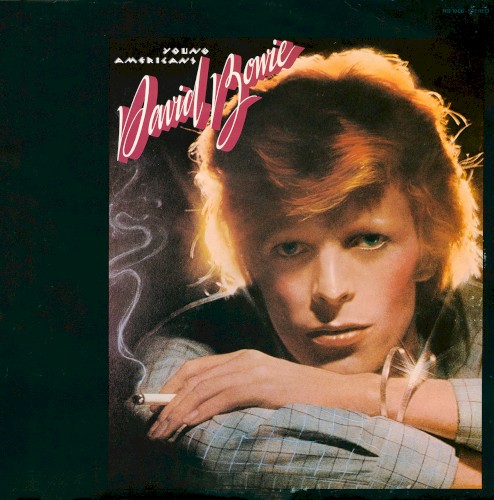
Young Americans (1975)
曲目
- A1Young Americans5:11
- A2Win4:45
- A3Fascination5:46
- A4Right4:15
- B1Somebody Up There Likes Me6:34
- B2Across the Universe4:32
- B3Can You Hear Me5:07
- B4Fame4:16
8 首 · 约 40 分钟 · 依据 1975-03-08 US 发行的版本,在 MusicBrainz 看这个版本。
介绍
这个词条没有中文维基百科条目,下面是英文维基百科的原文。
Young Americans is the ninth studio album by the English musician David Bowie, released on 7 March 1975 through RCA Records. A departure from the glam rock style of previous albums, the record showcased Bowie's interest in soul and R&B. Music critics have described the sound as blue-eyed soul; Bowie himself labelled the album's sound "plastic soul".
Recording sessions began at Sigma Sound Studios in Philadelphia in August 1974, after the first leg of Bowie's Diamond Dogs Tour. The record was produced by Tony Visconti, and includes a variety of musicians, such as the guitarist Carlos Alomar, who became one of Bowie's most frequent collaborators, and the backing vocalists Ava Cherry, Robin Clark and then-unknown singer Luther Vandross. As the tour continued the setlist and design began to incorporate the influence of the new material. The recording sessions continued at the Record Plant in New York City at the tour's end. A collaboration between Bowie and John Lennon yielded a cover of Lennon's Beatles song "Across the Universe" and an original, "Fame", during a January 1975 session at Electric Lady Studios, produced by Harry Maslin. The album's cover artwork is a back-lit photograph of Bowie taken by Eric Stephen Jacobs.
Young Americans was Bowie's breakthrough in the US, reaching the top 10 on the Billboard chart; "Fame" became Bowie's first single to hit number one. Bowie continued developing a similar sound on Station to Station (1976). Young Americans received mixed critical reviews on its release and in later decades; Bowie himself had mixed feelings about the album. However, the album has proved influential, as Bowie was one of the first white artists of the era to overtly engage with newly emerging black musical styles; other British artists followed suit. Young Americans has been reissued multiple times with outtakes, and was remastered in 2016 as part of the Who Can I Be Now? (1974–1976) box set.
Background and development
David Bowie released his eighth studio album Diamond Dogs in May 1974. His final album in the glam rock genre, it contained two songs, "Rock 'n' Roll with Me" and "1984", that exhibit elements of funk and soul, which predicted the musical direction for Bowie's next project. While his interest in soul music dated back to his mod days in the mid-1960s, he began listening to soul records extensively and incorporating soul material into his live sets. In July, towards the end of the first leg of his Diamond Dogs Tour, he performed covers of the soul songs "Knock on Wood" by Eddie Floyd and "Here Today and Gone Tomorrow" by the Ohio Players for shows in Upper Darby Township, Pennsylvania; these shows were recorded and released on the live album David Live in October 1974. Bowie had grown tired of the tour's lavish set-pieces and theatricality and was ready to fully embrace black soul music.
In early 1974, Bowie met the funk guitarist Carlos Alomar, an Apollo Theater session musician who had played with James Brown, Chuck Berry and Wilson Pickett. One of Bowie's favourite records was Brown's Live at the Apollo (1963), so meeting a musician who played at the Apollo meant a lot to him. Alomar had never heard of Bowie when they met, but they immediately connected and formed a working relationship that lasted almost 15 years; Alomar became Bowie's guide into American black music.
While in Pennsylvania, Bowie visited Sigma Sound Studios in Philadelphia to work on recordings with the American musician Ava Cherry. Sigma Sound was the home of Philadelphia soul and the favourite studio of the writer-producer duo Kenneth Gamble and Leon Huff; the two had co-founded Philadelphia International Records, the home of many well-known black American musicians. At the end of the first leg of the tour, Bowie returned to New York City to mix David Live, listening to various black albums in preparation for his return to Sigma Sound.
Recording history
For the backing band, Bowie wanted to hire MFSB ("Mother Father Sister Brother"), Sigma Sound's house band of over 30 session musicians. Due to conflicting schedules, all members were unavailable except the percussionist Larry Washington, so Bowie went to New York City for further recruitment. Mike Garson (piano), David Sanborn (saxophone) and Pablo Rosario (percussion) were retained from the Diamond Dogs Tour, while Earl Slick was replaced by Alomar on guitar. At Alomar's suggestion, Bowie hired Andy Newmark, a former member of Sly and the Family Stone, and Willie Weeks of the Isley Brothers to replace Tony Newman and Herbie Flowers on drums and bass, respectively. The producer Tony Visconti joined the project immediately after Bowie informed him of Weeks' involvement; Visconti co-produced much of Bowie's work for the rest of the decade. Cherry, Alomar's wife Robin Clark, then-unknown singer Luther Vandross, Anthony Hinton and Diane Sumler performed backing vocals for the sessions.
正文摘自英文维基百科「Young Americans」,按 CC BY-SA 4.0 使用;删去了参考文献、外部链接、表格和图片;篇幅所限只节选了前面一部分,全文见原条目。
资料卡
- 作品性质
- 音乐专辑
- 表演者
- 大卫·鲍伊
- 发行日期
- 1975 年 3 月 7 日
- 时长
- 40 分 32 秒
- 流派
- 蓝眼灵魂乐、节奏布鲁斯
- 语言
- 英语
- 唱片公司
- RCA唱片
- 制作人
- 托尼·维斯康蒂
资料来自 Wikidata Q765031(CC0)。
制作名单
- 厂牌
- RCA(目录号 APL1-0998)、MainMan
制作
- 混音
- Harry Maslin(其中 7 首)、Tony Visconti(第 A1、A2、A3、A4、B1 首)、大卫·鲍伊(第 B2、B3、B4 首)
- 制作人
- Harry Maslin(其中 7 首)、Tony Visconti(第 A1、A2、A3、A4、B1 首)、大卫·鲍伊(第 B2、B3、B4 首)
演奏与演唱
- 主唱
- 大卫·鲍伊(第 A1、B4 首)
- 钢琴
- Mike Garson(第 A1 首)
- 鼓
- Andy Newmark(第 A1 首)
- 打击乐
- Pablo Rosario(第 A1 首)
- 萨克斯
- 大卫·山朋(第 A1 首)
- 康加鼓
- Larry Washington(第 A1 首)
- 贝斯
- Willie Weeks(第 A1 首)
- 和声
- Ava Cherry(第 A1 首)、Robin Clark(第 A1 首)、路德·范德鲁斯(第 A1 首)、约翰·列侬(第 B4 首)
词曲与编曲
- 作曲
- 大卫·鲍伊(第 A1、A2、A3、A4、B1、B3 首)、路德·范德鲁斯(第 A3 首)
- 作词
- 大卫·鲍伊(第 A1、A2、A4、B1、B3 首)、路德·范德鲁斯(第 A3 首)
- 词曲
- 约翰·列侬(第 B2、B4 首)、保罗·麦卡特尼(第 B2 首)、Carlos Alomar(第 B4 首)、大卫·鲍伊(第 B4 首)
名单来自 MusicBrainz(CC0)这一发行版本的关系数据,由志愿者录入,不一定齐全。
更多资料与乐评
在哪听
大卫·鲍伊 的其他专辑
艺人页 ›

相似的专辑
同在 1975 年发行